
How Western militaries are trying to restore a sustainable cost-exchange ratio against cheap drones
The announcement out of BAE Systems’ Warton flight test center on April 8 was significant not for the shot itself, but for the number attached to it. A Royal Air Force Typhoon test and evaluation aircraft fired an AGR-20A Advanced Precision Kill Weapon System rocket against a ground-based target at a UK military range and hit it. The APKWS laser-guidance kit costs between $15,000 and $20,000. The Shahed-136 one-way attack drone it is designed to intercept is widely estimated at $20,000 to $50,000 to produce, though some recent analyses argue the true cost — particularly for Russian-produced Geran variants — may be higher. Against that threat class, that is still a ratio the defender can live with.
It is almost the only ratio in the current C-UAS toolkit that is. An AIM-120 AMRAAM costs approximately $1 million. RAF aircraft operating in the region have had to use expensive air-to-air missiles, especially ASRAAM, against much cheaper drones. A Typhoon’s intercept load still amounts to only a limited number of costly missile shots against a swarm that may have more members than that.
The Iran conflict has made the cumulative weight of that problem visible. Jane’s reported in March that an RAF Typhoon’s March 1 intercept over Qatar was the sixth such RAF UAV air-to-air kill in the region since late 2021 — each engagement expending a missile costing hundreds of thousands of dollars against a threat that cost a fraction of that to produce. When an RAF F-35B pilot fired two ASRAAMs to destroy a pair of Iranian Shahed-type drones over Jordan, the cost of those two shots likely exceeded the production cost of both targets by a factor of ten or more. The UAE, absorbing the highest volume of Iranian strikes in the region, tracked 689 drones in the opening days of the conflict and intercepted 645 of them — a significant defensive achievement, but one that consumed interceptor inventory at a pace the current procurement model was never designed to sustain.
Richard Hamilton, Managing Director of Air Operations at BAE Systems’ Air sector, called the Warton trial a demonstration of “a game-changing capability and a cost-effective solution that would enhance Typhoon’s already impressive range of weapons capabilities.” The trial was internally funded — BAE spending its own money on a capability it believes its customers will need, on a timeline faster than formal requirements would produce. The cost-exchange problem it addresses is not new. It is simply worse than it has ever been, and the Iran conflict has made that legible at a scale no previous campaign managed.
Why the Current Model Is Breaking
The C-UAS problem is not one problem. It is a stack organized by altitude, range, and threat platform type — each layer demanding different solutions at different price points, with different cost-exchange ratios against what it faces.
At the tactical edge, FPV and short-range drones have become a leading source of battlefield attrition in Ukraine. Their effective range has extended steadily through radio relay, fiber-optic guidance, and marsupial carrier systems — reaching up to roughly 20 kilometers in many frontline sectors, and farther in some carrier-assisted cases. The consequence for infantry is severe: troops must increasingly disperse and advance cautiously toward forward positions to reduce drone detection exposure, with the drone threat zone extending well into what was previously considered safe operating depth.
At the operational layer, the threat profile shifts to medium-altitude ISR drones and loitering munitions targeting the infrastructure behind the forward line — ammunition depots, fuel supplies, forward airbases. At the strategic layer, demonstrated in Iran’s raids against Israel and Russia’s sustained Shahed campaign against Ukrainian infrastructure, the central dilemma becomes visible: even when the defender wins tactically, the attacker wins strategically if the exchange ratio is unfavorable enough and attack volume is sustained. Israel’s layered defense in April 2024 performed well, but the coalition of systems that achieved those results was not cheap to assemble or to operate. See “The Current U.S. C-UAS Stack” for a summary of where Army and Marine Corps capabilities stand today.
What Is Actually Improving the Ratio
The APKWS argument is now battlefield-proven at scale. By early 2025, U.S. and coalition forces had destroyed over 325 Houthi drones since January 2024, including more than 200 in-flight — a sustained interception campaign that gave APKWS its first operational air-to-air combat record. Air Force Chief of Staff Gen. David Allvin put the economics directly: “The APKWS (~$35K each) is a fraction of the cost of missiles like the AMRAAM (~$1M each) or AIM-9 (~$500K each). More savings. More lethality.” That $35,000 figure reflects the fully loaded munition cost; the guidance kit alone runs between $15,000 and $20,000, with the balance in the rocket motor and warhead. Either way, against a Shahed-class threat in the $20,000 to $50,000 range, it is the first kinetic air-to-air option in a fighter’s magazine that is not operating at a structural loss.
By late 2025, Ukrainian F-16s carried the same capability. The Typhoon integration extends it to a platform that has been flying drone intercept missions in the region without it. With two seven-round APKWS pods, a Typhoon carries 14 guided rockets into a sortie alongside its standard missile complement — a materially different engagement capacity against massed threats. One caveat worth noting: demand in the Middle East and Europe has already surfaced supply constraints. Thales’ FZ123 points toward a European-produced low-cost anti-drone rocket option should that supply pressure continue.
Ukraine is pushing low-thousands-dollar interceptor drones as the next cost layer against Shahed-class threats — fixed-wing platforms cheap enough to absorb attrition while contributing meaningfully to the overall intercept count. Where jet fighters once had to prosecute every intercept with ASRAAM or worse, a tiered architecture — matching the cost and capability of the interceptor to the threat tier — produces better economics across the engagement spectrum. See “Not Just Fighters” for the data on how much of Ukraine’s Shahed kill count comes from light aircraft alone.
On February 11, 2026, Raytheon demonstrated what may be the most structurally important development in the intercept economics argument: the Coyote Block 3 Non-Kinetic, defeating multiple drone swarms during a U.S. Army exercise and then being recovered for reuse. The system uses what Raytheon describes as a non-kinetic payload — widely reported to be a high-power microwave effector, though this has not been officially confirmed. The significance is not the performance — it is the reusability. Every kinetic interceptor in the current stack consumes itself in the engagement. The Coyote Block 3NK does not. A recoverable non-kinetic effector that can be positioned on likely ingress routes, cued by radar, tasked to disable multiple threats, and then returned for rapid turnaround changes the mathematics of a sustained swarm engagement. The procurement signal behind it is concrete: a $5.04 billion contract awarded to Raytheon in September 2025 for Coyote effectors, launchers, and KuRFS radars, with ordering running through 2033. The forcing function is not abstract — RAF aircraft were operating at a very high tempo from Akrotiri and elsewhere under sustained Iranian drone pressure. That is exactly the base defense scenario a reusable non-kinetic effector is designed for.

What Still Breaks the Model
Two problems resist the solutions above. The first is manpower. Ukrainian defense analyst Olena Kryzhanivska, writing in her Ukraine Arms Monitor Substack, identified it directly: “Drone interceptors flying at around 300 kph are considered the priority — but Ukraine unfortunately doesn’t have enough trained pilots specifically for interceptor drones to operate the system at very high speeds.” Each intercept by the cheapest interceptor types requires operator skill approaching fighter-pilot level for terminal guidance. Training those operators means drawing skilled personnel from other units already under pressure. A Brave1/Palantir initiative to develop terminal autonomy — AI-enhanced engagement that removes the operator from the terminal phase — is in progress. Neither that nor other proposed alternatives are operational at scale.
The second problem is fiber-optic guidance. Ukrainian and Western reporting indicates that roughly 10 percent of Ukraine’s own drone production now uses fiber optics, while Russian usage may have reached 15 to 30 percent in some sectors. Russia’s Molniya fiber-optic loitering munition has been reported at 19-mile range. The tactical significance is direct: a fiber-optic drone ignores RF jamming entirely. It has no radio link to sever, no frequency to disrupt, no signal to spoof. The entire electronic warfare layer of the current C-UAS stack offers no protection against it.
What a Sustainable Stack Looks Like
In December 2025, Epirus demonstrated its Leonidas VehicleKit high-power microwave platform disabling a fiber-optic guided drone at a U.S. government testing site — described as the first known instance of electromagnetic interference being weaponized against a fiber-optic guided system. HPM works differently than RF jamming: it delivers weaponized electromagnetic interference directly to the drone’s onboard electronics, inducing system failure regardless of guidance method. Leonidas has been selected for the Army’s IFPC-HPM effort, with prototypes moving into operational evaluation. In August 2025 the system defeated 49 drones in a single engagement. On March 24, AeroVironment unveiled LOCUST X3, the third generation of its laser C-UAS system — explicitly designed around field producibility and modular maintenance rather than prototype performance, with engagements claimed at under $5 per shot. The same day, Epirus and General Dynamics Land Systems unveiled the Leonidas Autonomous Ground Vehicle, a fully autonomous mobile HPM platform that can reposition and engage without human intervention.
What these developments collectively suggest is that a sustainable defensive stack is not a single system. It is a layered architecture in which each tier is matched to both the threat it faces and the cost it can justify: APKWS and cheap interceptors for the kinetic layer, reusable HPM effectors for swarms, and directed energy for the fiber-optic threats that RF cannot address. The manpower constraint — the last problem without a fielded solution — points toward terminal autonomy as the necessary closing argument.
The cost-per-shot problem is being worked. Whether the solutions mature faster than the threat does is the question the next several years will answer.
The Current U.S. C-UAS Stack
Army and Marine Corps fielded systems, 2025–2026
The U.S. Army’s short-range air defense architecture has undergone significant recapitalization over the past decade. The M-SHORAD program reconstituted an armored self-propelled air defense capability on 8×8 Stryker APCs — initially armed with laser-guided Hellfire and Stinger missiles and a 30-millimeter autocannon. A follow-on Increment 2 Stryker equipped with a 50-kilowatt laser was combat-tested in the Middle East with results that media reports characterized as unsatisfactory. Increment 3 incorporates the Next-Generation Short-Range Interceptor Stinger successor and programmable air-bursting XM1223 30-millimeter shells; a distinct Increment 4 capability installable on JLTV trucks is planned.
The Army’s M-LIDS and FS-LIDS systems integrate Coyote interceptors and radar and electronic attack capabilities for mobile and fixed-site counter-drone protection respectively. New M-LIDS Increment 2.1 systems consolidate additional sensors, effectors, and fire control onto a single Stryker APC. The September 2025 Coyote contract — a $5.04 billion ordering vehicle running through 2033 — cements the Coyote family as the Army’s durable backbone for counter-drone protection at scale.
On the directed energy side, the Army’s Enduring High Energy Laser program issued an industry RFI in October 2025, targeting a competitive source selection in the second quarter of fiscal year 2026. If successful, E-HEL would be the Army’s first laser system of record. RCCTO leadership has emphasized that sustainment, manufacturability, and battlefield reliability — not raw performance — are the remaining barriers industry must solve before production at scale is viable.
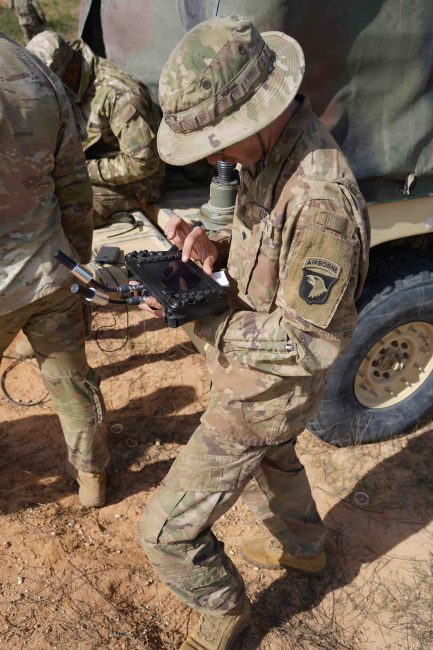
Dismounted Army C-UAS introduced since 2020 includes Dronebuster RF jammers, Bal-Chatri-2 RF detectors, SmartShooter fire control attachments, and Modi jammers for short-range protection.
The Marine Corps fields complementary systems at multiple layers. MRIC combines an AESA radar with trailer-based launchers capable of firing the Tamir interceptor — designated SkyHunter in USMC service — providing a cost-effective medium-range intercept option. Three MRIC batteries are scheduled to integrate into Low-Altitude Air Defense battalions by 2028. MADIS is a paired-vehicle system providing radar, electronic warfare, and automatic weapons capabilities for short-range air defense. Anduril was awarded a $642 million IDIQ contract in March 2025 to deliver and install I-CSUAS installation defense systems capable of autonomous operation against Group 1 and 2 threats.
The Individual Soldier’s Problem
The tactical C-UAS burden ultimately falls on the dismounted soldier, and the solutions available at that level reflect the difficulty of the problem. Individual fire control systems like the SmartShooter SMASH 3000 — a 1.6-pound unit that holds the weapon’s trigger until sensors calculate a probable hit — have shown promise, but require the soldier to be in position, armed, and already tracking the threat. The drone has no equivalent requirement. The Army’s fielding of Dronebuster jammers, Bal-Chatri-2 detectors, and SmartShooter attachments represents meaningful progress at the individual level, but training, distribution, and the cognitive load of adding C-UAS awareness to an already demanding combat task remain unsolved problems regardless of what the system can do.
Not Just Fighters — Light Aircraft in the Anti-Drone Role
Jet fighters are not always available. Ukraine has demonstrated that slower, cheaper aircraft can contribute meaningfully to anti-Shahed operations. A Ukrainian An-28 utility aircraft equipped with a minigun and infrared sensor has reportedly claimed a significant number of Shahed kills and was filmed downing multiple targets in a single sortie. Yak-52 trainers and A-22 ultralight aircraft have also recorded confirmed kills. Ukrainian and open-source reporting attributes a notable share of Shahed intercepts to light planes and helicopters — a contribution achieved at a fraction of the cost of fighter sorties. The implication for force planners is that a tiered response architecture, matching the cost and capability of the interceptor to the threat tier, produces better overall economics than routing all intercepts through high-value platforms.
What’s Still Unsolved — Directed Energy at Scale
The directed energy moment is real, but the transition from prototype to program of record has been slower for laser systems than for HPM. The Army has deployed DE M-SHORAD laser prototypes to CENTCOM for operational evaluation, and RCCTO’s Enduring High Energy Laser program is targeting a production competition in fiscal year 2026 — which would make it the Army’s first laser system of record. RCCTO leadership has been consistent that sustainment and manufacturability, not raw lethality, are the barriers that remain.
On March 24, AeroVironment directly addressed that critique with the unveiling of LOCUST X3, the third generation of its high-energy laser C-UAS system. The system features a scalable 20 to 35-plus kilowatt laser, a modular beam director, and AI-enabled targeting via AV’s AV_Halo PINPOINT software, with engagements claimed at under $5 per shot. LOCUST X3 builds on the LOCUST platform already fielded through the Army’s AMP-HEL and Palletized High Energy Laser programs and validated on the JLTV and Infantry Squad Vehicle. The third-generation framing is explicitly about producibility: modular subsystems, commercially mature components, and a design optimized for repeatable manufacturing rather than laboratory performance. The Army’s E-HEL competition provides the procurement vehicle to test whether that promise holds under contract conditions.
Epirus’s Leonidas has been selected for the Army’s IFPC-HPM effort, with prototypes moving into operational evaluation. The system defeated 49 drones in a single engagement in August 2025, and in December 2025 became the first to demonstrate HPM defeat of a fiber-optic guided drone — the threat class RF jamming cannot address. The Leonidas Autonomous Ground Vehicle, unveiled the same day as LOCUST X3, extends that capability to a fully autonomous mobile platform.
Left-of-launch targeting — striking drone operators, launch sites, and storage depots before weapons are airborne — remains conceptually attractive but operationally constrained. Locating and striking mobile drone launchers is a sustained intelligence and fires effort that competes for priority against faster-moving threats, and the Pentagon’s inability to silence Houthi drone operations from a nearby carrier illustrates the limits of the approach at scale.