
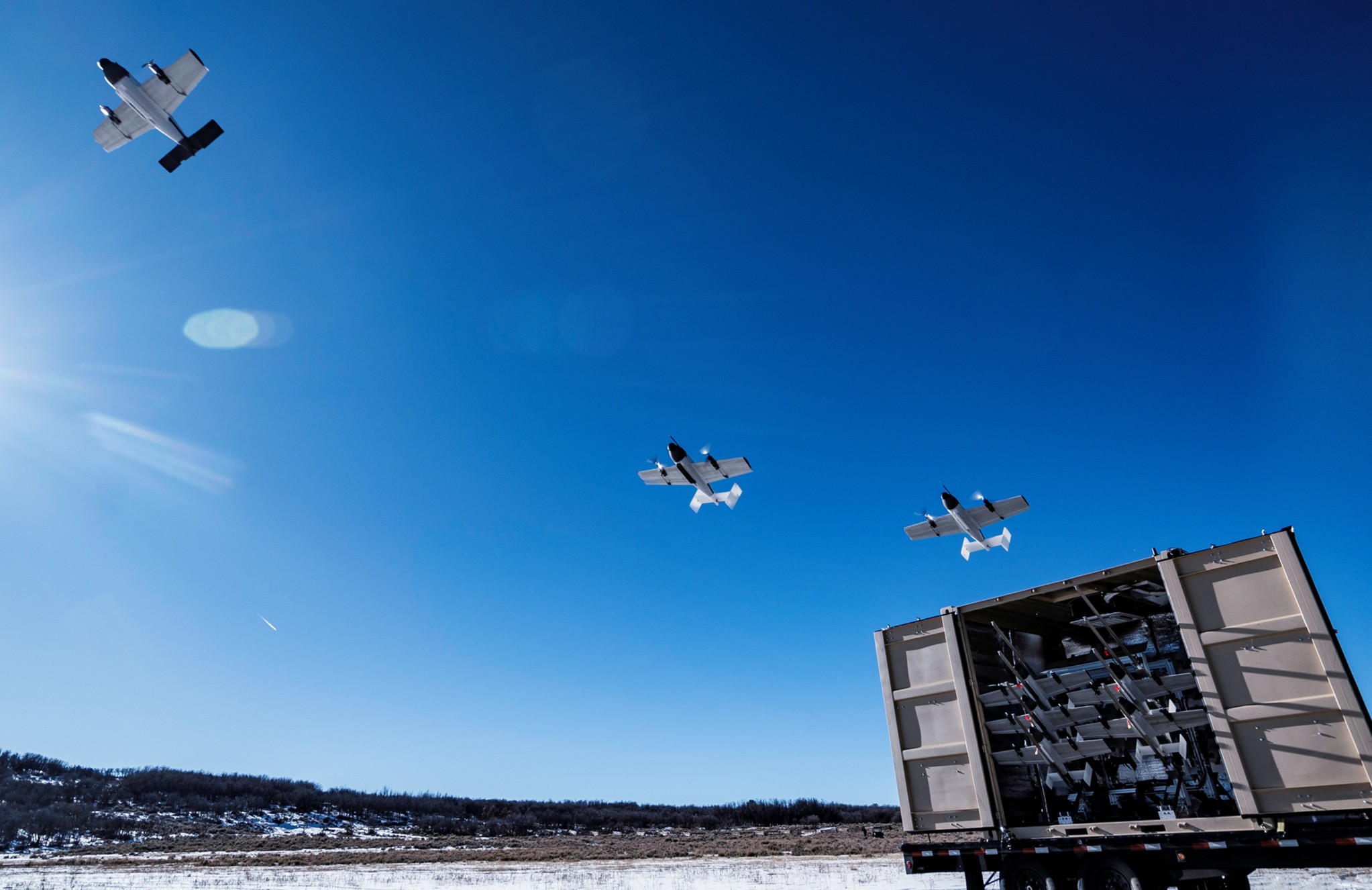
While America’s drone industry has fixated on first-person view quadcopters like those swarming Ukrainian battlefields, DZYNE Technologies is bucking the trend announcing on Thursday the public unveiling of a fixed-wing “affordable mass” Group 1 UAS called Blitz that can be hand-launched or alternately ejected for swarming operations from rail or container launchers.
Blitz can execute one-way missions at ranges of 50 miles, extendible to 93 miles—while carrying its full 5-pound payload. That’s a remarkable range for a missionized Group 1 drone, with 12-18 miles being common maximum ranges for 10″ one-way FPV quadcopters.
DZYNE is known for its LEAP and ULTRA long-endurance ISR drones and portable Drone Buster C-UAS systems. But the Irvine, California-based company is entering the strike market with Blitz, which the company competed in the Pentagon’s Drone Dominance Gauntlet Phase 1 competition earlier in 2026 which sought affordable mass-producible kamikaze drones.
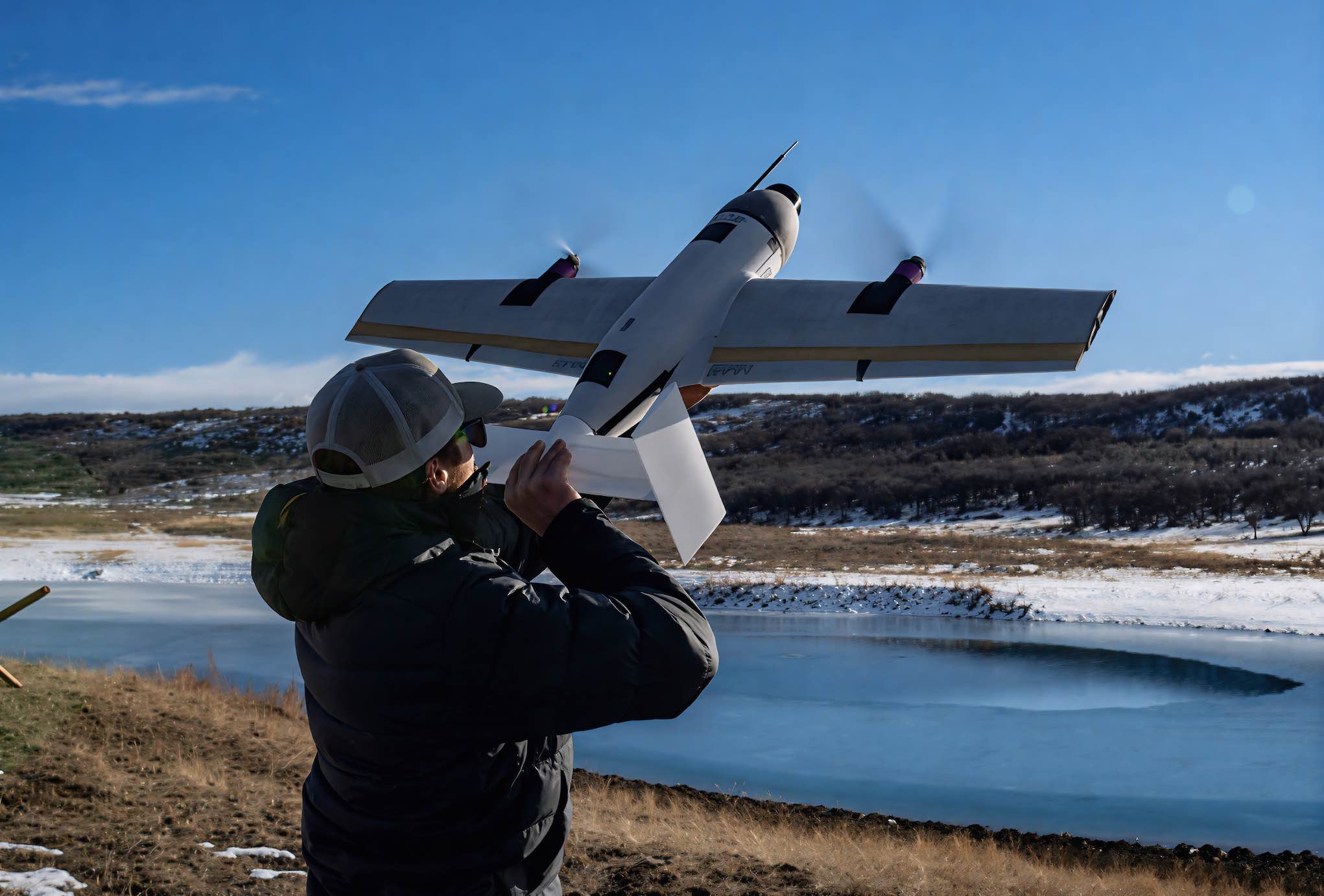
Blitz somewhat resembles a miniaturized B-25 bomber from World War II with its dual tailfins and mid-fuselage wings each with a quiet, electrically turned propeller. The 15-pound UAV has an endurance of one hour (or two, with extended battery), and a cruising speed of 40-75 knots-equivalent air speed (46-86 mph), the higher end achieved using a ‘High Performance Propulsion Kit.’
Blitz’s modular architecture supports payloads in both the nose and on its dorsal ‘backpack’, and even allows swapping out wingtips and tail fins.
- The nose bay fits diverse mission payloads (warheads, seekers, FPV camera, EW modules, and ‘deception’ systems) which DZYNE says can be 3D printed to fit
- The ‘backpack’ bay supports SOCOM MOD Payload Standard 1U systems (dimensions 1.5″x4.29″x6.25″ or 7.2″)
- Wingtip modules support EW antennas, dispensers and navigation lights
- Tail fins slot in with various radio systems (Silvus, Doodle Labs, Sine Engineering, DTC, Persistent Systems and others.) Blitz’s fins have also evolved in shape, DZYNE told IUS, to improve survivability of payloads recovered in training operations.
- The belly fits either a standard or extended-range battery
- The undertail bay supports installation of third-party visual navigation systems
The combination of physical modularity with a Modular Open Systems Approach (MOSA) to software allows Blitz mission payloads, radios and navigation systems to be configured to mission requirements, while controlled via a standardized ATAK interface and MAVLink protocol. DZYNE’s press release furthermore claims personnel can learn to operate Blitz following just two hours of training.
Mission-specific payloads include one-way attack, ‘deception’, and electronic attack missions apparently wielding a jammer. (Judging by the Blitz promotional video the ‘deception’ payload appears aimed at attracting fire from valuable anti-aircraft missile systems.)
DZYNE also emphasized Blitz’s adaptability to other roles, particularly suggesting ISR, Bomb Damage Assessment, and communications relay as examples. Reconfiguring payload bays for different roles can be done rapidly in the field “with minimal tools.”
Thanks to removable wings, a Blitz can be folded up and field-packed in an 80-liter rucksack, and assembled for hand-launch in under two minutes. 900 disassembled Blitzs also fit in a 40′ container.
For high-tempo deployment, up to four Blitzs can be rapidly launched from a rail launch system, or dozens or over 100 can be deployed from Blitz Box container-launchers measuring 10′, 20′ and 40′ mountable on maritime or land platforms.
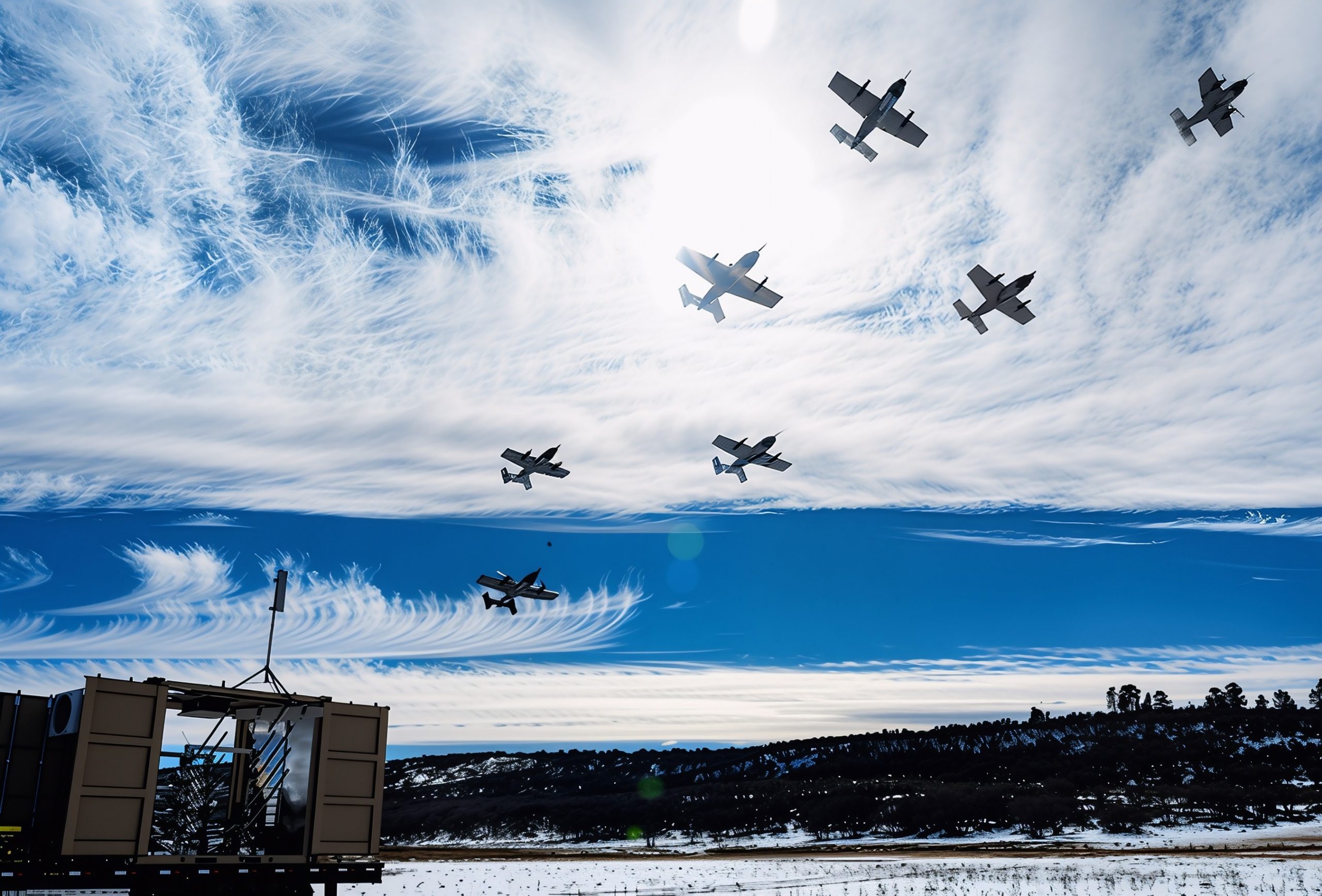
DZYNE said Blitz Box is intended for “…rapid deployment and flexible integration, supporting distributed and contested environment operations.” One can envision such box launchers delivering artillery-like saturation attacks, or conversely an infiltrated mission profile like the Ukrainian drones covertly deployed in trucks next to Russian bomber bases last year for Operation Spiderweb.
Regarding maritime deployment, DZYNE confirmed to IUS “…Blitz has been reliably launched at sea from both stationary and moving vessels, including at high speeds,” and that the design “…supports operations in challenging maritime environments.”
In terms of touted “low cost, high rate of production”, DZYNE told IUS its “…current manufacturing footprint can produce up to 5,000 vehicles per month, with capability to scale beyond that as required.” DZYNE furthermore confirmed to IUS that a baseline Blitz costs under $10,000 per UAV before factoring in payloads. (Also bear in mind Blitz was submitted to Gauntlet Phase 1, which nominally sought UAVs produced for no more than $5,000 each.)
DZYNE furthermore stated Blitz complies with NDAA component requirements and is currently in the process of being listed under Blue UAS “as a result of participation in DDP Gauntlet 1.”
IUS asked DZYNE why they designed Blitz counter to the prevailing quadcopter trend. They explained Blitz was intended “to fill the medium-range operational gap where multi-rotors struggle to deliver endurance and reach,” with hand-launch bringing similar ease of use to quadcopters while the fixed-wing configuration brought “range, speed and payload flexibility.”
To be sure, medium-range drone strikes just beyond the frontline targeting vehicular logistics, air defenses, artillery and enemy drone teams have greatly shaped warfare in Ukraine.
But IUS wondered how Blitz managed to fly 9 to 15 times further than a hand-launched RQ-11 with 6 miles range. DZYNE cited their “deep roots in advanced aircraft development” helping them implement “high efficiency aerodynamics, an optimized propulsion system, and rigorous weight management…to achieve ranges that significantly exceed legacy Group 1 systems.”
And how are Blitz UAVs controlled over such long distances, and under conditions of satellite-navigation and radio-link denial?
“Blitz uses a fully modular radio architecture, so control link range is dependent on the radio selected,” DZYNE explained. “Configurations can support anything from short-range line-of-sight links to long-range solutions, and Blitz can also operate without a radio in fully preprogrammed or autonomous modes. This architecture allows integration with a range of advanced comms solutions as required.”
Meanwhile, DZYNE said it’s working with partners on integrating advanced swarming capabilities, though Blitz “already supports native effector coordination without requiring real-time vehicle-to-vehicle teaming—an advantage in denied environments.”
Blitz’s unveiling comes as dozens of companies race to enter the market the Pentagon has finally moved to address. Despite Blitz’s selection among 26 companies to participate in the Drone Dominance Program’s Gauntlet trial, it was not among the 11 that placed on the leaderboard—though one should consider that Blitz’s 50-93 mile range would not have been rewarded in Gauntlet 1, which simulated strikes at a maximum 6 miles range.
Blitz must therefore stake out its competitive advantage over Group 1 rivals on: very long range for its class; versatile launch options; capacity for mass-launch using box launchers given integration of appropriate swarming autonomy and comms architecture; and modularity and adaptability.
Blitz’s capabilities may be most effectively leveraged by special forces or dedicated drone strike units executing missions beyond local tactical depths. Operators mating box launchers to trucks or boats could also execute high-intensity swarming mission concepts.
DZYNE says Blitz is “available now for demonstrations and procurement to eligible U.S. and allied customers,” and will be on display at the SOF Week expo in Tampa, Florida, running May 18–21.