
Operating across a 7,000-square-mile reservation has shaped the Cherokee Nation’s business portfolio, from medical supply delivery to manufacturing and fabrication to training U.S. Marines. Recently, a joint display of a massive vertical takeoff/landing platform and a large, customized truck system bore witness to Cherokee Federal’s evolution of public safety platforms designed for rugged, remote situations.
“Cherokee Federal is the economic engine behind the Cherokee Nation,” explained account executive Jason Nerio. “We’ve got a business development group in northeast Oklahoma with two different plants, and these two products are kind of our ‘delve’ into new product development.”
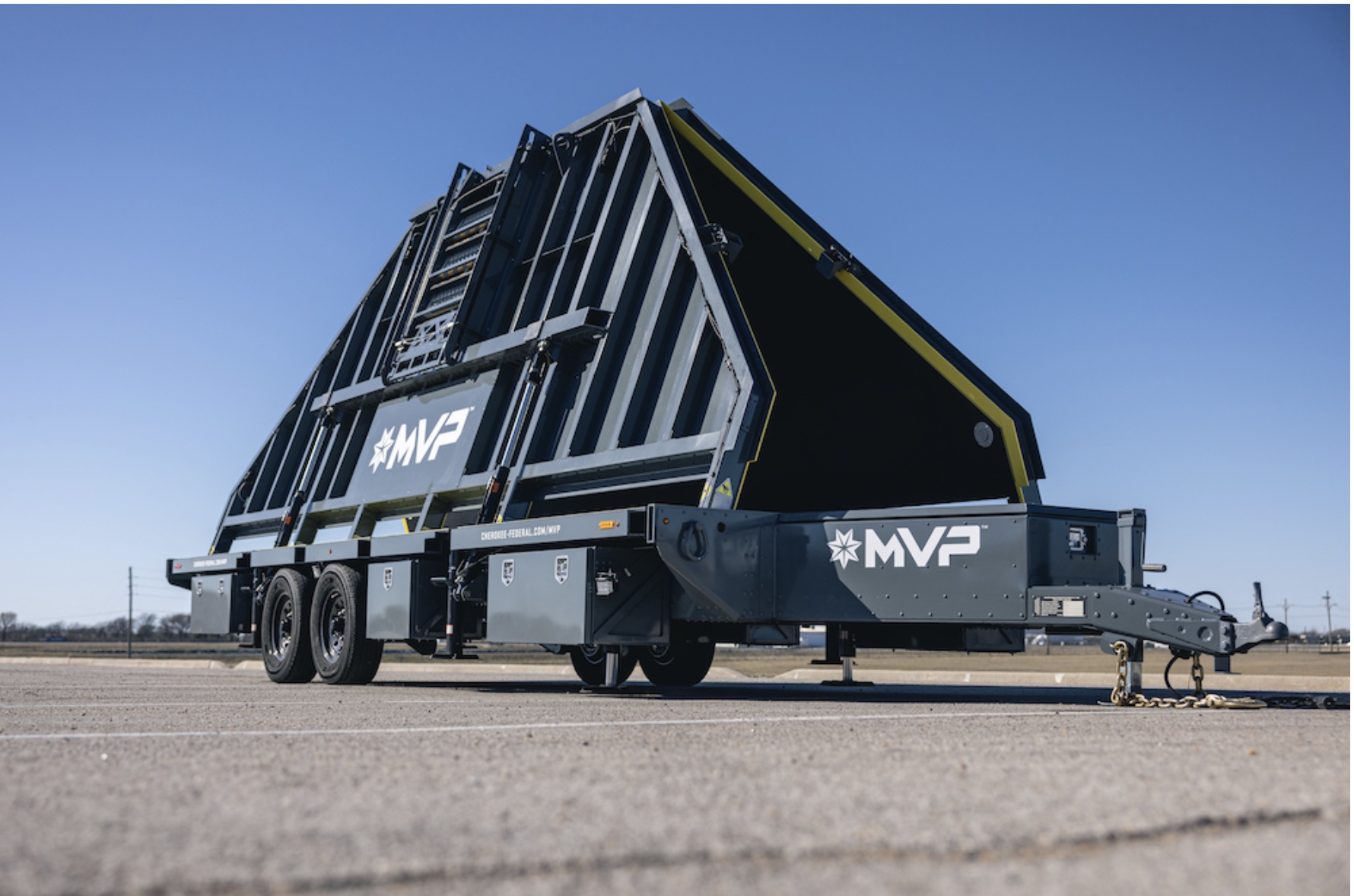
Standing between his solutions-on-steroids, Nerio first explained the MPV, a massive Mobile Vertipad Platform designed for EVTOL and AAM use. Rolling down a highway, the unfolded 32-foot trailer looks a bit like the spaceship in the movie “Independence Day.” “But once you’re parked,” Nerio said, “within five minutes you’ve got a 24-by-24-foot landing pad,” one that can host a 30,000-pound UAV. “There’s probably not much than can’t fit.
“The beauty of it,” Nerio continued, “is it’s only 8,600 pounds—we’ve got an F-350 here but you can tow it with an F-150. Once you’re set up, it auto-levels up to an 8% grade, so uneven terrain that maybe some pilots aren’t as comfortable with or a disaster relief area where it’s marshy, very wet land—all the pads underneath the landing surface spread that weight so you’ve got a safe place to land and operate.” Visual and IR landing lights enhance that safety.
Nerio then turned to the MC2, the Mobile Command Center that debuted in March. The fire engine red frontline coordination, communications and control vehicle is marked by a telescoping sensor-camera-thermal imaging mast and offers VHF radio and Starlink real-time data sharing. It can form an integrated solution with the MVP.
“This is a blank canvas,” Nerio said about the MC2’s potential as a UAS mission coordination hub. “What kind of connectivity do you need? Do you need cellular? Do you need Starlink? Do you need some type of protected satcom? The configuration will depend greatly on the use cases. If you’re talking advanced air mobility, you can nest four drones on top of this truck and you’ve got connectivity with two workstations in the back seat, where you can operate your drones from, do communications relay to other units.”
Nerio offered firefighting as a deployment example. “You could put a water tank on and refill a drone and do cyclic operations, being more strategic in laying that line of water in front instead of fighting directly on the fire. With all the imagery and technology we have today, it’s just a big math problem: how many gallons in front of the fire in this width? You’ve stopped it, and you’ve won the game.”