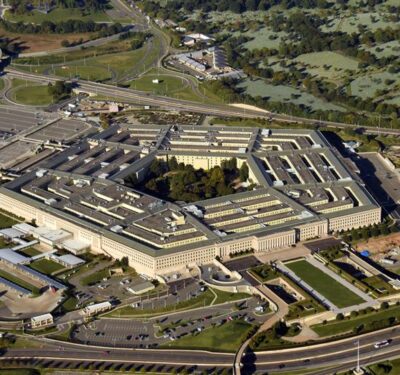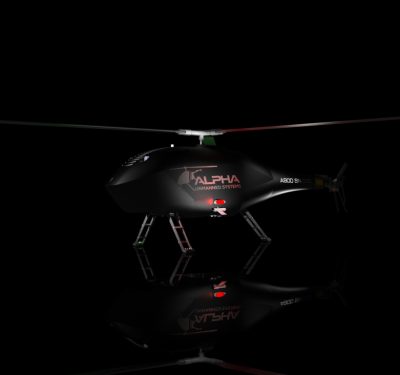

Two same-day contract actions tie AV’s counter-UAS portfolio directly to the Pentagon’s expanding homeland counter-drone posture, with Titan systems already flowing to U.S. Air Force Global Strike Command sites.
AeroVironment, Inc. announced two connected contract actions on July 6 that anchor its counter-UAS business to the Department of Defense’s expanding homeland protection mission. The first is a three-year, $500 million Indefinite Delivery, Indefinite Quantity contract awarded sole-source in support of Joint Interagency Task Force 401’s Domestic Shield Program. The second, executed against that same IDIQ, is an $80.5 million task order selecting AV’s Titan-MS multi-sensor system for base defense at multiple domestic U.S. Air Force Global Strike Command sites. Together, the two announcements show how quickly JIATF-401 is converting a broad contracting vehicle into specific, dollar-denominated deployments.
A $500 Million Vehicle for Domestic Shield
Under the IDIQ, AV will supply a range of Counter-Unmanned Aircraft Systems and Counter-Small Unmanned Aircraft Systems capabilities to the Department of Defense for force protection, base defense and counter-UAS operations in support of Domestic Shield. The Pentagon announced the award on July 1. Domestic Shield is a JIATF-401 initiative built to advance a more proactive, scalable domestic counter-UAS posture, expanding defensive perimeters, streamlining threat identification, strengthening interagency data sharing and operational coordination, enabling trained contractor support, and delegating protection authorities so installation commanders can better defend high-risk facilities and critical assets.
“Domestic Shield is about protecting Americans where they live and work, and safeguarding the critical infrastructure that underpins our economy and national security. This award reflects strong confidence in AV, our people and our technology and it reinforces the shared obligation we have to stay ahead of rapidly evolving drone threats, not only in contested theaters abroad, but in the skies over our own communities,” said Wahid Nawabi, Chairman, President and Chief Executive Officer of AeroVironment.
The award builds on momentum JIATF-401 has already signaled this year. In April, the task force said it had committed more than $600 million at a record pace to strengthen counter-UAS capability in support of Operation Epic Fury and homeland defense. That push traces to guidance the task force issued in January, when its director framed domestic counter-drone defense as a standing operational requirement rather than a contingency.
“Drones are a defining threat for our time. Technology is evolving fast and our policies and C-UAS strategy here at home must adapt to meet this reality. Countering drones does not start and stop at the fence line. With this new guidance, installation commanders are empowered to address threats as they develop, and the guidance makes clear that unauthorized drone flights are a surveillance threat even before they breach an installation perimeter,” said Brig. Gen. Matt Ross, Director of Joint Interagency Task Force 401.
AV frames its delivery against Domestic Shield around AV_Halo, the integration layer that connects sensors, effectors and operators and is meant to interoperate with third-party technologies, command-and-control systems and emergency response networks. The company describes the resulting architecture as persistent detection, tracking, identification and defeat capability spanning military installations, critical infrastructure and contested environments alike. AV said it will release further news as task and delivery orders are issued against the IDIQ — the Titan-MS award below is the first of those to be announced.
First Task Order: $80.5 Million for Titan-MS Base Defense
JIATF-401 has selected AV’s Titan-MS (Multi-Sensor) system for an $80.5 million contract in support of U.S. Air Force Global Strike Command base defense, with systems to be deployed at multiple critical domestic sites. The order is being executed against the $500 million Domestic Shield IDIQ and follows an earlier JIATF-401 purchase of a Titan-MS fly-away-kit multi-sensor system that is already deployed and conducting base defense operations within the continental United States. AV said the award follows a series of U.S. Air Force test events in which Titan-MS demonstrated effective, adaptable performance against evolving threats.
Under the purchase order, AV will deliver Titan-MS, Titan 4, electro-optical/infrared camera payloads, and C-UAS radar systems intended to strengthen the Air Force’s layered air defense against small unmanned aircraft threats. Titan-MS itself is described as an AI-powered, multi-sensor fusion system that detects, identifies, tracks, defeats and reports on unmanned threats across air, sea and land environments, fusing machine-learning algorithms across sensors to counter both RF-controlled and autonomous drones.
“Counter-UAS is no longer a future requirement, it is the defining operational imperative of modern defense. This milestone award and the unprecedented demand we are seeing for Titan mark a historic turning point, as customers move decisively toward proven, fielded solutions that can be rapidly deployed at scale to protect civilians, servicemembers and critical assets against increasingly sophisticated drone threats,” said Nawabi.
“We continue to refine our software-defined Titan family based on direct customer feedback and hard-earned lessons from combat operations, ensuring our capabilities evolve faster than the threats and keep our customers decisively ahead. This JIATF-401 award underscores Titan’s ability to deliver mission-ready performance at scale for some of the most demanding base defense environments in the world,” said Trace Stevenson, President of Autonomous Systems at AeroVironment.
Titan Family Momentum
The Titan line, comprising Titan3, Titan4 and Titan-SV, is a modular C-UAS suite designed to detect, identify, track and mitigate hostile or unauthorized drones across varied environments. AV said it delivered 118 Titan 4 systems and 400 Titan-SV systems worldwide during the quarter, and that Titan is now operationally deployed in 17 countries, including three new international customers fielding the system this quarter. Titan products are integrated into multiple U.S. government programs of record as well as deployments with other agencies and international partners.
AV pointed to two federal policy developments as tailwinds for continued Titan demand: the presidential executive order “Restoring American Airspace Sovereignty” and the SAFER SKIES Act, both of which the company said are enabling broader deployment of compliant, mission-ready counter-drone capability. AV describes Titan as designed and manufactured to meet U.S. regulatory requirements.
Titan4, introduced in 2025, is the family’s portable variant, built for mobile, dismounted or fixed-site operations and deployable in under five minutes to create a protective envelope around personnel and infrastructure. AV says the single-chassis unit is 17% lighter and 73% smaller than its predecessor while delivering nearly 250% more transmit power, at 540 watts across six RF bands, and integrates with Titan-SV for AI-enabled passive detection and airspace awareness.
What to Watch
With the $500 million IDIQ now in place and a first $80.5 million task order already executed, the near-term signal for IUS readers to track is the pace and location of further Domestic Shield task and delivery orders. AV has said it will disclose additional awards as they are issued against the vehicle, and JIATF-401’s stated posture — expanding perimeters, pushing protection authority down to installation commanders, and leaning on contractor support — suggests further site-specific Titan and AV_Halo deployments are likely across additional Air Force and other service installations in the coming quarters.