
Times Microwave’s Levitate family is built for the middle market in military UAS: lighter than legacy aerospace practice, stronger than commercial coax and available when programs are ready to build.
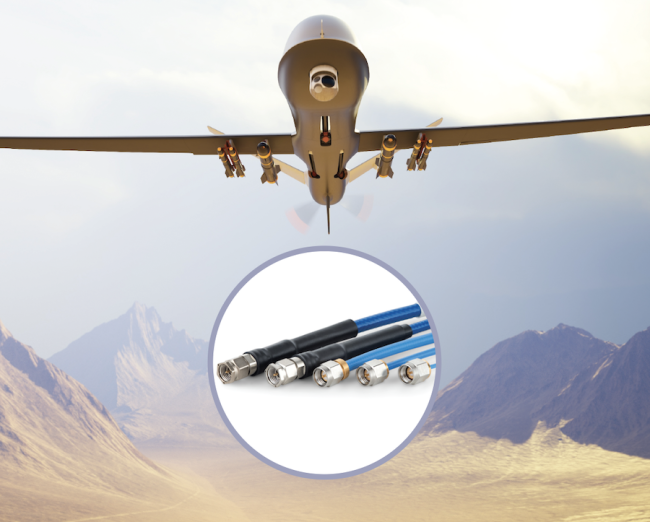
and full MilTech® qualification. Photo courtesy of Times Microwave.
The unmanned market has moved into a different phase. The era of exquisite programs, long timelines and small production lots has not disappeared, but it is no longer the whole story. The market is moving toward systems that have to be lighter, cheaper and faster to build as well as easier to source, while still surviving the realities of military use. That shift reaches all the way down the stack, including the RF interconnect layer that too often gets treated as an afterthought until something fails, a signal degrades or a production schedule slips.
That is the opening Times Microwave Systems sees in the current UAS market. Levitate™, the company’s lightweight cable assembly family, is aimed at a segment that has been underserved for years: builders who cannot live with commodity commercial coax, but do not want to pay for a full-up MilTech® solution on every airframe either. As Matthew Radicchi, director of market intelligence, put it, “We saw a gap in product between that commercial cable and our Ferrari of the MilTech.”
At one end are the large, exquisite platforms where nobody argues about spending for top-tier performance, redundancy and qualification. At the other end are cheap commercial builds, often relying on readily available RG cable and in-house terminations because price and speed matter more than anything else. The market opening up in the middle is bigger than it was even a few years ago. It includes newer defense suppliers, venture-backed airframers, subsystem houses and established firms pushing into unmanned programs that need stronger performance than commercial coax can deliver but cannot tolerate the cost and lead times of legacy aerospace practice.
Radicchi said the requirements fed into Levitate were straightforward: “It needs to be lightweight, it needs to be low cost, and it needs to be readily available, preferably in distribution.” He was equally direct about why. Some smaller UAS manufacturers are building at rates that make 12- to 16-week lead times a nonstarter. In that environment, the supply chain itself becomes part of the spec. If the part is right on paper but not on the shelf, it is not the right part.
The Pentagon still buys through the classic program-of-record machinery, but it is also leaning harder on rapid pathways, on-ramps, OTAs and newer entrants that are expected to field hardware faster and in larger quantities. The UAS market is no longer simply borrowing from manned aviation or precision weapons. It is becoming its own category, with its own procurement tempo and its own cost-performance logic. Suppliers that understand that shift early are going to have an advantage.
The Optimization Problem
Chris Cooper, director of engineering, described the design task in plain engineering terms. “Engineering, in my opinion, is an optimization problem,” he said. For Levitate, the variables were SWaP-C, availability and, in some cases, country of origin. Getting to a lower-cost answer without giving up mission-relevant performance is where suppliers with deep aerospace RF experience earn their credibility.
Times pushed hard on material selection to take weight out without surrendering the level of RF performance a more demanding unmanned platform still requires. Radicchi said the company tried to get as much aluminum into the product as possible, then optimize from there. The result was a family lighter than comparable RG cable, available through established distribution and priced in a range the emerging UAS market can absorb.
Levitate spans Group 1 through Group 5 unmanned aircraft, covering flight control, autopilot, communications, navigation and identification, electronic warfare, camera and video, telemetry, surveillance, reconnaissance and weather detection. The five variants run from 40 GHz at the small end down to 8 GHz on the larger-diameter options built for longer runs.
Signal Discipline
Radicchi said the family was really developed with Group 3 through Group 5 aircraft in mind, with selected use in Group 1 and Group 2 systems where short RF jumpers are still needed. Some of the smallest drones simply do not have the internal architecture that calls for much cable assembly at all. Others increasingly do, especially as payloads, radios, navigation packages and onboard processing become more capable and more tightly packed.
The team targeted 60 dB shielding, knowing it would not reach the 90 dB levels associated with higher-end MilTech products but would still clear a meaningful bar above common commercial alternatives. Radicchi said the finished product exceeded that 60 dB mark and estimated that, at the frequencies involved, shielding performance was roughly 50% to 70% better than similar RG cable. That means better resilience at the tactical edge of operations, where it really matters.
For the unmanned community, shielding is not a spec-sheet trophy. It is about surviving in crowded electronics environments where everything sits close to everything else. Radicchi pointed to crosstalk and interference between adjacent transmission lines. Cooper expanded on that from the RF side, noting that out-of-band emitters can bleed into sensitive paths and that strong unwanted signals can create intermodulation products that degrade a receiver’s ability to pull out the signal that matters. In a dense aircraft, self-interference is a real design problem. In an EW-heavy environment, it becomes one more way to lose error margin you did not know you could spare.
The drone sector learned early that low cost opens the door to scale. Now, it is learning scale alone does not make a system effective. As payloads become more sophisticated and operators push farther into denied or degraded environments, the supporting hardware has to keep up. Cable assemblies are mission-critical enablers within the RF architecture, carrying command-and-control, navigation, ISR and EW payload traffic. If that path is noisy, vulnerable to interference or physically weak, the effect is felt across aircraft performance and mission reliability.
Beyond the Cable
Times is also making a larger argument about integration. Cooper said the company increasingly wants to be seen not just as an interconnect supplier but as part of a broader RF and interconnect capability inside Amphenol. He pointed to filtering, amplifiers, switches and related RF building blocks now available across the larger organization, along with the ability to help customers think through signal-chain problems earlier in the design cycle.
Radicchi said one advantage of the larger Amphenol ecosystem is supply-chain consolidation. Instead of forcing a customer to chase six to 10 different RF suppliers, the company can assemble more of the stack under one roof, reducing procurement complexity and potentially lowering unit cost. In a market under pressure to build more systems at lower cost while still improving resilience, fewer handoffs and fewer unknowns have real value.
The custom side of the business has not gone away either. Stocked assemblies in distribution may be the fast path for a growing share of orders, but Times is still inviting customers to come forward with connector changes, interface changes, angle requirements and other nonstandard needs. The drone market wants speed, but it is not becoming generic. It is becoming bifurcated: standardized where it can be, tailored where it has to be.
Times Microwave Systems bringing 75 years of aerospace RF discipline into a market that did not exist at scale five years ago. SWaP-C pressure, contested spectrum, harsh operating environments, compressed procurement timelines and the practical reality of needing parts on the shelf when programs are ready to build—these are the forces shaping military UAS production right now. The companies that succeed in this environment will be the ones that understand their architecture at a system level, make the right performance trades early and avoid the hidden RF weakness that can later show up as lost margin, integration trouble or mission risk.