
The company’s silicon anode cells deliver twice the flight time of standard lithium-ion. The race to build a compliant domestic supply chain is underway.
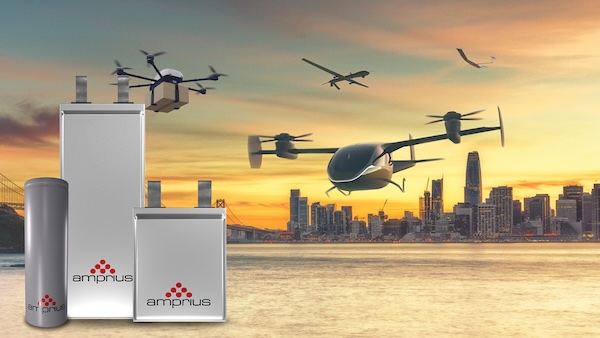
When Tom Stepien, CEO of Fremont, California-based Amprius Technologies, describes his company’s battery technology, he reaches for an analogy his audience at XPONENTIAL Detroit would appreciate immediately.
“Think of it like espresso versus standard coffee,” Stepien said. “Same caffeine, same energy, in a much smaller package. Drones that use our cells can fly twice as long.”
He pointed to a cellular relay drone suspended above the Amprius booth as a concrete illustration. With a conventional battery, the platform needed eight sorties a day for 24-hour coverage—about three hours per flight. With an Amprius cell, it gets five hours and flies five times. “That’s a dramatic improvement to the mission just by changing the battery.”
The technology behind that gain is a silicon anode. Standard lithium-ion batteries use graphite anodes; replacing graphite with silicon has long been recognized as the path to roughly double the energy density. The problem is that silicon swells and cracks during charge cycles, degrading the cell. Amprius, founded in 2015, spent the better part of a decade solving that swelling problem at the materials level. It says it has cracked it—and at commercial scale.

“It took a while,” Stepien acknowledged. “Batteries are not for the faint of heart. But the advantage is real and we’re now at scale.” The company is guiding to at least $130 million in revenue for 2026, up from $73 million in 2025, and is gross margin positive—a milestone only recently achieved after years of development investment.
A Defense-First Customer Base
Amprius’s commercial trajectory is tracking closely with the broader surge in defense drone demand. Its customer list includes AeroVironment, Teledyne FLIR, L3Harris, Kraus Hamdani Aerospace, and BAE Systems—all prime or subprime contractors supplying surveillance, strike, and ISR platforms to U.S. and allied forces.
The Q1 2026 earnings call, held the week before XPONENTIAL Detroit, illustrated the pace of that activity. Three Amprius customers received major contract awards in a single quarter. Kraus Hamdani Aerospace, a Northern California developer of long-endurance UAS, secured a DoD award alongside a separate $270 million Air Force Central Command contract for its K1000ULE—a fully electric aircraft capable of 24-hour flight at 1,000-mile range. AeroVironment received a $117 million U.S. Army firm fixed-price agreement. Teledyne FLIR landed a European order for its Black Hornet 4 nano-drone. All three platforms run on Amprius SiCore cells.
“The world has become aware of the huge asymmetries that drones are providing,” Stepien said, “and we’re seeing that spill into public safety and other areas as well.” He described the drone-as-first-responder market—pre-positioned aircraft tied into 911 dispatch systems across roughly 1,800 police and emergency departments—as a civilian analog to the loiter-time advantage driving defense demand. “Hang time is what we can help with.”
DoD Investment and the DIU Partnership
Beyond customer contracts, Amprius has built a direct funding relationship with the Defense Innovation Unit. The DIU contract has been expanded three times, reaching $18.1 million and now covering three types of silicon anode cylindrical cells and four standard-sized pouch cells. That funding is supporting both the NDAA compliance pathway and a capacity expansion at Amprius’s Fremont pilot line.
“In large part because of your tax dollars, we’ve been able to start building that capability,” Stepien said at XPONENTIAL. “It’s helped fund an expansion of our pilot line and the standing up of U.S. material suppliers.”
The DIU relationship is significant beyond the dollar amount. A Program of Record designation—which analysts are watching for in the second half of 2026—would provide multi-year, predictable DoD revenue and signal Amprius as a formally recognized defense battery supplier rather than a commercial company selling into the defense channel.
The NDAA Supply Chain Problem
The more structurally significant challenge at Amprius is one the whole defense battery industry is navigating: NDAA compliance. The National Defense Authorization Act will prohibit DoD from purchasing batteries for weapons and support systems using materials from foreign entities of concern—China and Russia chief among them—beginning January 1, 2028 for new acquisition programs.
The current global battery supply chain is built around Chinese and Korean manufacturers. CATL, BYD, and a third Chinese producer occupy the top three global slots; Korean producers including LG, Samsung SDI, and SK On follow. U.S. manufacturers, as Stepien put it, are “everybody else.”
Amprius has responded with what Stepien describes as an Apple-style model: design in the U.S., manufacture through qualified partners. The company has partnered with Nanotech Energy as a U.S. production partner for high-performance silicon battery cells, a move positioned to help meet NDAA requirements ahead of the 2028 deadline. Korean cell assembly is already supplying NDAA-compliant orders. Of the company’s approximately 25 battery SKUs, not all are NDAA-compliant yet, and scaling that full catalog will take additional time.
The cost question remains open. Stepien was candid that allied-nation or domestic production will cost more than Chinese pricing—but the range of that premium matters enormously. “Is it 20 percent more than China, or is it 2x? Labor is only about 10 to 12 percent of battery cost, and some materials are coming in at roughly the same landed cost. But stay tuned.”
From Battlefield to Delivery Network
On the civil side, Amprius’s most significant recent partnership signals how far silicon anode technology has traveled from its military origins. In May 2026, Amprius announced a strategic collaboration with Matternet, the only FAA Type Certified drone delivery company, deploying Amprius cells in Matternet’s M2 aircraft and extending the partnership to battery solutions optimized for Matternet’s next-generation platform.
The partnership is focused on translating battery performance into commercial operating advantage—optimizing cell selection, form factor, thermal performance, charge rate, and cycle life for Matternet’s delivery network, with the goal of improving aircraft availability, expanding service areas, and reducing cost per delivery.
Matternet has completed more than 60,000 commercial flights across dense urban and suburban environments in the U.S. and Europe, operating in partnership with UPS and under FAA Part 135 authority. For Amprius, the partnership demonstrates that the same energy density advantage driving military demand maps directly to the commercial delivery economics problem: more range per charge means more addresses served per sortie, and more sorties per charge cycle means lower fleet operating cost.
“Matternet is exactly that kind of partner—a company with a proven certified platform, real commercial operations, and a clear path to scale,” Stepien said.
What the Battlefield Is Teaching
Stepien also described the feedback loop now running between conflict zones and U.S. battery development. Ukrainian engineers—many of whom have set up operations in the Bay Area following years of frontline drone development—are compressing battlefield learning into commercial product cycles at a pace no traditional procurement timeline can match.
“The cycles of learning they’ve done on the frontline, under extreme conditions—it’s remarkable,” he said.
That learning is shaping Amprius’s product thinking on chemistry for one-way versus reusable platforms.Expendable strike drones have a completely different optimization: maximize range, with no need to recharge.