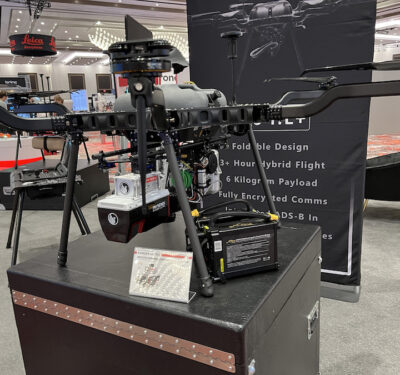

The U.S. Army Combat Capabilities Development Command C5ISR Center is pushing a new generation of unmanned aircraft sensor payloads that promise higher-resolution imagery at longer ranges, while also reducing dependence on expensive and scarce optical materials.
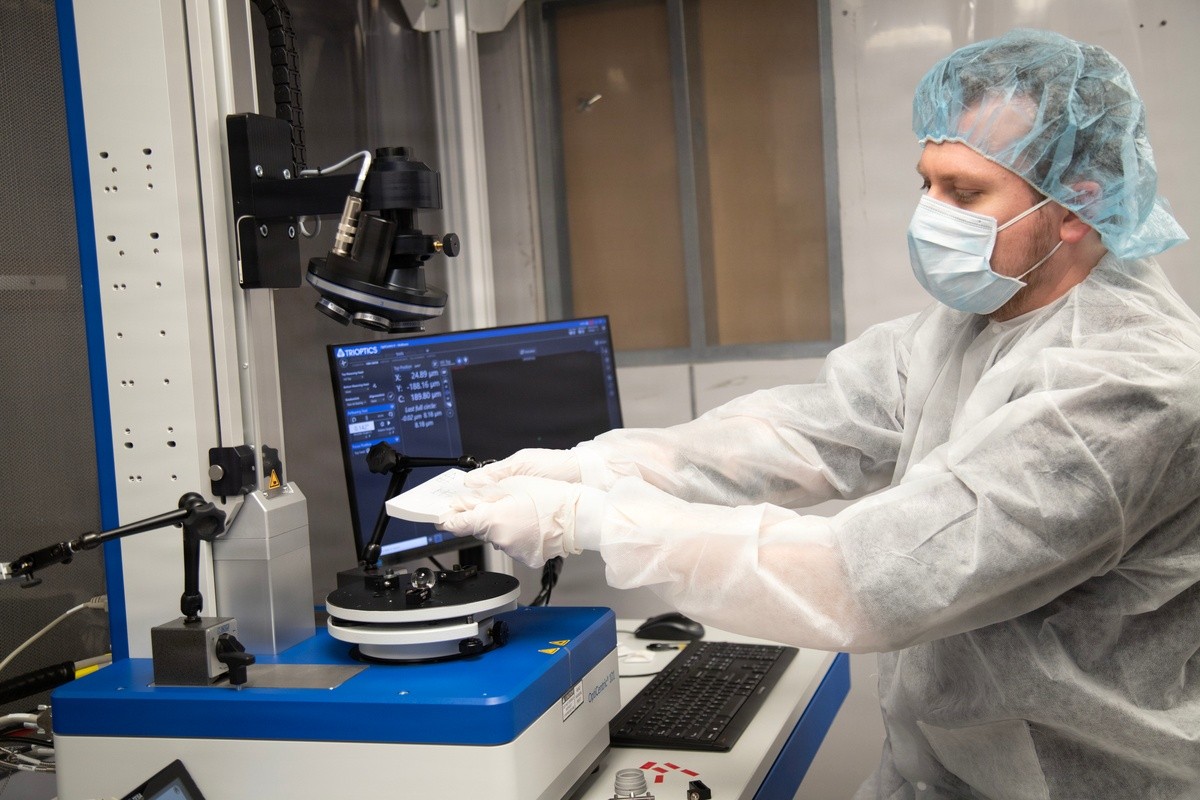
The Folded Lightweight Annular Telescope, or FLAT, is a mirror-based optical design being developed at Fort Belvoir as a compact, low-cost payload for small UAS and Launched Effects platforms. By pairing advanced reflective optics with precision mirror fabrication and alignment techniques, the system is intended to deliver significantly sharper images than current fielded sensors when combined with aided target recognition algorithms, improving search, cueing and threat-avoidance in contested environments.
Mirror-based design to ease rare-earth and cost pressures
According to C5ISR Center optical engineer Brian Kellermeyer, FLAT’s mirror-centric approach is designed to “push boundaries” by avoiding reliance on rare earth minerals and other high-cost optical components. Instead, the program is focused on a scalable reflective telescope architecture that can be manufactured more affordably and adapted across multiple payload sizes. With the Army planning to buy large quantities of unmanned systems for future conflicts, the Center’s UAS science and technology portfolio is increasingly focused on how to incorporate long-range EO/IR capability without driving up per-aircraft cost. The FLAT designs are also being engineered to work across multiple wavebands, including both cooled and uncooled thermal sensors, opening the door to day/night and all-weather ISR configurations on small platforms.
Government-owned IP aimed at rapid transition
One of the notable aspects of FLAT is that the government owns the design rights. That allows the C5ISR Center to share the architecture with multiple industry partners and integrate it directly into emerging payloads through Cooperative Research and Development Agreements, Small Business Innovation Research awards and Manufacturing Technology efforts. Kellermeyer said this approach is intended to “burn down risk” for vendors, strengthen the defense industrial base and broaden supply chains for advanced UAS optics. Initial small-form prototypes are slated for field demonstrations and operational experimentation in 2026, with plans to package the sensor suite into a gimbaled payload and list it on a UAS Marketplace that will catalog validated counter-UAS systems and components for defense and interagency users.
Beyond FLAT, the U.S. Army’s C5ISR Center is using forums such as the Military Sensing Symposia to socialize its work across the broader sensor community, highlighting the potential to adapt the same folded-annular optics to ground systems and other soldier-borne applications that can exploit higher magnification in compact form factors.