
The Pentagon’s Drone Dominance Program wanted the eleven companies that made the leaderboard of its Gauntlet 1 competition concluded in March to deliver thousands of first-person view (FPV) kamikaze drones according to a demanding schedule: half in 2.5 months and the remainder within 4.5 months.
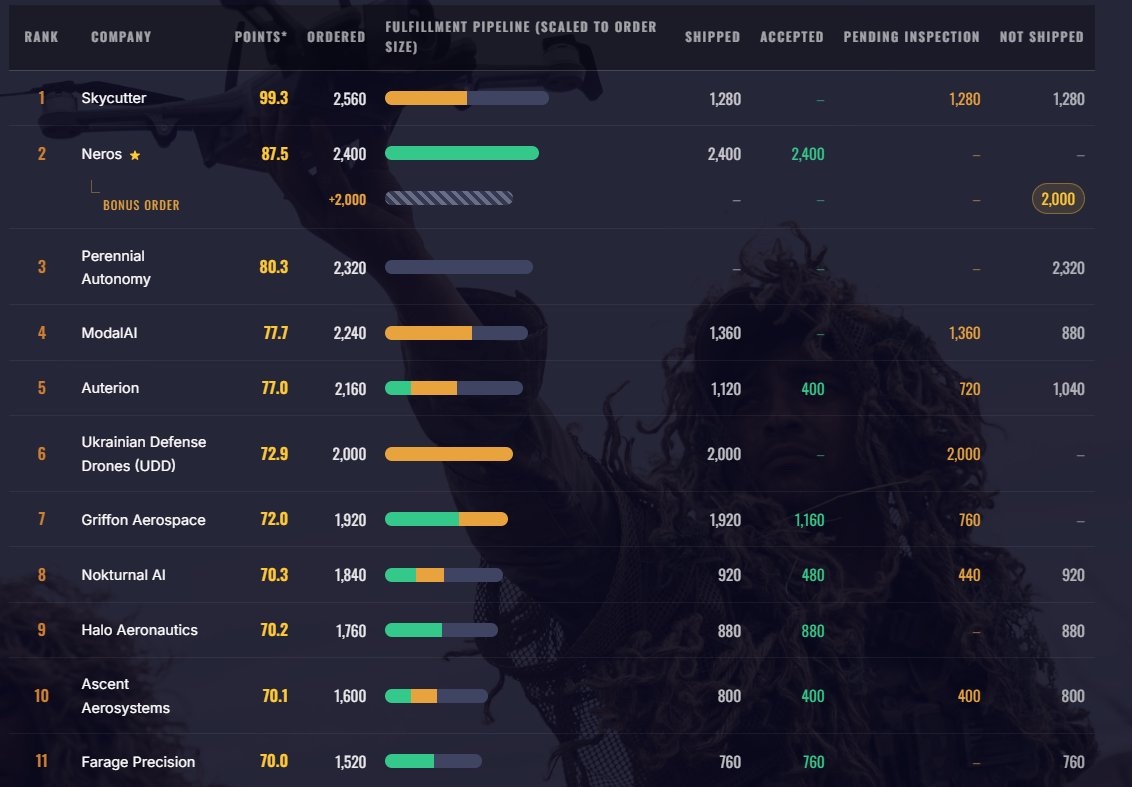
But now, over five months later, the competition’s order-tracking website reveals just how ambitious those goals were—out of 22,320 FPVs collectively ordered, only 13,440 drones have been delivered. And only three out of 11 companies awarded contracts have completed deliveries; most of the rest appear to have delivered around 50%.
The likely culprit: not a lack of effort or money, but a nearly industry-wide deficit sourcing NDAA-compliant drone components, particularly including sensors, electric motors, batteries, computer chips, electronic speed controllers, and navigation systems. Ukraine and Russia now build many millions of DPV drones annually by sourcing highly affordable mass-produced Chinese drone components—a source legally unacceptable for the U.S. military for several sound reasons.
Of course, DDP officials were well aware of the component production deficit when they designed the competition, and the Gauntlet contracts were precisely intended to provoke a supply-and-demand crunch to stimulate the drone industry with demand signals to scale component production upwards. The ultimate goal: to jump start a competitive alternate small drones industrial base for American’s military.
To start with, the eleven top-scoring FPV designs from Gauntlet 1, detailed in earlier articles by IUS, were awarded contracts for between 3,000 and 1,500 drones based on their ranking. Furthermore, companies that completed early deliveries were furthermore dangled the promise of extra orders.
What the Tracker Actually Shows
As it turned out only one company—Neros Technologies—delivered its full order of 2,400 drones early this July, and in August DDP revealed it had issued Neros a bonus order for 2,000 more UAVs.
This is not entirely surprising, as Neros had specialized itself in FPV mass production early on; earlier that March it was the only company of the initial three contractors to complete deliveries of FPVs ordered for the Purpose Built Attritable System (PBAS) program kicked off late last year.
Only two other companies fulfilled their deliveries: Ukrainian Defense Drones Corp (a U.S.-based platform for Ukraine’s F-Drones mass-producer), and Griffon Aerospace, a well-established target drone builder that partnered with Kinetic Frames for DDP Gauntlet. UDD has delivered 2,000 of its F10 FPV drones, while Griffon has delivered all 1,920 of its Scourge FPVs ordered.
However, UDD shares a trait in common with top-scoring Ukrainian/British partnership Skycutter and California-based ModalAI: none of their delivered drones are marked as having been formally accepted, rather all are ‘Pending inspection’. That could mean that DDP has found issues with components in these UASs, or it may reflect bureaucratic issues outside the control of the manufacturers.
Finally, it’s worth observing that Napatree’s third-place winning slot has been replaced by Perennial Autonomy, another company associated Eric Schmidt and his Swift Beat entity. Furthermore, Perennial uniquely isn’t listed as having delivered any drones so far.
Perennial is, however, known to have delivered considerable numbers of Bumblebee and Hornet kamikaze drones, as well as AS3 Surveyor interceptors drones, directly to U.S. military units. Notably, the Pentagon’s Joint Interagency Taskforce 401 devoted to rapid fielding of counter-drone (C-UAS) capabilities awarded Perennial a $500 million IDIQ contract earlier this year for Bumblebee V1s and V2s, Hornets and Surveyors. Perhaps the handover from Napatree to Perennial has complicated registration of the Gauntlet 1 order.
Where the Bottleneck Really Sits
The generalized difficulties meeting Gauntlet 1’s fast-paced delivery schedule demonstrates the seriousness of component shortage challenges when following NDAA regulation forbidding use of cheap and ubiquitous Chinese components. Even though American industry is proving capable of building FPV drones (and other are Group 1-3 UASs) at cheap unit costs approaching those seen in Russia and Ukraine, likely U.S. and European industry simply isn’t building enough secure sub-components to keep up with demand.
While DDP Gauntlet and heavy tariffs recently placed on Chinese drones seeks to stimulate demands signals to encourage domestic mass production of NDAA-compliant subcomponents, attacking the problem from the other end are initiatives like SkyFoundry (in which the Army is attempting to standup its own component production capacity that could help bridge over shortages) and industrial awards aimed at component producers.
A particularly notable example of latter is an $800 million loan extended by the Office of Strategic Capabilities to Alabama-based Performance Drone Works for mass-production of subcomponents.
“The financing will help establish production of critical drone and robotics components currently dependent on foreign-controlled supply chains, including propulsion, power and control, vision systems and other enabling technologies,” PDW told IUS. PDW competed in Gauntlet 1, where it did not make the leaderboard but did receive a positive evaluation for production capacity.
“The expectation is that as our manufacturing capabilities grow, so would our physical footprint and workforce in order to deliver critical components and systems at the scale and speed required,” added PDW CEO James Slider.
Time will tell if delivery rates improve for winners of Gauntlet 2, taking place this August at Fort Carson, Colorado. While domestic component production capacity seems bound to further scale upwards during the second half of 2026, DDP plans to order twice as many FPV drones (60,000) from the expected eight winning designs.