
After four years of experiments with Army and Marine Corps units, DARPA’s RACER program is wrapping up with a reusable autonomy stack for uncrewed ground vehicles operating off-road, at speed, and without GPS, the agency said.
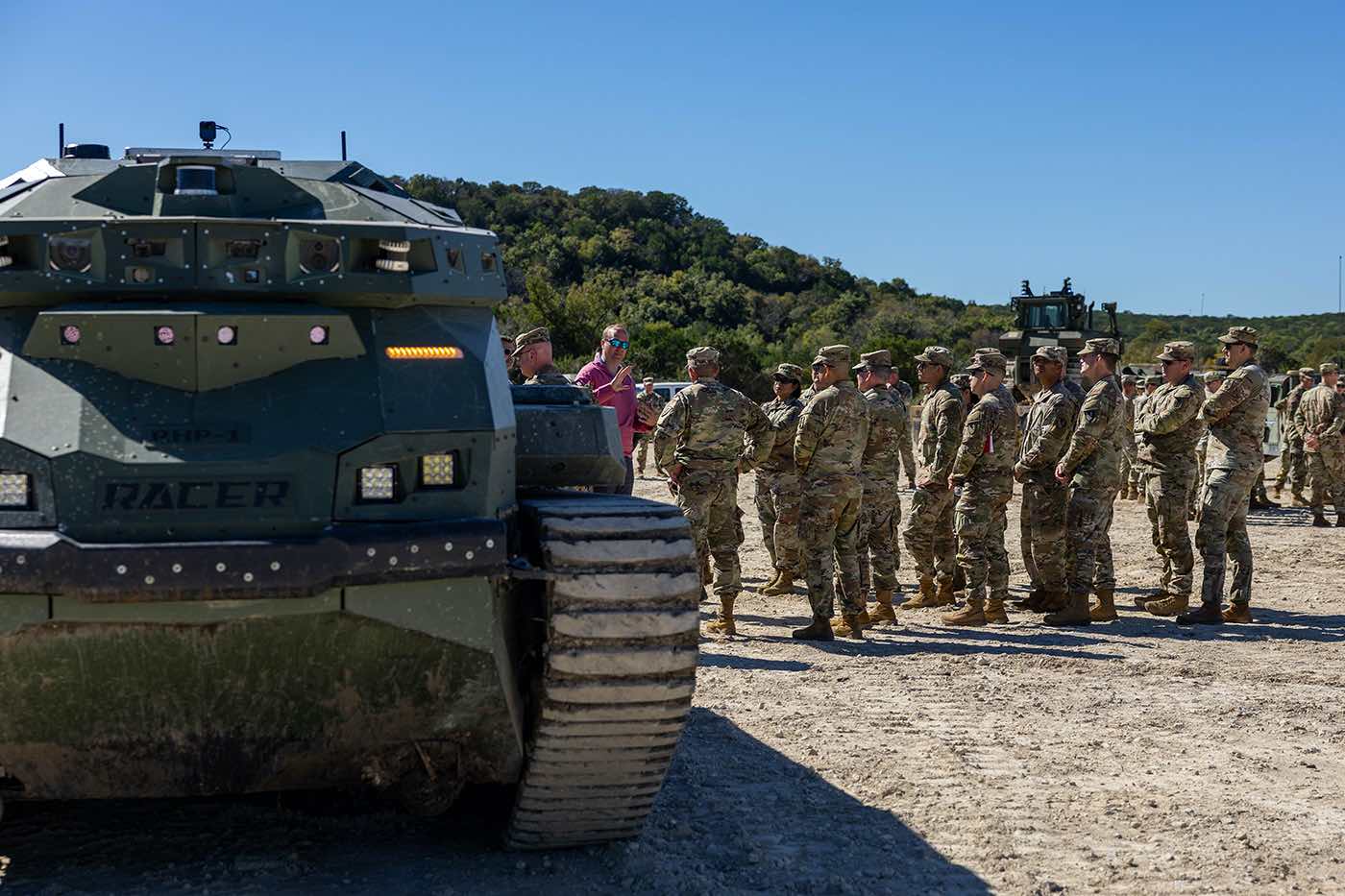
DARPA says its Robotic Autonomy in Complex Environments with Resiliency (RACER) program is nearing completion after a series of Army and Marine Corps experiments that pushed off-road ground autonomy into operational test environments. The agency now sees RACER’s software stack as ready for transition into Department of Defense programs and commercial use, positioning it as a successor of sorts to the famous 2004–2005 Grand Challenge almost 20 years on.
Launched in 2021, RACER was designed from the outset as an autonomy stack rather than a single vehicle program. The core deliverable is a collection of algorithms, datasets and neural network models that can be ported onto multiple ground platforms equipped with appropriate sensors. According to DARPA, that software now allows vehicles to navigate complex off-road terrain at mission-relevant speeds, without GPS or pre-mapped routes.
“RACER isn’t just about replicating existing military capabilities. It’s about fundamentally reimagining how missions are executed,” said RACER program manager Stuart Young in the agency’s announcement.
Breaching and reconnaissance without a driver
In October 2025, RACER moved into a combat engineering scenario with the U.S. Army’s III Armored Corps 36th Engineer Brigade during a machine-assisted breaching demonstration at Fort Hood, Texas. As part of the Machine Assisted Rugged Soldier effort, the Army used the RACER Heavy Platform, a robotic system built by Carnegie Robotics on a Textron M5 chassis, and paired it with an M58 Mine Clearing Line Charge (MICLIC) to autonomously clear a lane through a minefield.
DARPA highlighted that demonstration as an example of how heavy uncrewed platforms could take on some of the most dangerous tasks in combined-arms maneuver—lane breaching under fire—while keeping soldiers farther from the point of contact.
A month later, in November 2025, soldiers from the 11th Armored Cavalry Regiment used RACER-equipped “RACER Fleet Vehicles” based on Polaris RZR platforms as an opposition force during a live force-on-force rotation at the National Training Center, Fort Irwin, California. The vehicles carried integrated ISR payloads and were tasked with autonomous long-range reconnaissance, a mission profile that would traditionally be assigned to manned scout teams.
“By decreasing reliance on GPS and pre-programmed paths, RACER ensures warfighters can deploy autonomous assets in any environment, even when operating off the grid,” Young said. “Instead of human scouts going 12 or 15 kilometers into enemy territory, that dangerous work can be handled by a robot while humans are safe.”
Sgt. First Class Gavin Ros of the 11th ACR said the system “is working very well for what we need it to,” adding that he is interested to see where software and system improvements take the capability next.
Perception architecture and rapid retraining
DARPA calls RACER’s perception architecture the program’s most significant technical accomplishment. Rather than relying on detailed pre-mapped routes, the software learns how to interpret terrain and anticipate what lies over the next hill in a way DARPA likens to a human driver’s prior experience on a country road. When cues indicate that conditions are unusual—like an awkwardly parked vehicle or warning cones—the system shifts to a more cautious behavior, adjusting speed and path based on uncertainty.
Earlier generations of autonomous ground vehicles often required weeks of retraining when moved to a new environment. According to Young, RACER’s architecture can adapt a new model in roughly a day, which DARPA argues is critical if units are going to deploy robotic assets quickly into unfamiliar terrain. That adaptive behavior was exercised during RACER’s eighth and final experiment at the National Training Center.
Transition targets and commercial spinouts
With military testing largely complete, DARPA is positioning RACER for transition both into DoD programs of record and into the private sector. The agency notes that multiple companies emerged from RACER-funded research, including Field AI, which traces back to NASA Jet Propulsion Laboratory work, and Overland AI, founded out of the University of Washington’s Robot Learning Laboratory.
DARPA sees RACER’s autonomy stack as dual-use technology applicable to commercial sectors such as agriculture, construction, mining and off-road logistics, where fleets face many of the same perception and navigation challenges as military vehicles operating on unimproved terrain.
“Now that the RACER program is ending, there is a lot of commercial opportunity for private equity,” Young said. “It’s time for both military users and private investors to recognize the transformative potential of RACER and embrace a future where autonomous systems are not just a possibility, but a reliable and integral part of our world.”
For uncrewed systems developers and integrators, RACER’s conclusion marks the handoff from a DARPA-run experimentation campaign to a broader ecosystem of Army, Marine Corps and industry partners who will decide where rugged, GPS-independent ground autonomy fits into future concepts—from combat breaching and reconnaissance to logistics and civil-support missions.