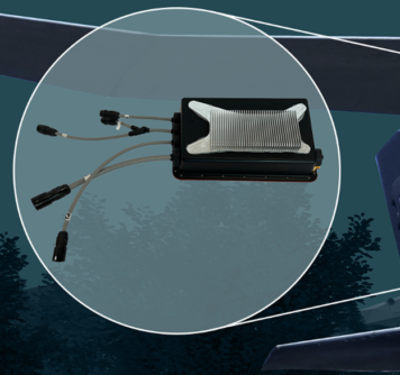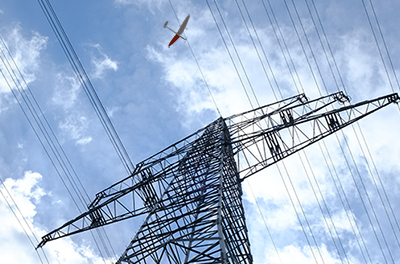

Washington is finally beginning to absorb a hard lesson: the United States cannot afford to lose robotics and autonomous systems the way it allowed the commercial drone market to drift for years toward strategic dependence on the PRC. That lesson is now starting to drive real action—stronger legislation, more serious procurement frameworks, and a clearer national conversation about trusted systems, industrial scale, and supply chain security.
But domestic policy alone will not be enough.
The next frontier for trusted autonomy will require trusted international partnerships. And two recent developments, one in Taipei and one in Washington, make clear that the work is underway.
TAIWAN: MANUFACTURING DEPTH AND DEMOCRATIC ALIGNMENT
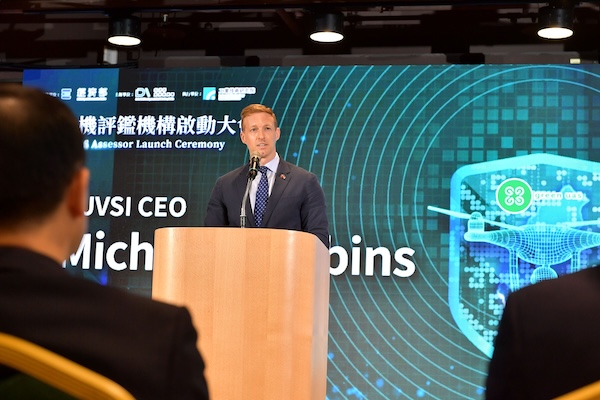
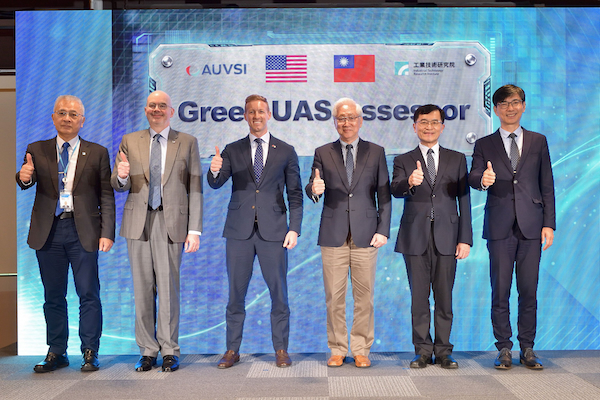
In early June, I traveled to Taiwan as part of a delegation for the 2026 National Strategic Summit on Supply Chain Resilience hosted by the Research Institute for Democracy, Society and Emerging Technology (DSET). Over the course of the week, I met with senior government officials, joined a public panel on AI supply chain resilience alongside colleagues from Boston Dynamics, SCSP, and a16z, and marked a significant milestone with our partners at ITRI: their designation as the first Green UAS assessment body outside the United States.
That is a significant development. Taiwan’s drone manufacturers now have a practical pathway to internationally recognized cybersecurity and supply chain verification locally in Taiwan. This saves time and reduces friction. It extends the trusted democratic supply chain into an ecosystem with real manufacturing depth and the technical sophistication to help democratic nations compete.
Taiwan’s strengths in semiconductors, precision machinery, aerospace manufacturing, and optical sensing make it one of the most capable places in the world to produce trusted autonomous systems and components at scale. The leaders I met there understand that clearly. They are thinking seriously about how to turn that industrial base into a globally competitive autonomy ecosystem, and they want to build it with partners who share democratic values.

KOREA: FORMALIZING THE FRAMEWORK
Back in Washington, AUVSI signed a Memorandum of Understanding with the Korea Trade-Investment Promotion Agency, KOTRA, in conjunction with the Korea-U.S. Defense Industry Cooperation Forum. The agreement creates a framework for deeper cooperation between U.S. and Korean industry, including increased awareness of U.S. market requirements, information exchange on uncrewed systems technologies and certification pathways, and joint industry engagement activities.
Korea, like Taiwan, brings serious industrial capacity and a genuine commitment to trusted autonomous systems. Its strengths are complementary to ours. The United States brings innovation, software, systems integration, and policy momentum. Our Indo-Pacific partners bring manufacturing depth, hardware capability, and scale potential. Together, we are stronger for it.
THE STAKES
AUVSI has argued for years that industrial capacity is national power. In the era of autonomy and physical AI, trusted industrial capacity matters even more. The next phase of competition will not be defined only by who develops the best software or invents the best technology. It will be defined by who can build, integrate, manufacture, and deploy trusted systems at scale, with partners who share democratic values and strategic interests.
The domestic policy environment is improving as AUVSI’s advocacy efforts are positively impacting the narrative and generating positive outcomes. But the U.S. can’t do it alone. We are stronger when working with our allies and partners to counter authoritarian-scale. These trusted alternatives to adversary-controlled systems do not emerge by accident. They require sustained partnerships, aligned frameworks, and deliberate investment in the international relationships that make scale possible.
Taiwan and Korea are two of those partners. The work AUVSI is doing with ITRI and KOTRA is part of a broader effort to ensure that the trusted autonomy ecosystem gets built, on purpose and with the right allies.
The window to get this right is not unlimited. The decisions being made now, in Washington and in democratic capitals across the globe, will shape whether trusted autonomy is built at scale by nations that share our interests and values — or whether the market is once again distorted by authoritarian scale and state-backed leverage.
That is the strategic challenge in front of us. It is also a major opportunity, if democratic nations choose to build together.