
A new FAA-sponsored report has documented how AURA Network Systems’ aviation-grade voice-relay architecture performed in beyond visual line of sight (BVLOS) operations, with latency and clarity metrics aligned to RTCA DO-377B standards for command-and-control (C2) links.
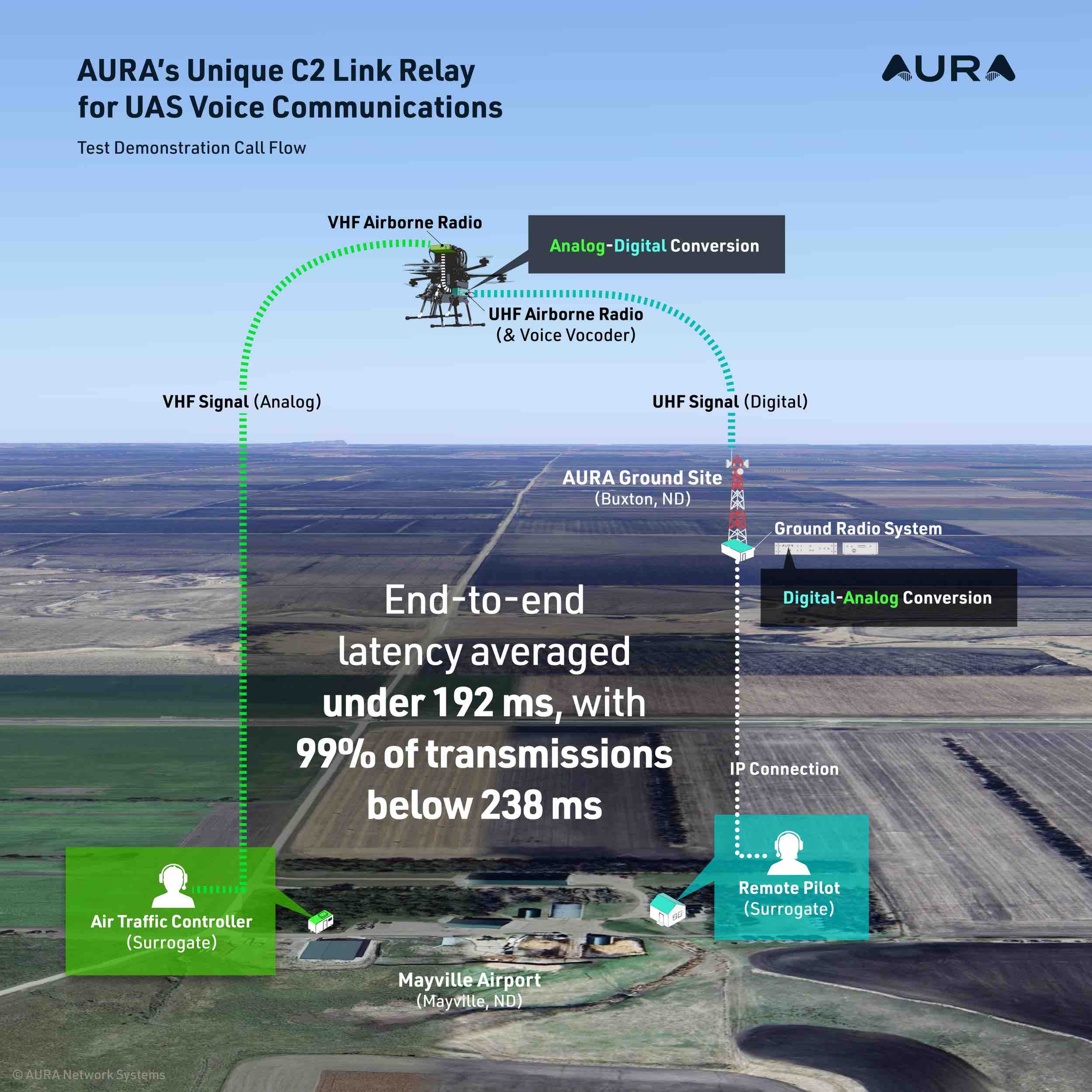
The report, authored by AURA under the FAA’s Broad Agency Announcement (BAA) program, details flight tests conducted with the Northern Plains UAS Test Site (NPUASTS) in North Dakota to validate remote pilot–air traffic controller (ATC) voice communications over an aviation-dedicated network.
Hybrid voice relay for BVLOS
The testing focused on AURA’s hybrid voice-relay architecture, which connects remote pilots to ATC using both a UHF command-and-control link and legacy VHF systems. The goal was to show that an uncrewed aircraft operator can maintain the same kind of clear, low-latency voice exchanges with ATC that crewed aviation already depends on—an essential prerequisite for routine BVLOS approvals.
AURA’s network is built on exclusive, licensed spectrum reserved for aviation and is designed specifically for crewed and uncrewed operations. In these trials, the system converted analog voice to digital and back again while remaining within the latency and intelligibility thresholds defined in RTCA DO-377B, the updated standard for C2 link systems that was published in December 2023.
Kevin Steen, AURA’s CEO, said the results demonstrate that the company has delivered “a reliable, aviation-grade voice link” capable of supporting safe, confident operations for remote pilots and air traffic controllers.
Test campaign and key performance metrics
The FAA-funded flight tests took place near Mayville and Buxton, North Dakota, using surrogate pilots and controllers operating through AURA’s airborne and ground radios. An independent team from the University of North Dakota Aerospace evaluated voice quality.
According to the report:
- Latency averaged under 192 milliseconds, with 99% of transmissions below 238 ms—well within FAA-relevant thresholds for real-time voice exchanges.
- Voice clarity was validated for both male and female voice samples across all test scenarios.
- The architecture maintained secure, low-latency communications over licensed aviation spectrum, supporting remote pilot situational awareness in representative BVLOS environments.
To measure intelligibility, AURA and NPUASTS used Perceptual Objective Listening Quality Analysis (POLQA), a widely used standard for evaluating speech transmission across telecommunications and critical communications networks. POLQA scoring in the campaign met or exceeded FAA benchmarks under all tested conditions, with intelligible audio maintained across scenarios.
Trevor Woods, executive director of NPUASTS, noted that clear, reliable voice remains critical for BVLOS flight and said the tests show that AURA’s system delivers on that requirement while advancing technologies needed for safe integration of uncrewed aircraft into the National Airspace System.
Supporting BVLOS integration and regulatory paths
Voice communications between remote pilots and ATC are a recurring focus in FAA BVLOS integration efforts and recent standards work. While many BVLOS demonstrations have emphasized detect-and-avoid and C2 data links, regulators continue to point to crew-like voice communications as a key element in scaling routine operations in controlled airspace.
By documenting performance against RTCA DO-377B and using standardized voice-quality assessment methods, the AURA/NPUASTS report provides additional evidence that dedicated aviation networks can support those communications within recognized thresholds. For operators and manufacturers pursuing waivers or future rule-based operations, such data can help address FAA concerns about latency, clarity, and reliability during abnormal or contingency scenarios.
The testing was conducted under the FAA’s BAA program, which sponsors research, flight trials, and technology evaluations to close remaining gaps in UAS integration. NPUASTS, one of the FAA’s designated UAS test sites, continues to play a central role in that work, partnering with industry and academia to validate operational concepts, procedures, and infrastructure.
AURA and NPUASTS have released a short video highlighting the flight tests and technical validation work, including real-world voice-relay demonstrations and commentary from program leaders.
AURA positions its private aviation network—spanning command-and-control services, spectrum management, and supporting infrastructure—as a foundation for the commercial viability of emerging BVLOS applications, while NPUASTS continues to focus on research, commercialization, and policy development for autonomous systems across the National Airspace System.