
Surveyor to receive JAGM launcher in 2026 live-fire demo; larger unmanned vessels planned for Mk 70 VLS and other payloads.
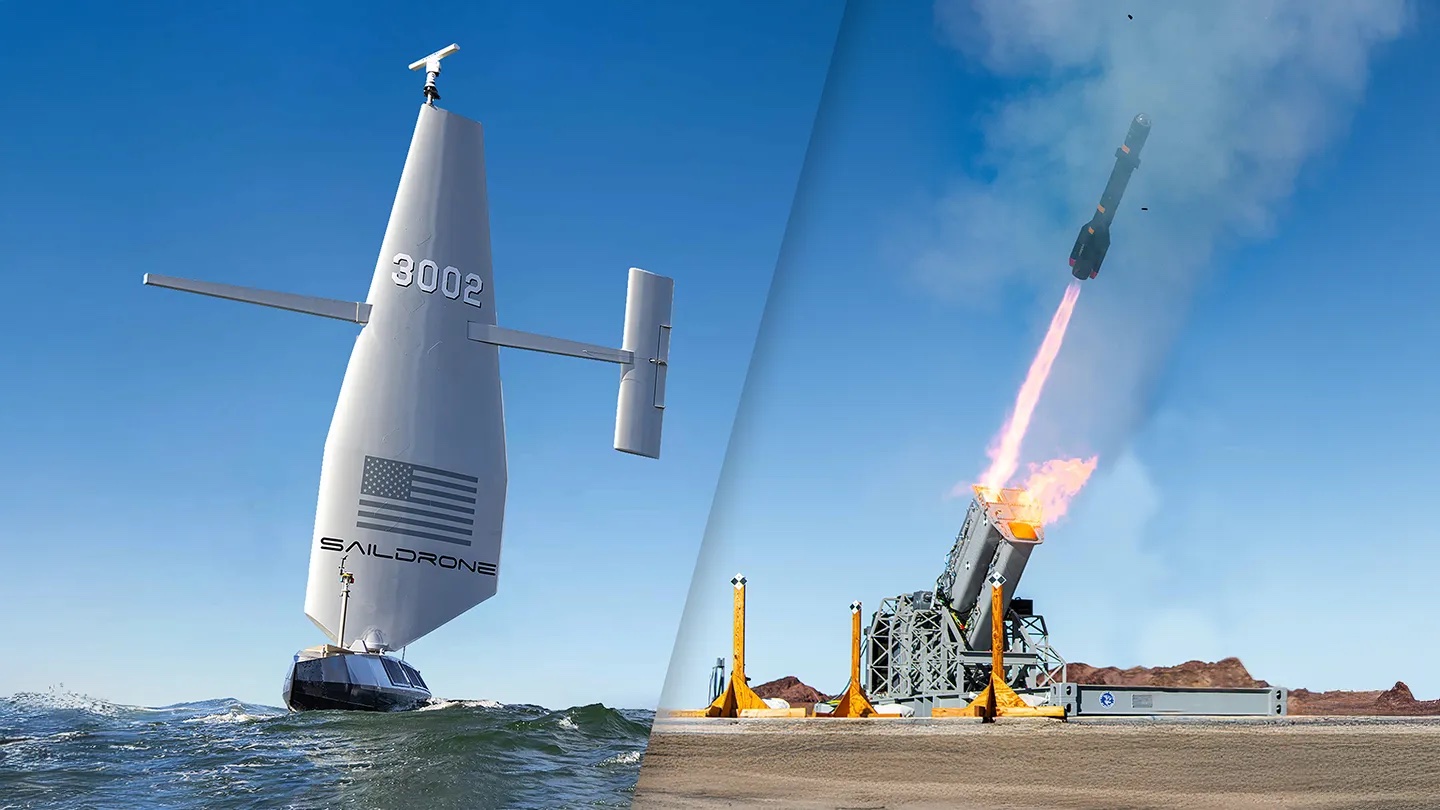
Saildrone and Lockheed Martin are moving to arm long-endurance unmanned surface vehicles (USVs), announcing a partnership to integrate “combat-tested, mission-ready” payloads on Saildrone platforms in line with the U.S. Navy’s drive toward a hybrid manned–unmanned fleet.
Under the agreement, the companies will begin by equipping the 20-meter Saildrone Surveyor with Lockheed Martin’s Joint Air-to-Ground Missile (JAGM) launcher, with proof-of-concept integrations and a live-fire demonstration slated for summer 2026. Saildrone also disclosed that larger USV designs are in development to carry a broader range of Lockheed Martin payloads, including the Mk 70 vertical launch system (VLS) launcher.
Lockheed Martin has committed a $50 million investment in Saildrone as part of the effort, which is intended to accelerate fielding of lethal capabilities on unmanned platforms at what the companies describe as “the pace and scale the Navy demands.”
Turning ISR workhorses into armed USVs
Surveyor is Saildrone’s high-endurance, extreme-range USV, designed to operate autonomously for months at a time anywhere in the world with minimal human intervention. The platform is already used for persistent maritime intelligence, surveillance and reconnaissance (ISR) and deep-ocean mapping.
Equipped with sensors, radars and communications systems, Surveyor is designed to detect, track and classify vessels and relay near-real-time information into a common operating picture for operators. The new partnership layers offensive and defensive payloads on top of that ISR role.
According to the companies, integration work will not stop at the JAGM launcher. Lockheed Martin’s investment will support broader command-and-control enhancements to enable Saildrone USVs to contribute to fleet defense, signals intelligence, reconnaissance and strike missions. Larger USV variants capable of hosting systems such as the Mk 70 VLS launcher are being developed to expand the range of weapons and effectors that can be deployed from unmanned platforms.
Enabling distributed and hybrid fleet concepts
Senior Navy leaders have repeatedly described the future fleet as a mix of traditional manned warships and a variety of unmanned surface, subsurface and aerial vehicles, all networked to support distributed maritime operations. The Saildrone–Lockheed Martin collaboration fits squarely into that vision, leveraging a commercially proven USV hull form and pairing it with legacy and emerging Navy payloads.
By using unmanned platforms for persistent ISR and, increasingly, for strike and fleet defense roles, the Navy aims to increase maritime domain awareness while spreading risk and cost across a more distributed force. Arming USVs such as Surveyor, and developing larger hulls with VLS capacity, would give operational commanders more options for stand-off engagement, magazine depth and sensor–shooter pairing at the edge.
The companies position their approach as a combination of “best-in-class commercial and defense technologies,” with Saildrone bringing high-endurance autonomy and Lockheed Martin providing existing combat-proven launchers and weapon systems.
Operational pedigree in contested and domestic missions
Saildrone points to an operational track record to support the move into more heavily militarized roles. First deployed by the U.S. Navy in 2021, Saildrone USVs have been used in missions with the Navy and Coast Guard across a wide theater, including the Middle East, Caribbean, Gulf of Mexico, Atlantic and Pacific.
The company notes that its platforms are designed for the harshest open-ocean environments and are ABS-classed, manufactured in the United States and built for long-duration autonomous operations. In support of domestic security, Saildrone USVs have participated in operations such as Windward Stack and Southern Spear, contributing to U.S. southern border security by detecting, tracking and relaying coordinates of boats allegedly smuggling illicit contraband.
Over the past year, Saildrone reports more than 10,000 cumulative days at sea across its fleet, covering over 380,000 nautical miles and detecting more than 2.3 million unique vessels. Those metrics underscore the core ISR value proposition that the Navy is now looking to fuse with kinetic payloads.
Next steps in 2026 and beyond
The near-term milestone for the partnership is the 2026 proof-of-concept series and live-fire demonstration with the JAGM launcher installed on the 20-meter Surveyor. That event will provide an early indicator of how quickly armed USVs can be pushed from prototype integration toward operational experimentation within carrier strike groups, surface action groups or regional task forces.
In parallel, work on larger Saildrone USVs and additional Lockheed Martin payloads, including vertical launch capability, will shape what the next generation of unmanned combatants might look like in a fully hybrid fleet.