
German officials on Tuesday formally attributed a drone attack targeting a Ukrainian cargo aircraft at Leipzig/Halle Airport last month to Russia, and announced a package of diplomatic and security countermeasures in response.
Interior Minister Alexander Dobrindt told reporters in Berlin that after reviewing the drone’s technical construction and other intelligence, the government has concluded Russia is responsible for the attack. He said the operation was carried out by low-level agents and that the drone’s components, explosives, and ignition system matched patterns seen in other Russian hybrid operations tied to the war in Ukraine. Dobrindt added that authorities do not view the incident in isolation, but as part of a broader pattern of hybrid activity, and raised Germany’s national threat assessment from “general” to “high.”
What happened at Leipzig
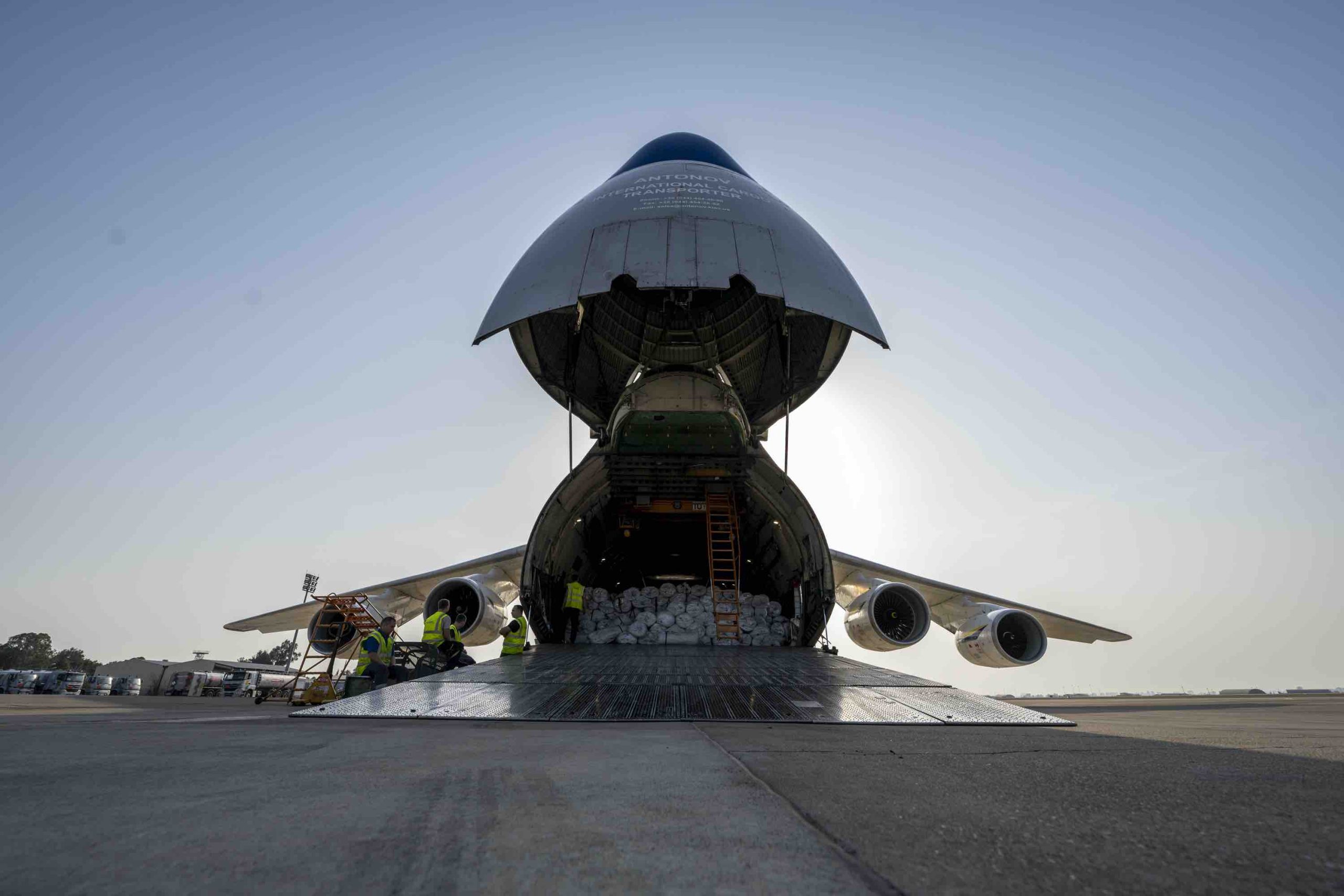
An explosive-laden drone was discovered on the secure cargo apron at Leipzig/Halle Airport overnight on Aug. 4-5, near a Ukrainian Antonov An-124 heavy-lift cargo plane. The site is the base for Antonov Logistics SALIS, the sole maintenance provider for the An-124-100 since Russia’s 2022 invasion and a near-daily conduit for equipment shipments to NATO forces along the alliance’s eastern flank. A bomb disposal robot removed the device’s detonator, which investigators believe malfunctioned before it could explode; the payload was later identified as Semtex packed inside a sealed food tin. German federal prosecutors, who handle major national-security cases, took over the investigation and described it as a serious attack on the country’s transportation and logistics infrastructure.
A later investigation by German broadcasters NDR and WDR and the newspaper Süddeutsche Zeitung found the operation was larger than first disclosed. Investigators now believe three separate drones were involved: one found on the airport grounds, a second that may have collided with a DHL cargo aircraft, and a third recovered Aug. 14 in a field near Kabelsketal carrying roughly 50 grams of the military explosive RDX. Technical equipment believed to have been used to control the drones, including an antenna taped to a tree, was also recovered nearby. A U.S. defense official separately told ABC News the explosives and device structure were consistent with equipment typically used by Russia’s military intelligence agency, the GRU.
Berlin’s response
Foreign Minister Johann Wadephul said Germany will summon Russia’s ambassador in Berlin, close the Russian consulate in Bonn, and cancel the contract for the Russian House cultural center in Berlin. He said the government is tightening entry controls for Russian nationals and will propose additional individuals for listing under European Union sanctions. Chancellor Friedrich Merz said Germany has “increasingly become a target for hybrid attackers.” The Kremlin has dismissed the attribution as a manufactured pretext and said it would respond to any German countermeasures. Moscow has denied involvement in the airspace and infrastructure incidents reported across Europe this year.
European Commission President Ursula von der Leyen said the bloc stands in full solidarity with Germany, and said EU foreign ministers are expected to announce a broader response, including additional sanctions, later this week. NATO said it would defend its members, and officials in the UK, Estonia, and Poland offered support.
A widening counter-drone buildup
The Leipzig incident follows a year of escalating drone activity over European airports and military sites that has already reshaped German policy. In October 2025, the German cabinet approved legislation authorizing federal police to down drones violating national airspace using kinetic measures, lasers, or jamming, after a wave of sightings forced the closure of Munich Airport. In February 2026, the Bundestag went further, amending the Air Security Act to let the Bundeswehr intercept, jam, or shoot down drones over German territory when civilian authorities request assistance, and giving the defense ministry authority to act independently in acute cases.
Germany has committed more than 100 million euros to counter-drone systems for 2025 and 2026, including jammers, sensors, and upgraded airport radar, alongside a separate 490 million euro program with MBDA Deutschland for short-range anti-drone missiles expected to enter production by 2029. According to data from air-traffic control provider Deutsche Flugsicherung, Germany recorded 172 drone-related disruptions to air traffic between January and September 2025, up from 129 over the same period the previous year.