
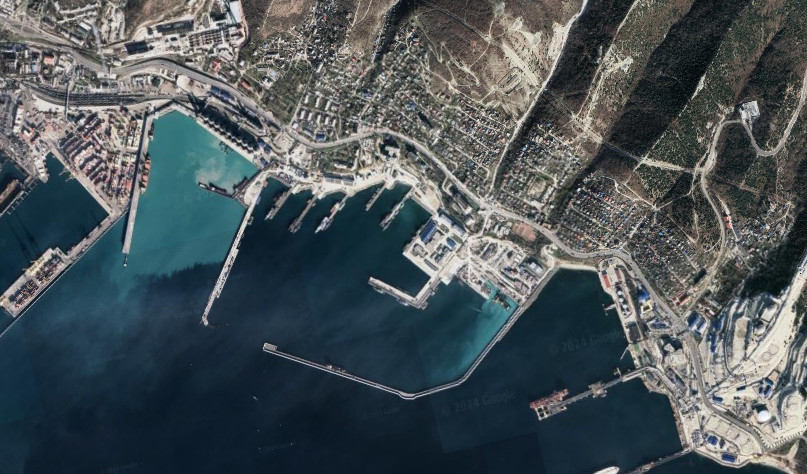
This Monday morning, Ukraine’s SBU security service announced it had carried out an attack with a “Sub Sea Baby” unmanned underwater vehicle (UUV) that damaged a Russian Improved Kilo-class diesel-electric attack submarine with land-attack capability. A video from Novorossiysk shows a huge blast seemingly in proximity to the berthed submarine.
The aftermath of the attack is not visible behind the smoke cloud. The SBU claims “critical damage” was inflicted upon the targeted submarine making it “effectively put out of action”, while Russia claims no vessels were damaged at all.
H.I. Sutton a published expert on submarine and UUV warfare said in a video commentary “It’s almost certain that that submarine is unserviceable,” noting the rear section housing the propulsion was seemingly hit likely causing a mobility casualty necessitating extensive repairs.
He added that Russia’s Navy was evidently completely surprised by the attack due to the open harbor entrances and lack of observable defensive activities; and that the open harbor doors themselves would have required some fine maneuvers for a UUV to circumnavigate.
A Ukrainian government statement asserts the UUV attack is the first ever use of the Sub Sea Baby, and was conducted jointly by Ukraine’s Navy and the 13th Directorate of the SBU. In fact this may mark the first ever combat use of an attack UUV, though operational use of mine-countermeasure UUVs dates back to at least the 2003 invasion of Iraq.
While Ukraine has famously made extensive use of USVs in the Black Sea, the attack this December appears to be first publicly known operation by a Ukrainian underwater drone or UUV.
Russia belatedly improved harbor defenses, moved most berthing of operational warships hundreds of miles east of Ukrainian soil, and deployed more counter-USV patrols. A submersible UUV has better odds of escaping detection both in transit and during the attack phase, and may even be able to dive under certain anti-USV defensive obstacles.
Of course developing a stealthy underwater vehicle controllable over long distances poses major technical challenges, and the specifics of its communication/navigation/control system architecture remain an intriguing mystery.
Ukraine has advertised development of multiple attack UUVs since 2022, including the 6 meter-long Marichka by AMMO non-profit, and the Toloka family of UUVs by Brave1 as detailed in our 2023 report on the Black Sea drone war. Ukraine also received UUVs from foreign military aid generally for mine-countermeasure purposes.
Russia’s drone-beleaguered Black Sea submarine force
Russia began the war with four Project 636.3 Improved Kilo submarines in the Black Sea, also known as Varshavyankas, a heavily modernized variant of the Cold War attack submarine featuring improved acoustic stealth and land attack capability through Kalibr (SSN-30A) cruise missiles which have been employed for strikes in Syria and Ukraine. Technically, there’s also an older-model Project 877V Kilo-submarine, Alrosa, berthed at Novorossiysk for testing purposes.
However, the Black Sea Kilo Rostov-on-Don was badly damaged by a Storm Shadow cruise missile in 2023 while in drydock in Sevastopol, then attacked again and finished off in August 2024 by an additional Ukrainian drone/missile attack.
The submarine likely damaged in Novorossiysk may only be reparable at this same demonstrably vulnerable facility in Sevastopol, Sutton noted in his video. Russia cannot replace submarine losses in the Black Sea because the Treaty of Montreux prevents passage of military ships engaged in hostilities through the Bosporus Strait controlled by Turkey.
Despite lacking any large operational warships, Ukraine has successfully employed USVs and cruise missiles to harry Russia’s Black Sea Fleet, damaging or destroying vessels both berthed and at sea, compelling the fleet’s withdrawal from to Sevastopol to Novorossiysk, Russia 200 miles to the east.
Ukraine primarily uses two USV families, the agile Magura V5 multi-purpose USV developed by Ukraine’s HUR intelligence service, and the SBU-developed Sea Baby built for heavy kamikaze payloads. Starting in December 2024, a new Magura V7 anti-aircraft USV armed with short-range R-73 anti-aircraft missiles, shot down Russian helicopters and one or two Su-30 jet fighters.
Whether or not Ukraine’s UUV attack on Novorossiysk inflicted substantial damage, it will impose additional burdens on the Black Sea Fleet as Russia’s Navy can no longer treat UUVs as future hypothetical. Likely the service will deploy a host of new anti-submarine defenses and patrols despite the unknown magnitude of Ukraine’s UUV capabilities. The costs and inefficiencies imposed of the defensive response—even though arguably merited—may outweigh the disabling of ‘just’ one submarine.
Russia’s new defensive predicament is one navies beyond the Black Sea should take seriously. Australia, China, Japan, Russia, Taiwan and the U.S. (among others) all are moving toward introducing combat-capable UUV designs into operational service for roles ranging from anti-ship and counter-UUV missions armed with mini-torpedoes to laying smart mines and even delivering coastal-attack nuclear weapons.