
The Defense Innovation Unit (DIU), working with a cross-service team led by U.S. Northern Command (USNORTHCOM) and Joint Interagency Task Force 401 (JIATF-401), has named MatrixSpace Inc. the overall winner of its Counter-small Unmanned Aircraft System (C-sUAS) Low-Cost Sensing (LCS) challenge.
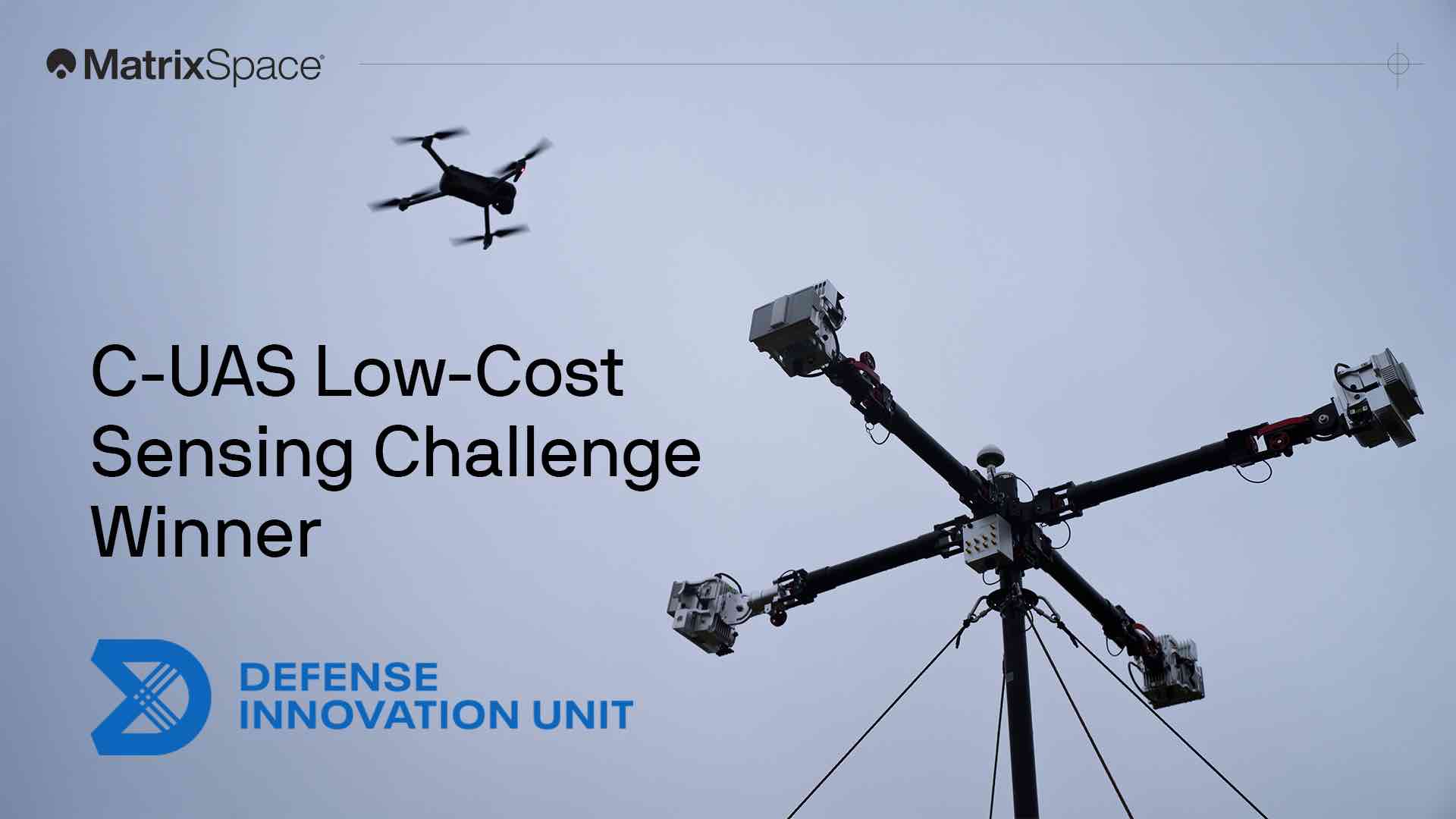
The competition, launched in May 2025, is intended to push affordable sensing deeper into the C-UAS stack, complementing higher-end radar and ISR systems with scalable, distributed detection layers that can be fielded widely across fixed sites and deployed formations.
MatrixSpace will receive a top award of $500,000. Three other companies—Guardian RF, Hidden Level, Inc., and Teledyne FLIR Defense—were named top performers and will each receive $100,000.
The effort is being run by DIU in close collaboration with USNORTHCOM, JIATF-401, the U.S. Army, U.S. Navy, U.S. Marine Corps and U.S. Indo-Pacific Command.
“Small UAS threats are evolving faster than traditional acquisition cycles, and meeting that challenge requires capabilities that can be deployed at speed and scale,” said David Payne, acting director of DIU’s Autonomy Portfolio. “The selected solutions show how commercial innovation can strengthen our layered defense – delivering affordable sensing that we can field widely, adapt quickly, and keep the warfighter ahead of the threat.”
From 115 Submissions to Live-Flight Finalists
The LCS challenge drew 115 submissions from traditional and nontraditional vendors across the country. Ten finalists were selected for live testing during USNORTHCOM’s Falcon Peak 25.2 exercise, where their systems were run against a variety of small UAS targets.
Those trials included individual and coordinated flights using diverse communications protocols. Vendors were not told in advance which platforms or flight profiles they would face, a deliberate move by organizers to push the systems into “realistic, un-scripted, and operationally relevant conditions.”
The government team evaluated performance across several dimensions: detection, classification and localization of targets; ability to scale; cost; and integration readiness. Officials said the challenge winners distinguished themselves not only on technical metrics, but also on whether a given architecture could be deployed at scale across “fixed, mobile, and austere environments.”
Distributed Sensing, Lower Cost
The technical brief for LCS emphasizes a layered approach. Rather than trying to replace high-end sensor systems, the challenge looked for technologies that could extend coverage and resilience by adding low-cost sensing nodes at the edge.
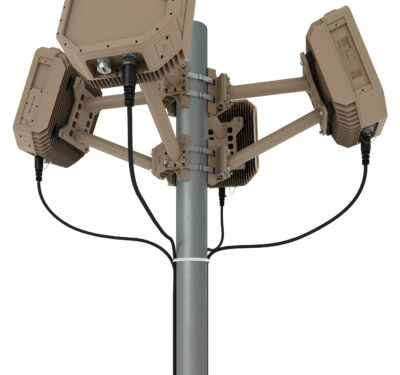
Finalist solutions spanned multiple modalities, including RF passive detection, active radar, acoustic sensing, optical and infrared systems, and hybrid combinations of those approaches. According to DIU, the ten finalists collectively showed potential total cost of ownership reductions on the order of 50–80 percent while still meeting key coverage and performance requirements for C-sUAS defense.
The overarching goals, as described in the program documentation, were to:
- expand detection coverage,
- reduce total lifecycle cost,
- integrate seamlessly into joint C2 architectures, and
- provide resilience and redundancy against small UAS threats.
From Challenge to Transition
The four named winners will share an $800,000 prize pool and, more importantly, are now eligible for follow-on acquisition pathways.
As with other DIU efforts, the organization is signaling a move from “demo” to “deployment” via flexible contracting. The announcement highlights potential Other Transaction (OT) agreements and other contract types designed to “expedite direct transition into operational use.”
That transition imperative is aligned with JIATF-401’s mission, which is focused on accelerating C-UAS capability into the hands of operators.
“JIATF 401 [Joint Interagency Task Force 401] has one measure of effectiveness: quickly deliver state-of-the-art C-UAS capability to the warfighter at home and abroad,” said Brig. Gen. Matt Ross. “Our partnership with DIU contributes to warfighter lethality and homeland defense.”
Falcon Peak and the Layered Defense
The Falcon Peak 25.2 exercise provided the operational backdrop for the LCS live trials. USNORTHCOM has used Falcon Peak to test and refine elements of a layered homeland air and missile defense architecture, with JIATF-401 and other partners folding C-sUAS into that picture.
In that context, the Low-Cost Sensing challenge is one piece of a broader strategic push: using commercial innovation and rapid acquisition tools to build denser, more resilient sensor networks against small UAS, without driving cost curves in the wrong direction.
For MatrixSpace, Guardian RF, Hidden Level and Teledyne FLIR Defense, the next phase will be turning challenge performance into fielded capability—plugged into joint C2 architectures and validated under the same kind of operational conditions that defined the Falcon Peak trials.