
Leading-Edge Mesh Radio Companies are Marketing For the Future.
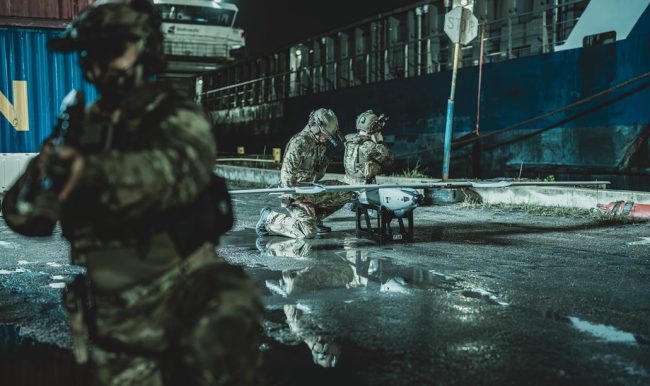
Radios and their underlying comms systems have been near-invisible enablers, guiding UAS toward successful missions. But they’re now operating within increasingly contested environments, where kill zones, drone swarms and attritability raise the ante on how Mesh and MANET (mobile ad hoc network) ecosystems can support operators with reliable algorithms, waveforms and equipment, maintaining control, preserving data flow, and protecting platforms and pilots alike.
“There’s kind of a realization that comms is the absolute key to successful unmanned systems and electronic warfare,” said April Kom, senior product manager, uncrewed systems solutions at TrellisWare Technologies.
Morphing battlescapes are generating specific demands for speed to market and scale alongside product resilience and on-the-fly adaptability. “The push in the industry around rapid scaling and rapid innovation is a thing we are certainly spending a lot of time thinking about,” said Chike Farrell, vice president marketing at Doodle Labs. “Because when the OEMs get pushed it means that their partners and their supply chain need to push with them.”
Traditionally high-end operator Silvus Technologies also is paying attention to this more commodified market. “We’re definitely seeing a strong customer signal or demand for lower costs, lower capability, more attritable solutions,” Director of Strategic Accounts Alex Hinkle said. “We’re working to capture portions of the market where we traditionally have not been.”
TrellisWare, Doodle and Silvus are among leading multiuse wireless network companies meeting these UAS market needs from different yet perhaps converging perspectives.

Lessons from Ukraine
“We are recognizing that in a near-peer environment the luxury of operating uncontested in the spectrum is of the past,” Silvus’ Hinkle said. “It’s a game of numbers and volume, and if you can have a disproportionate amount of impact by a lower cost, that’s an asymmetric benefit on the battlefield.
“The idea is to give our end users the highest likelihood of being able to operate their capabilities in those environments,” he continued. “You can’t reasonably expect everybody to be an expert on the radio in the network, so ensure that they are making the right decisions based on the current situation they’re in.”
Hinkle cited Silvus’ development of Spectrum Dominance, layered EW defense software that enhances survivability and can be added to Silvus’ COTS hardware.
Doodle co-CEO Ashish Parikh also recognizes today’s market reality: “People are looking for adaptability, looking for the radios themselves and the networks themselves to just figure everything out.” Customers also want harder-to-detect signals that can’t be traced back to operators and frequency agility in the face of smart jammers.
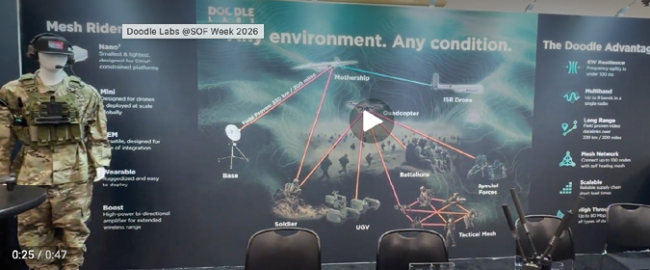
This April, Doodle debuted its Nano2, a 48.3 gram product that grafts the company’s high performance Mesh Rider ecosystem onto a smaller form factor for UAV, FPV, ground and wearable use. It offers MANET networking for self-forming, self-healing links and the new Sense EW automatically jumps between frequencies to avoid smart signal interference.
While Ukraine warfare seems to move at warp speed, Parikh also noted a more deliberative process. “We spend a lot of times iterating, doing field testing. We’ll give early features to some customers to test out for use, and we’re fine if things don’t work out perfectly in those control tests before we release things more broadly.”
Everything, Everywhere All At Once
Programs like American Drone Dominance are pushing high-volume commercialization.
Parikh expanded on their impact. “You’re going to have thousands and thousands of things talking to each other so the cost becomes really relevant. Customers need to be able to see that, ‘Hey, I’m going to be able to get my parts, my components in time and at a price that makes this entire project viable.’ Luckily for us, the requirements that were being requested we could meet at the right price point.”
But customers also want products to be customizable. “People are, ‘Hey, I want the same bit of hardware to operate in five different ways depending on how I’m using it—a drone to a ground user, a swarm of drones to a base,’” Parikh said.
Parikh used an intriguing analogy for how Doodle delivers adaptability: “We think of ourselves as providing Lego blocks and you can put the pieces together. It’s the same underlying radio, the same underlying software, but they’re packaged in different ways. We keep the same architecture but differentiate the offerings based on needs and volumes, and therefore our prices. We’re doing some top-level capability development that will apply across all our products and all our scenarios.
“The second level is very program, use case, customer specific—here’s the exact hardware and here’s the very specific features, like remote monitoring.”
Doodle’s design decisions focuses on using widely available parts and components. As an example, Parikh cited what he called “best in class commercial chipsets.” Qualcomm makes millions of those a year for cell phones and routers, he said, so “there’s no limitation there versus other people who are doing their own custom chip design, things that are very bespoke and expensive.” Doodle, which was fully founded in 2008, can turn out 200,000 radios annually and expects that number to grow.
Since 2000, TrellisWare’s core competencies have involved waveforms and the ground tactical side of comms networks. It has 230,000 fully interoperable radios fielded worldwide. But entering the unmanned space has required reassignments and relentless focus.
“How do we please our customers in this space?” Kom asked rhetorically. “Everything I do is ‘How can I get all our key capabilities into something smaller, lighter, cheaper, into such a challenging supply chain?’”
TrellisWare’s radios were quality leaders, she said. But there was a major issue. “We said, ‘Hey, we were really lagging on size and weight, and we’re kind of top tier expensive, with relatively low transmit power.” A marketing table diagnosed deficiencies. “Well, wait a minute, an unmanned UHF function isn’t that popular, what with noise and interference,” Kom recalled. “If we strip out the noise and crank up the power, we’re losing a feature that this market doesn’t really care about and delivering something that is.” The just-released TW-310 embedded datalink module is being marketed as “enabling long-range ops at a lower cost per unit.” [See the “What Are the Customers Saying” sidebar for more on how TrellisWare developed it.]
Highs and Lows
Both Silvus and TrellisWare described market repositions.
Silvus concentrates on supporting its OEM prime customers. “But as people are starting to sharpen their pencils and figure out where we need to be numbers-wise, that’s kind of forcing us to leverage some of the capabilities that we offer in the higher end,” Hinkle said. “Right, wrong or indifferent, the laws of good, cheap and fast will remain true over time. The market signal was clear for a smaller SWaP and we’re seeing continued growth in that space. I’m always seeking out opportunities and programs where we can be an enabler.”
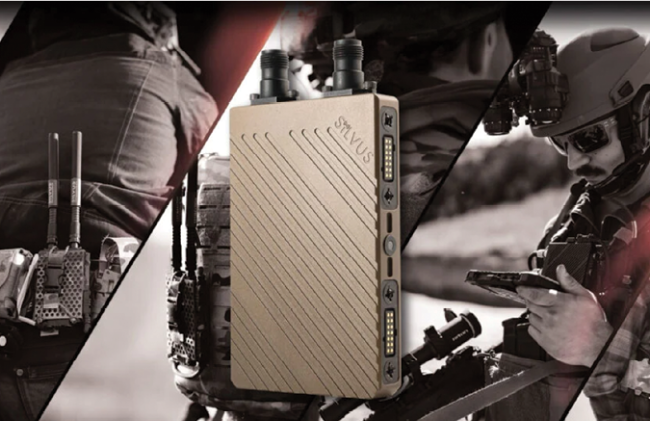
Silvus is pitching its 5000 series of SWaP-optimized Streamcaster MANET radios to that market. With Transmit Eigen Beamforming boosting performance and link range, the 56-gram-with-shields MANET waveform product shares voice, video and data without relying on any fixed infrastructure or cellular towers. “It’s supporting predominantly Group 1,” Hinkle said. “That was in large part was we were seeing the growth specifically in the UAS space. We’re working to understand how you support some of those segments.”
TrellisWare has traditionally succeeded in the defense sector. “They have the more complex technical need and the budget to pay for cutting-edge technology,” Kom said. Now lower-end activity has suggested expansion.
“One key way we succeeded with the U.S. Army was our willingness to port our waveforms onto other software-defined radios. We’ve gone more partner radio type three, relatively lower cost, lower weight, and that was one key to making TSM a program of record waveform.”
Now TrellisWare is taking its technology toward civil and commercial spheres. “You have crazy things like drug runners actually having jamming technology,” Kom said. Trellisware is beta testing the Katana Wideband (WB) frequency-hopping MANET waveform. “It’s extremely anti-jam,” Kom said.
Though Doodle centers on the accessible sector, Parikh reiterated that upmarket producers may need more customized solution. For example, Red Cat’s Black Widow leveraged Doodle Labs’ Helix Mesh Rider configuration for anti-jamming. “They need all frequencies, all the EW algorithms, they need all the mesh, but it’s obviously going to cost higher.”
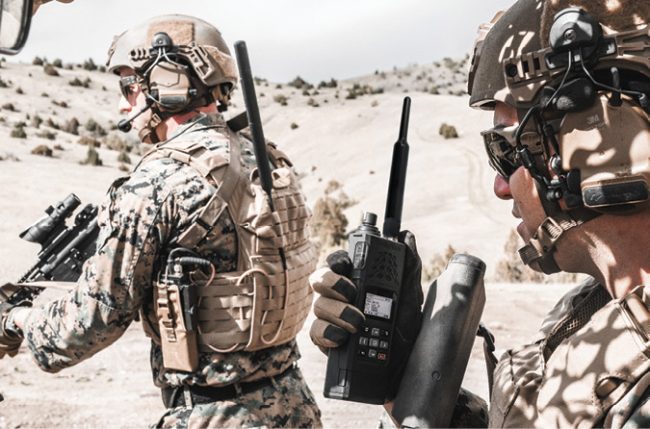
Customer Journeys
Effective customer focus comes before and after the sale.
“Our entire R&D roadmap is based on customer requests, both near-term and long-term,” Parikh said. “We keep adjusting, making sure we’re working on the most impactful things that customers are asking for. Every week we capture all the requests that come in and try and put business cases against them: how many people it’s going to impact, how much impact it’s going to have and how much effort it will be for us to build. Then we make prioritization decisions.”
Parikh cited the company “sales engineering function” as probably its biggest non-technical differentiator.
“The sales engineering team will have an initial intake-qualification meeting, saying, ‘Hey, are we the right fit?’ ‘Can we really help you achieve your goals?’”
A technical evaluation process follows. “It starts with some bench testing; they follow our script. Then let’s move to Step Two, which is longer-range testing with some of these other features. Then Step 3, let’s go out to the field, put them on your drone, try flying with it. And then Step 4, let’s optimize it, let’s turn all the dials to make it operate exactly how you want based on your missions.”
Weekly conversations also explore technical tradeoffs: How our radio can better integrate with your flight controller, and here’s how you might want to pass video through.”
TrellisWare also embraces customer intimacy. “We just give away our labor all the time,” Kom said. “We have an incredible crew of military veterans that are our customer-facing team. You’ve got to make sure that customers in the field are getting everything they need out of their radios, and these guys will just come in and shower love on the engineers.”
An example involves small uncrewed company Titan Dynamics. “They are working on Drone Dominance and we’re absolutely participating like they’re a different department of our company,” Kom explained. “They have engineering units of our next-gen radio that’s not available to ship yet—it’s great for us because we get all this good early feedback, and it never seems to fail that these guys get bigger and bigger and are grateful.”
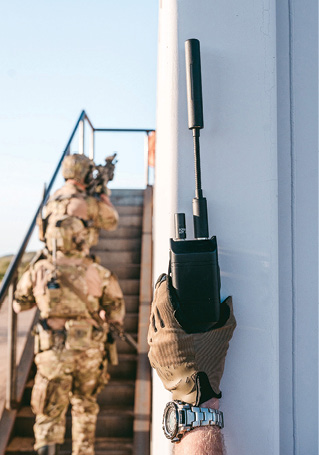
Broader Footprints
Each company has been ramping up to meet increased demand.
Motorola Solutions acquired Silvus to complement its land mobile and video technologies. The $4.4 billon transaction and an impending 165,000 square foot facility in Salt Lake City likely demand expansion to justify them.
Doodle is simultaneously engaged in local and global expansion. Production in L.A.-area factories may grow, and the company just announced an increase in its European focus. “Europe is moving quickly to field autonomous systems at scale and resilient connectivity is becoming one of the core technologies that determines whether those systems can operate effectively in the field,” Parikh said. “We are taking deliberate steps to support European customers with the local responsiveness, technical expertise and trusted supply chain options they require.”
The same growth pattern applies to TrellisWare. “Our international business is tripling our domestic business, even in a world of NDAA and onshoring,” Kom reported. TrellisWare representatives now work closely with the EU’s Ministry of Defense and the company just opened a second office in The Netherlands. Efforts have spread as far as Philippine defense groups.
“Right now,” Silvus’ Hinkle concluded, “the demand in the market is strong. We’re just trying to stay ahead of it, to make sure we’re able to support the demand for the next thing. It’s tools in the toolbox; we’re making the toolbox bigger.”