
The Pentagon’s multi-phase Drone Dominance Gauntlet competition seeking to stimulate development and mass production of low-cost first-person view (FPV) kamikaze drones is expanding to include a very different kind of platform: gravity-bombing drones able to sustainably fly sorties over distances exceeding 9 miles dropping multiple heavy warheads.
The program’s website announced on Monday a new ‘Phase 2.5 Mission C’ Request For Solutions (accessible here) for a “Reusable Bomber/Dropper Platforms”— which will be competed in two events in rapid succession planned for this October.
At stake: $32 million in procurement contracts to procure 1,200 Mission C night vision-equipped bomber drones. These orders will likely be split between the top three-rated vendors on a 600/400/200 basis, with no more than $20,000 allocated per UAV. These must be delivered alongside a $5,000 logistics packages including batteries, spare parts and inert payloads; and alongside sets of durable components at a 1:10 ratio for ordered UAVs.
The Mission C competition in October will debut with a qualifying event in which vendors must bring at least six complete UASs and two sets of durable components for operation by vendor pilots to demonstrate performance in scripted tests lanes. DDP will then down-select “approximately 8 vendors” from the qualifier to compete in the Gauntlet proper—held just 48 hours later—in which qualifying UASs are operated by teams of military operators engaging in more realistic “dynamic” operational scenario.
The UASs will be rated on their ability to “find, fix and finish” targets “in both permissive and contested environments,” dropping inert payloads. As usual for DDP Gauntlet, the overall performance will be calculated by blending scores on observed outcomes in Gauntlet (time to conduct mission, accuracy etc.), operator evaluations, supply-chain compliance, and production capabilities. The winning companies must deliver 50% of their order within 2.5 months, and the remainder in 5 months.
The announcement furthermore indicates Mission C drones will be competed in the subsequent Phases 3 and 4 of Gauntlet. (The outcome of Gauntlet’s Phase 2 qualifier event suggests winners of Phase 2.5 will be heavily favored to qualify for later phases.) The later phases will likely involve more challenging Gauntlet scenarios, larger-volume production awards and decreased unit costs.
The introduction of Mission C marks the latest mutation of the DDP Gauntlet program which over the last six months expanded to include a munitions competition, and subdivided into separate competitions for long-range Mission A and short-range, indoors-capable Mission B procurements. Still, the new Mission C subcategory encompasses a more departure to include non-one-way strike drones likely using gimbaled cameras rather than FPV-style interfaces.
This attention towards heavy bomber quadcopters is arguably overdue. While not as cheap per airframe as the one-way FPVs Gauntlet has focused upon, heavy bombers nonetheless may rank the second-highest cause of Russian battlefield attrition in Ukraine following FPVs.
What kind of platform is the DDP program looking for its Mission C ‘bombers’?
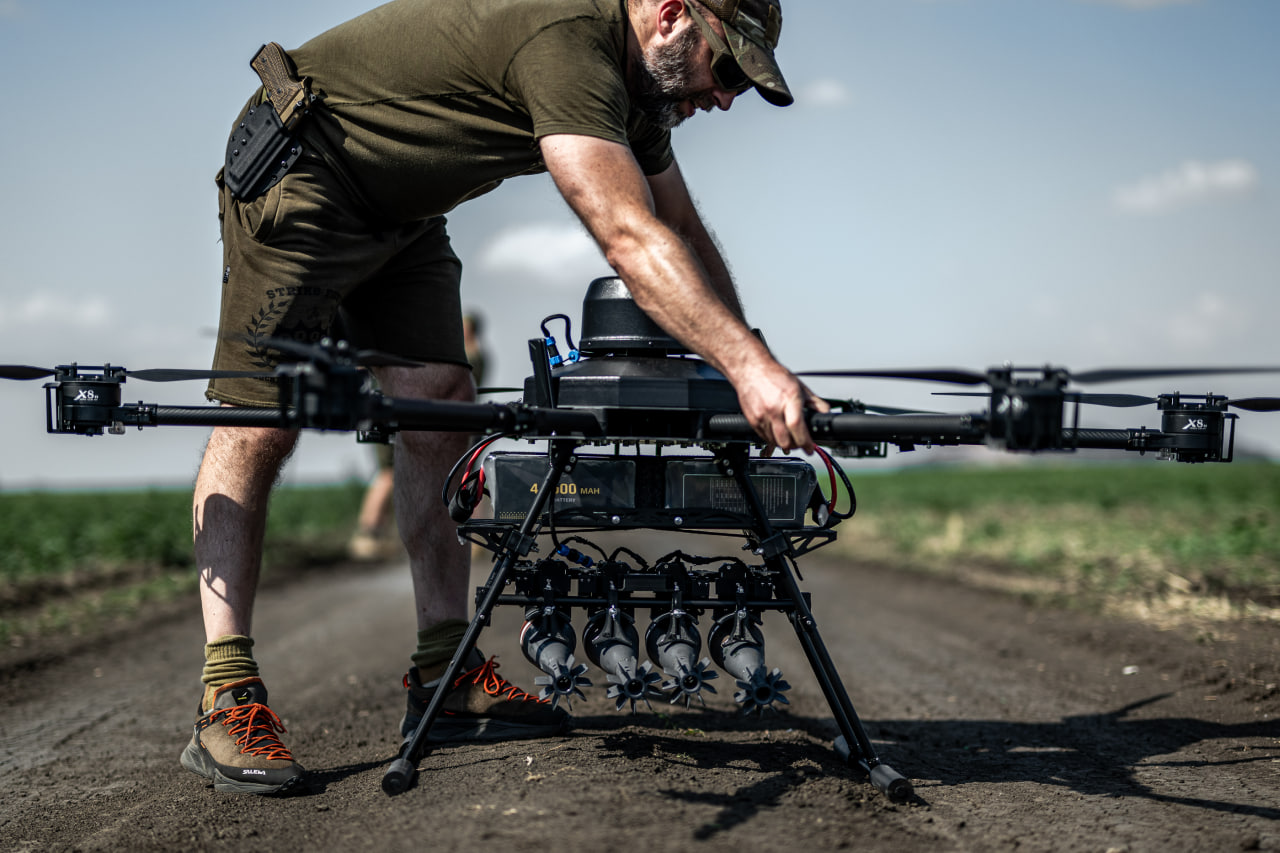
The new RFS requires drones with a mission range between 9.3 and 18.6 miles (15-30 kms) and capable of carrying upwards of 17.6 pounds (8 kg.) of weapons, including 60- and 81-millimeter mortar shells. (Typical 81-millimeter M821 and M889 high-explosive rounds weigh 9-10 pounds, while the 60-millimeter M734 and M888 high-explosive rounds weigh roughly 3.7 pounds.) UASs unable to meet minimum range and payload requirements, or that can’t carry more than one warhead, will be automatically disqualified per Pass/Fail ‘gates’. Man-packability is preferred, while transportability on light vehicles is required.
The payload and range specifications clearly correspond to Ukrainian-style ‘heavy bomber’ multi-rotor drones—not, say, small quadcopters like DJI Mavics or fixed-wing UAVs able to drop only individual small munitions. Technically, however, the RFS nowhere requires multirotor vertical-lift platforms, leaving the door open to submissions of fixed-wing or other UAV types if they can meet the cost, packability and payload requirements.
Besides range and payload, the RFS unsurprisingly states that ability to operate under adversary electronic warfare conditions disrupting command and satellite navigation links is “paramount.” It also emphasizes all-weather and all-day operability—particularly at night, the primary operating time for heavy bombers in Ukraine.
Capability to engage multiple moving targets in succession is also expected, with the target set notably ranging from static assets and personnel to “heavy armor” and “maritime surface or landing craft”—the latter perhaps indicating defense-of-Taiwan scenarios on the mind.
The RFS also specifies an expectation of flying a “minimum of 30 missions with a preference of achieving 150 missions before loss,” one of several indicators of active C-UAS capabilities at Gauntlet 2.5.
Program documents also note they expect a “higher degree of reliability” for reusable heavy bombers compared to kamikaze drones, and emphasize they will favorably rate UASs sporting non-mandatory autonomy features, interoperable open-architecture systems, and advanced target engagement capabilities such as pixel-lock, predictive release and automatic target recognition.
The RFS also highlights that Mission C Phase 3 will likely involve adoption of the Army-developed MALET payload interface/fusing system, and DDP seems likely to favor early adopters in Phase 2.5.
Why heavy bombers drones are deadly complements to one-way FPVs
It’s often forgotten that before the large-scale introduction of one-way FPV drones to Ukrainian battlefields in 2023, gravity bombing drones contributed substantially to attrition of Russian personnel and armored vehicles in 2022. And the thing is, they never stopped doing so.
Heavy bombers were originally adapted from beefy agricultural drones and DJI Matrice-series UASs, and then subsumed in Ukraine by indigenous mass-produced R18 octocopters, Kazan hexacopters, Vampyr quadcopters and others. Collectively known as ‘Baba Yaga’ drones, these typically range in cost from $10,000 to $30,000 apiece including thermal viewers required for survivable night operations.
Of course, one-way FPV drones costing $400-$1,000 overtook gravity bombers in prominence because they’re more agile and expendable for daytime operations, can be cheaply mass-produced using fixed cameras, and can precisely strike targets that are moving evasively or require three-dimensional approach vectors (for example, to enter windows, duck under cage armor, or hit lower-hull components).
Still, experts allege heavy bombers may account for 20-30% of Russian casualties in Ukraine, with FPVs accounting for 40-50%. Heavy bombers typically survive 30-70 sorties according to Ukrainian operators, can deploy deadlier standard battlefield munitions than FPV’s can lug, have better sensor setups for ISR functionality, and remain apt for 90-degree strikes down hatches or into trenches. And because heavy bombers can deliver multiple warheads per sortie, and typically survive dozens of sorties, they compare favorably by ‘cost-per-strike’ metrics.
Combat videos also show gravity-bombers can strike moving targets through skillful (or computer-assisted) prediction. They are also adaptable to diverse secondary roles thanks to their substantial payload and endurance, including battlefield resupply, object recovery, FPV-drone carrier, radio relaying and heavy ISR.
Now that Pentagon is showing greater interest in tactical heavy bomber UASs, it seems possible the heavy multirotors quadcopters currently being procured for the U.S. Army’s company-level Medium Range Reconnaissance (MRR) requirement— namely the Mistral THOR and PDW C100—might participate in Gauntlet 2.5 too. (Other MRR drones—the Anduril GhostX and AeroVironment Vapor helicopters, and eVTOL Quantum Systems Vector—appear too expensive per UAV to fit Mission C procurement rewards.) However, while designed to support bombing missions, existing MRR UASs might still require some stripping down to more comfortably meet Mission C’s cost parameters and payload/range requirements.
Perhaps that also suggests the Army should consider fielding dedicated gravity bomber units serving in a role akin to heavy mortar platoons, not just multi-role support UASs at the company level.
In any event, the introduction of Mission C reflects the broadening scope of the Pentagon’s Drone Dominance program to encompass a new type of low-cost tactical strike drones, and finally brings deserved attention by the U.S. military to a class of UAS that has played a major role in tactical ground warfare in Ukraine.