
Kongsberg Defence & Aerospace and PGZ will deliver 18 SAN counter-UAS modules under a NOK 16 billion contract, combining PROTECTOR-based weapon stations, interceptor drones and APS command-and-control into what Warsaw is calling Europe’s largest integrated anti-drone network.
Poland has signed a major counter-UAS contract with Kongsberg Defence & Aerospace and consortium partner Polska Grupa Zbrojeniowa (PGZ), ordering 18 SAN Counter-Unmanned Aerial System (SAN CUAS) modules to strengthen its air-defence posture against mass drone threats along NATO’s eastern flank. The deal is valued at about NOK 16 billion (roughly $1.6–1.7 billion) to Kongsberg.
Signed on 30 January between the Polish Armaments Agency and the Kongsberg–PGZ consortium, SAN CUAS will field 18 anti-aircraft system modules, each built around multiple firing platoons and a support platoon.
Signed on 30 January between the Polish Armaments Agency and the Kongsberg–PGZ consortium, SAN CUAS will field 18 mobile anti-aircraft system modules, each built around multiple firing platoons and a support platoon. Polish officials describe the overall architecture as an integrated “anti-drone wall” of roughly 700 vehicles, sensors and effectors, with initial operational capability planned before the end of 2026.
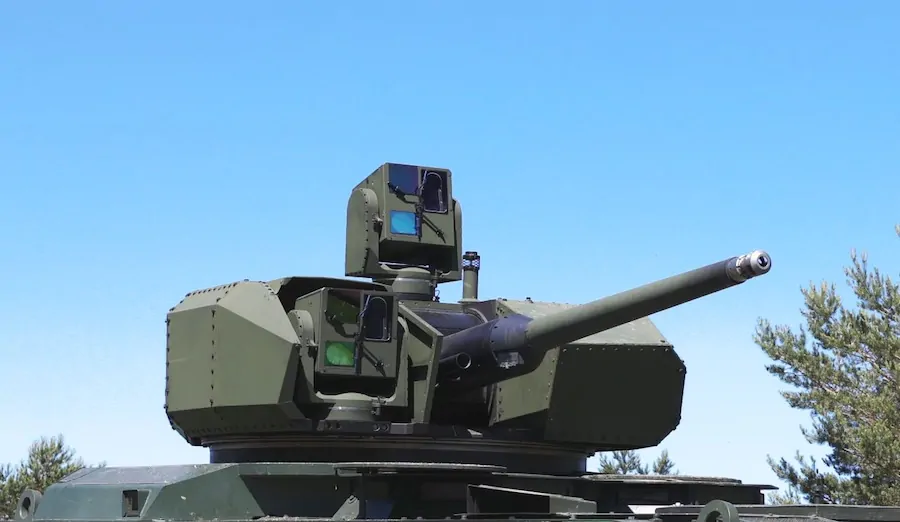
At the heart of the programme are Kongsberg’s PROTECTOR family weapon systems. According to the company, SAN CUAS will employ both the Medium Caliber Turret MCT30—an unmanned, fully digital 30 mm turret already in full-rate production—and PROTECTOR remote weapon stations configured for a mix of effectors. For SAN, the remote stations will be optimised around 70 mm guided rockets, with the wider modules also fielding 35 mm guns, additional 30 mm cannons, 12.7 mm heavy machine guns, surface-to-air missiles and interceptor drones to defeat a wide spectrum of UAS threats.
Those kinetic options sit inside a wider sensor-to-shooter network. PGZ subcontractor Advanced Protection Systems (APS) will supply a dedicated command-and-control architecture that fuses short- and medium-range radars, passive RF detectors and electro-optical systems, and links SAN CUAS into existing Polish air-defence assets. APS already provides operational counter-UAS systems to Polish and international customers, and its tailored C2 layer is intended to allow each firing platoon to operate autonomously or as part of the wider SAN construct.
Polish reporting frames SAN as a direct response to repeated airspace incursions and drone incidents linked to the war in Ukraine, including Russian UAV overflights that prompted Warsaw to invoke NATO’s Article 4 consultations in 2025. SAN is being positioned as a key element of the national “Eastern Shield” deterrence concept and as a bridge between classic medium- and short-range air defence and the mass proliferation of small tactical drones and loitering munitions.
The programme is also notable for its industrial structure. Official figures cited in Polish media indicate that roughly 60 percent of SAN’s value will flow to domestic industry, with companies such as PIT-RADWAR, Jelcz, Rosomak, Huta Stalowa Wola, Mesko and Transbit providing radars, vehicles, guns and support equipment. Kongsberg, for its part, says it will invest in expanded manufacturing capacity and capabilities in Poland as part of the deliveries, positioning the country as a regional hub for counter-drone production and sustainment.
SAN CUAS is significant on several fronts. It formalises one of Europe’s largest dedicated counter-drone procurements to date, built explicitly around lessons from Ukraine about drone saturation, electronic warfare and the need to combine guns, missiles, guided rockets and non-kinetic effects under a single C2 layer. It also extends Kongsberg’s PROTECTOR ecosystem—already widely used on armoured vehicles—into a specialised anti-UAS role, creating another reference customer for turret- and RWS-based counter-drone architectures.
As deliveries begin, SAN will be watched closely by other frontline NATO states looking to scale up counter-UAS capacity beyond ad-hoc jammers and point-defence systems. For Poland, it is intended to provide a mobile, layered screen against small UAS and loitering munitions across key regions; for industry, it marks a major long-term commitment to integrated, networked counter-drone defence.