
Last Sunday (September 21st), Lockheed-Martin unveiled the company’s first public Collaborative Combat Aircraft (CCA)—a stealthy new unmanned aircraft concept called Vectis which the aerospace giant says it plans to design, build and fly in the next two years. The resulting CCA would be offered to both the U.S. military and its allies.
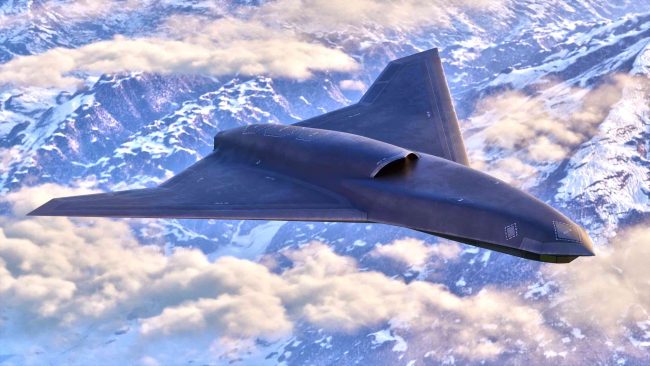
The aerospace giant differentiates its Vectis concept from loyal wingmen already on the market by its greater emphasis on stealth—Lockheed’s known forte—and “best in class survivability.”
The company describes Vectis as a runway-dependent Group 5 CCA falling in size somewhere between an F-16 and smaller Common Multi-Mission Truck drone/missile. The company’s graphic shows a tailless airframe with lambda wings—design elements excellent for minimizing radar cross-section—and a top-mounted air intake. However, its exhaust nozzles and belly have yet to be visualized.
The company says Vectis is adaptable (and rapidly upgradeable/customizable) to a wide variety of missions: launching air-to-air and air-to-surface missiles, ISR and target acquisition, or electronic attack and communications relaying. A declaration of “endurance ranges compatible with the Indo-Pacific…” implies long range, probably greater than that of currently competing CCAs. However, company VP Oscar Sanchez told media that supersonic performance likely wouldn’t be required based on their analyses.
Lockheed’s press release also touts affordability, claiming Vectis would be offered at a “CCA price point.” The emphasis on stealth optimization would seemingly cut against that claim, though Lockheed’s press release argues prior project work on NGAD and CCA, and advanced digital engineering tools, will enable meeting “aggressive cost targets.”
A promotional animation shows an F-35 jet controlling four Vectises (Vecti?) screening their controlling jets and executing air-to-air and air-to-surface attacks—all commanded via Lockheed’s touch-screen Angry Bees software in the cockpit of an F-35. The company says it has tested Vectis’s capabilities in combat simulations featuring manned-unmanned teaming (MUM-T) with F-22 and F-35 fighters with satisfactory results.
Lockheed also describes Vectis as a component of its Agile Drone Framework of distributed operations. A video sharing some parts in common with the Vectis trailer showcases multiple types of UAVs supporting diverse manned platforms, including the company’s Indago 4 quadcopter and Common Multi-Mission Truck (CMMT) drone/missile shown being tasked variously as a MALD-style decoy, an electronic attack system and an air-to-surface munition. The same video depicts Vectis-like drones flying ahead to screen F-22 and F-35 stealth fighters, while RQ-170-like flying wing stealth drones fly orbits over enemy airspace acquiring targets.
Stealth versus attritability
Over analyzing the as yet unbuilt Vectis airframe is arguably less fruitful than considering the design philosophy underlying it—particularly in the light of what Lockheed has shared about its unsuccessful proposal for Increment 1 of the Air Force’s CCA competition.
Lockheed executives told media their design boasted “higher levels of stealth than were necessary”—a degree of gold plating the Air Force wasn’t looking for. They defended their approach as being based on the evaluation that higher costs for stealthing the platform would be more than offset by lower loss rates over time in a high-intensity conflict context.
Furthermore, they said their simulations showed tethering not-as-stealthy loyal wingmen to manned stealth jets backfired in simulations by giving away the presence of the manned aircraft (even if not their exact position), potentially even putting them at risk.
The provocative subtext, then, is that Lockheed’s design team believe the Air Force has gotten the attritability calculus wrong: that the lower cost of attritable CCAs will be offset by disproportionately higher losses. Even if the loss rate is acceptable on day one combat, the progressive inventory depletion degrades effectiveness severely over time. And that’s a problem if the adversary can sustain an effective air-denial fight after, say, a month of combat. Bear in mind even the cheapest loyal Wingman costs more than Russia and China’s best SAMs.
While Lockheed’s Vectis unveiling is rebalanced to emphasize affordability, it’s still clear that there remains a through line prioritizing stealth and survivability. Leave the bullet-catching to decoys costing well under a million dollars, CCAs that survive to fight another day bring intrinsic value.
Of course whether Lockheed has correctly estimated the loss rate differential of its competitors’ CCAs is a matter for debate! Likewise, the company’s ability to simultaneously attain target levels of stealthiness and affordability as development advances.
Lockheed Seeks Foothold in Crowded Loyal Wingman Market
Lockheed has a long history working on unmanned projects like the RQ-170, and more recently the Multi-Domain Combat Systems for unmanned system C2, aerial autonomy through its F-16-based X-62 VISTA autonomy testbed, and of course its proposal for the CCA Increment 1. However, it has not until now publicly offered a CCA platform like those which have hit the market in the last six years.
On one level, it makes sense for Lockheed to pursue the trend despite setbacks attracting U.S. military orders. In 2026 the service will choose between the General Atomics YFQ-42 and Anduril YFQ-44 CCAs currently being evaluated and then launch the follow-on CCA increment 2. Air Force service leaders have sent mixed signals as to whether they’re seeking more or less expensive CCAs, or a mix of both types for that increment.
But just as importantly, both Kratos and Boeing have also missed out on Air Force CCA orders, yet had commercial successes selling their XQ-58 and MQ-28 loyal wingmen to the Marine Corps and the Royal Australian Air Force respectively. So it makes sense for Lockheed to try carving out its own foothold in that market before the competition is fully entrenched.
Three strategies to differentiate a newcomer to a crowded market include:
- Offering something qualitatively different
- Offering essentially the same thing as the competition, but better and/or cheaper
- Offering synergies with other products in the company portfolio
Within that framework, Lockheed is explicitly making the case for 1 by emphasizing greater stealth and survivability. But there’s also an important implicit argument for #3—because Lockheed is already selling F-35 stealth fighters to 20 countries.
That may make it attractive to offer Vectis in tandem with F-35s—not only designed to integrate with them, but allegedly able to accompany them into enemy airspace without compromising stealth. (To be fair to Lockheed insists Vectis’s open-architecture design will enable interoperability beyond the company’s proprietary systems.)
Admittedly, Lockheed faces headwinds recently, having lost the Air Force’s sixth-generation fighter competition and been eliminated before make the final round of the CCA competition. Still, the company’s financial future seems secured for decades by the commercial success of the F-35 jets, with well over 2,000 orders expected. However, high F-35 operating costs and delays to its Block 4 upgrade have attracted critics including within the Trump administration, which halved F-35 orders in 2016 and, through bellicose rhetoric, harmed its sales abroad.
Still, Lockheed has accumulated the financial security to more safely pursue cutting edge projects at its Skunkworks facility in California. Perhaps then its unsurprising their take on the Loyal Wingman is more on the high-end side than the more attritional concept the Air Force is exploring.