
Maritime Robotics, Eelume and partners have unveiled a new optionally-manned USV that carries a swarm of flexible AUVs and ROVs, pairing a proven workboat hull with autonomous navigation and AI-based mine detection.
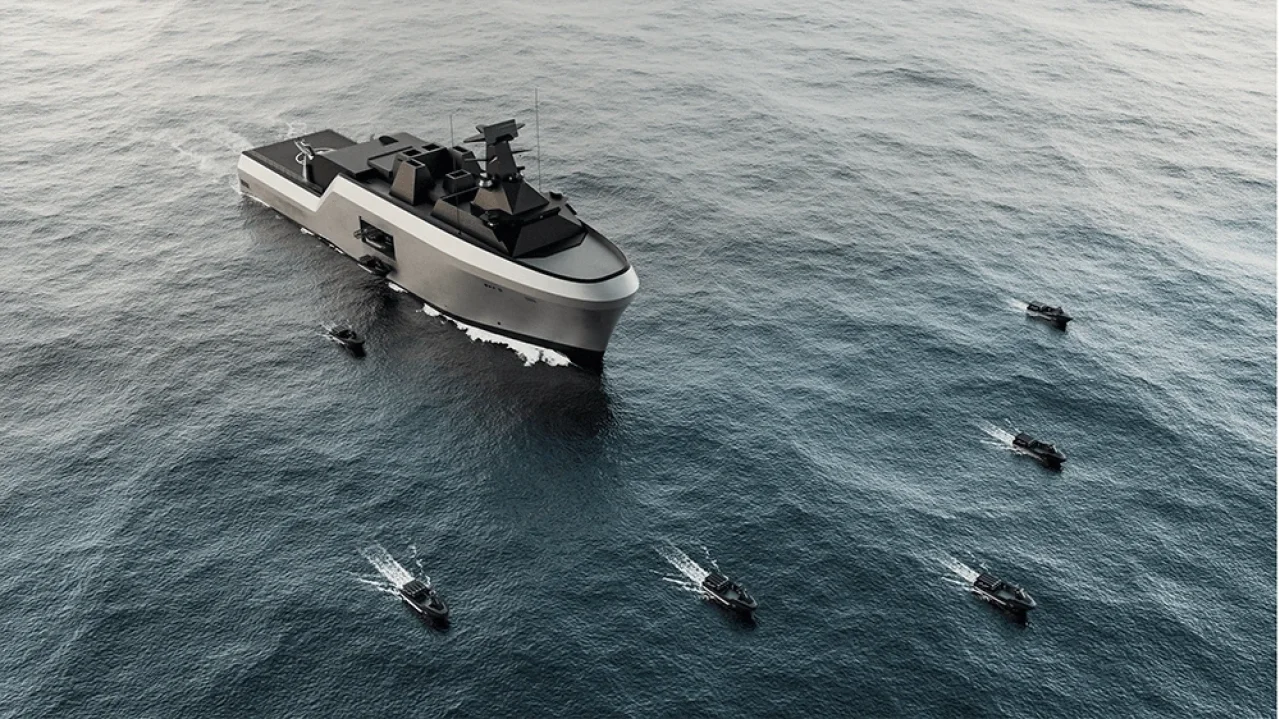
Norwegian autonomy specialists Maritime Robotics and Eelume have launched a new unmanned surface vessel concept for mine countermeasures (MCM), positioning it as a flexible “system-of-systems” hub that fuses surface, subsurface and AI-driven decision support.
The 9.6-meter Eelume WP960 is built on Westplast’s WP960 hull and integrates Maritime Robotics’ autonomous navigation stack with Eelume’s S All-Terrain AUVs and Blueye Robotics inspection ROVs, the companies said in a joint announcement.
Designed as an “optionally unmanned” platform, the WP960 can operate fully autonomously or with crew on board. It can be configured with or without a wheelhouse, hoisted by a single-point lift, and transported by road, sea or air for deployment from larger mother ships or as part of a multi-USV fleet.
“The vessel is equipped with autonomous solutions in an ‘Optionally unmanned’ configuration, meaning it can operate fully autonomously without crew, or be manned when needed,”
said Eelume’s Thomas Nygaard in the release.
Mine countermeasures as a system of systems
The new concept is explicitly framed as a mine-countermeasures “system of systems”, combining:
- the WP960 USV as a carrier and command platform;
- a swarm of Eelume S All-Terrain AUVs for search and clearance;
- Blueye underwater drones for close-in inspection; and
- Biodrone’s AI-based automatic object recognition to classify mines and other threats in sensor data.
From the surface, the WP960 is intended to deploy, recover and coordinate multiple AUVs simultaneously, creating a distributed sensor network that can cover large areas of seabed while keeping sailors at standoff. Norwegian defence, research and civilian users are a primary target market, particularly for operations in constricted, challenging waters such as fjords.
“The combination of autonomous surface vessels, underwater drones, and AI-based decision support provides a level of operational pace and precision far beyond traditional solutions,” said Maritime Robotics COO Eirik Hovstein, adding that the approach is “particularly relevant for complex operations in Norwegian fjords.”
COTS hull, third-party autonomy
One of the concept’s more progressive elements is its use of a commercial off-the-shelf (COTS) workboat hull rather than a bespoke military design. The WP960 hull, developed by KACE AS and produced at the company’s shipyard in Fosnavåg, has over 70 units in operation worldwide for demanding workboat missions, according to the partners.
Key characteristics include:
- Length 9.6 m (options from 7.8–11.8 m); beam 3.4 m; draft 0.9 m
- FRP construction with high structural strength and stability
- 2 × 315 bhp engines with twin Hamilton waterjets, enabling survey speeds around 4 knots and transit speeds above 30 knots
- 2,800 kg bollard pull and 2,100 kg back deck capacity
- DNV-approved classification and third-party-proven autonomy
- Capacity for up to eight Eelume All-Terrain AUVs, plus MBES, sonar and other payloads
By combining that hull with Maritime Robotics’ Autonomous Navigation System and an open, modular deck layout, the WP960 is pitched as a multi-mission platform for mine countermeasures, seabed mapping, inspection, research, surveillance and maritime security.
KACE CEO Geir-Arne Bøe described the collaboration as “the start of an exciting new segment,” arguing that pairing mature WP-series hulls with advanced autonomy “provides a solid foundation for the solutions of the future.”
AI-assisted mine recognition “made in Trøndelag”
Another notable feature is the AI layer. Norwegian firm Biodrone will provide automatic object recognition algorithms that run on sensor data from the AUVs and underwater drones. The goal is to speed up mine detection and reduce cognitive load on operators by highlighting likely mine contacts in real time, the partners said.
“When Eelume, Maritime Robotics, Blueye Robotics, and Biodrone come together, we create world-class development environments where sensor data from satellite, air, surface, and underwater sources is converted into precise real-time decision support,” said Biodrone’s Vegard Forbord. “This collaboration delivers real operational effect for Norway and our allies.”
The project also emphasizes speed of fielding. Rather than launching a long, bespoke development program, the companies are positioning the WP960 solution as a way for defence customers to combine existing platforms and off-the-shelf tech into new operational capability with lower technical and commercial risk.
Cluster play: Ocean Autonomy and NORDSEC
All three core companies—Eelume, Blueye Robotics and Maritime Robotics—are members of Norway’s Ocean Autonomy Cluster and the NORDSEC Nordic Defence and Security Cluster, and participate in the FI Ocean Space Incubator.
Nygaard framed the WP960 debut as an example of that ecosystem in action. “Norway has incredible expertise in shipbuilding, artificial intelligence, and drones. What we are presenting here allows control over every square centimeter and threat in any fjord,” he said, calling it a forward-looking, AI-based solution built on recent technology developments.
The USV has already been booked for its first missions and was recently showcased with AUVs on deck at Dark Drones, a Norwegian defence and autonomy demonstration event at Nyhavna, Trondheim.