
Following months of flight testing, in 2026 the Air Force was expected to choose between two competing drone combat jets of class generally called ‘Loyal Wingmen’ or Collaborative Combat Aircraft (CCAs) intended to assist the service’s formidable manned fighter fleet in air-to-air combat: either General Atomics’ YFQ-42A or Anduril’s YFQ-44A.
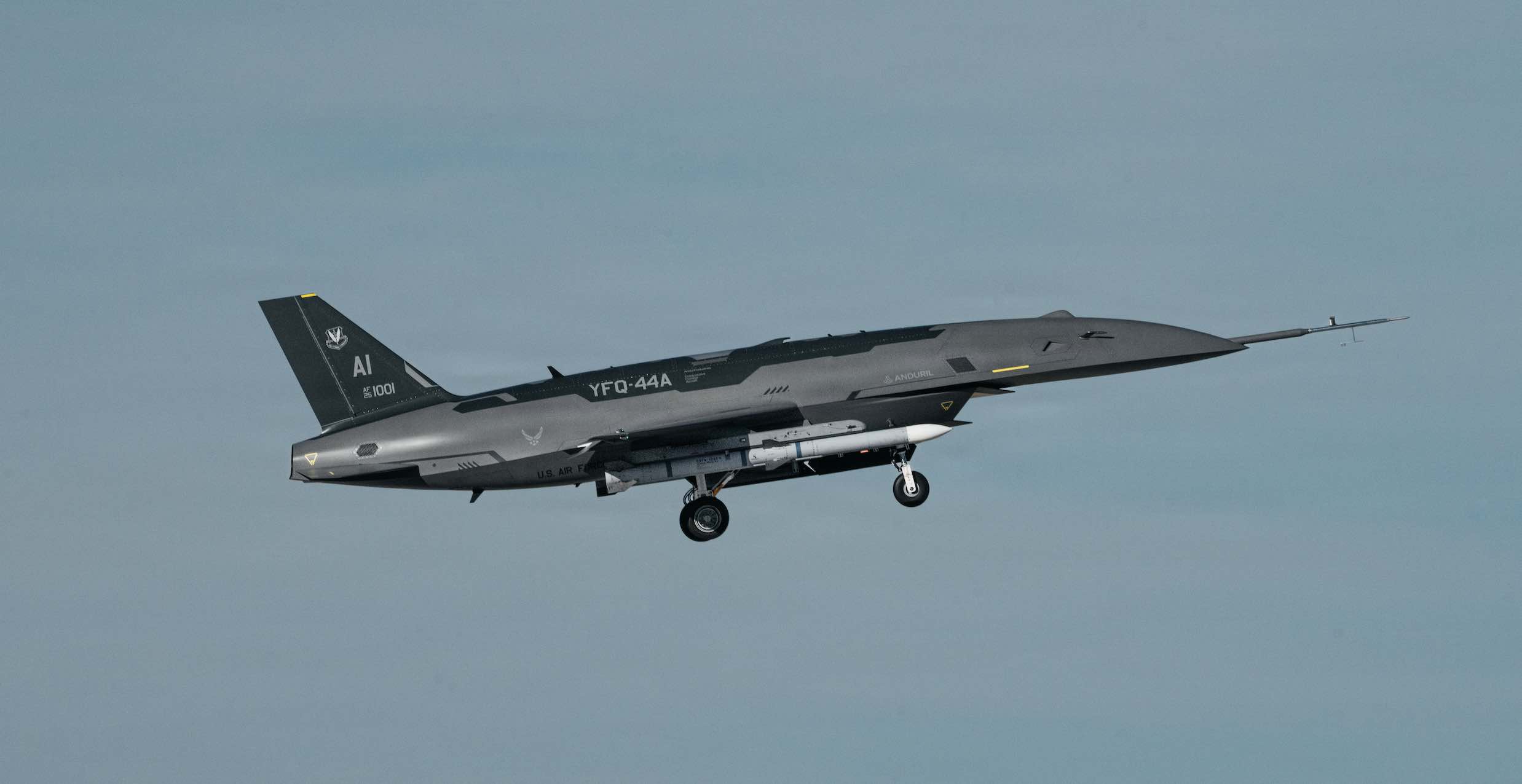
But this Wednesday the Air Force revealed that rather than go for one over the other, it’s instead ordering bothinto production four months ahead of schedule thanks to their maturity. The forthcoming production aircraft will drop the ‘Y’ prototype-code from their designations, and be redubbed the General Atomic FQ-42A Dark Merlin and Anduril FQ-44A Fury—and thus become the U.S. Air Force’s first semi-autonomous drone fighters in operational service.
The service declined to clarify quantities and price per unit, nor how orders will be split between the two designs. However, it’s known to be planning at least three Increment 1 production lots (likely followed by more), and to have requested $1 billion to fund CCA procurement for fiscal year 2027, complemented by $1.4 billion in CCA development funding.
The service has stated it wants to field 150 CCAs by 2030, and in the past characterized CCAs as costing roughly one-third the price of an F-35A stealth fighter, implying a unit cost in the $25-30 million range.
The specifications for CCA Increment 1 call for air-superiority combat aircraft with a combat radius of 805 miles (700 nm), and armament of at least two AIM-120 beyond visual range air-to-air missiles. Both Dark Merlin and Fury can attain high subsonic but not supersonic speeds, and the former also has an internal bay for stealthy stowage of weaponry.
The Air Force eventually plans to acquire other CCA types differing in role, capability and cost to build towards a planned fleet of 1,000 CCAs. Future CCA capabilities are likely to include long-distance sensing, electronic warfare, and air-to-surface warfare.
The CCA autonomy solution: six vied for the crown. Only one can win.
However, the Pentagon is choosing to compete the autonomy systems controlling CCAs separately from the aircraft themselves, an approach which amongst other benefits helps stave off vendor-lock.
For the next six months, the Air Force is contracting three solutions—Shield AI’s Hivemind system, RTX/Collins Aerospace ‘Sidekick’ Collaborative Mission Autonomy, and Anduril’s Lattice system.
Of the above autonomy systems, Fury has already integrated Lattice and Hivemind, while Dark Merlin has integrated Sidekick. Following a six-month performance-based evaluation, the service says it will narrow it down to one or two solutions during the subsequent six month period. Then a final selection of a singular autonomy solution will follow in summer 2027.
However, the Air Force says it will continue to consider three additional autonomy solutions in the vendor pool by General Atomics, Lockheed and Northrop-Grumman, as backups should the need arise. These autonomy systems may be General Atomics’ GA-ASI (Fury’s original autonomy package), Lockheed’s MDCX, and Northrop’s Prism.
The Air Force’s software contract also incorporates a novel mechanism by which the service may deny part of the licensing fee should software fail to deliver expected combat capabilities.
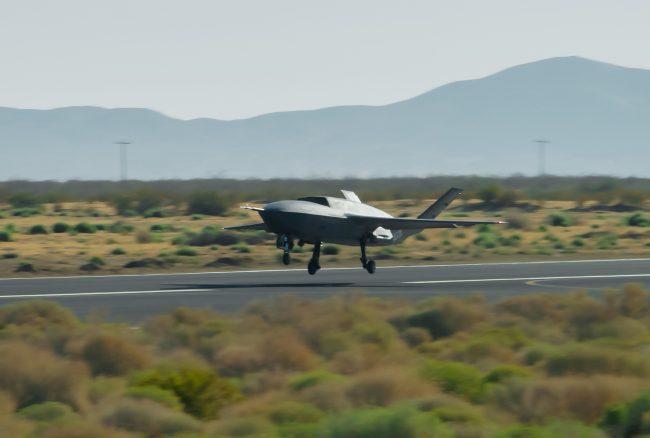
Two loyal wingmen for the job of one?
Technically, the Air Force could have awarded the CCA Increment 1 production contract to alternative loyal wingman designs it had earlier declined to down-select for flight testing from Boeing, Lockheed and Northrop-Grumman—but unsurprisingly that did not happen. That said, Northrop’s Talon/Project Lotus demonstrator has since received an official prototype designation as YFQ-48A Talon Blue and should flight test this year.
Meanwhile, nine companies continue to compete for the Air Force’s still shadowy CCA Increment 2 competition, the specifications and timeline for which remain unclear. The Navy also stood up its own exploratory CCA program last year, while the Marine Corps is already procuring MQ-58 Valkyrie CCAs specialized in air defense suppression.
At this juncture, then, it’s worth pondering why the Air Force chose to procure two distinct CCA solutions for the same increment. There are significant added costs from operating two different types fo aircraft to do—in theory—the same job.
Reportedly, in a conference call, Air Force fighter PAE Col. Timothy Helfrich said the split buy reflected that “….we believe that continuous competition drives the best outcomes, both in schedule, cost, and often times in performance as well.”
Beyond such paeans to the benefits of competition, there may be additional factor including a desire to stimulate the drone industrial base broadly rather than stack the rewards all on one company—particularly as the follow on Increment 2 doesn’t seem to be moving along quickly. The Pentagon explicitly wants to avoid collapsing the number of companies able to compete in the UAS market. Furthermore, a split order is at less risk of exceeding the production capacity of either manufacturer.
The Anduril-General Atomics showdown is also a clash between the in defense-aerospace old guard and the new ‘tech bro’ neo-primes which may politically complicate procurement decision-making in favor of compromise.
Another factor could be hedging/risk management, as the concepts for how to best use CCAs remain immature. Thus the Air Force may prefer to place several ‘bets’ on what the better loyal wingman solutions looks like rather than gambling on a single path.
In regard to technical risks, it’s worth recalling that on April 6 a YFQ-42 was destroyed in a crash following takeoff, causing the type to be grounded through May 21. A safety review found the accident was caused by errors in the autopilot leading to miscalculation of weight and center of gravity. Helfrich, however, said this incident didn’t affect the service’s production decision.
It’s also possible the service sees utility in a ‘hi-lo’ mix of CCAs. With autonomy software being competed independently of the airframe, one of the few major distinguishing characteristics between Dark Merlin and Fury is the former has an internal weapons bay facilitating stealth operations, which should make it more survivable. Should Fury be less expensive (which is not confirmed), the service might desire a mix of higher and lower cost CCAs to efficiently prosecute different missions.
Overall, how best to design CCAs and employ them in air warfare remains debated at this early stage in their development. However, by moving forward with production, the Air Force shows it wants to scale up from tests of a handful of prototypes to experimenting with mass to carry the necessary evolution forward. Meanwhile, the split buy will let the service essentially double that experimental output by having two distinct platforms to compare or use for different roles.