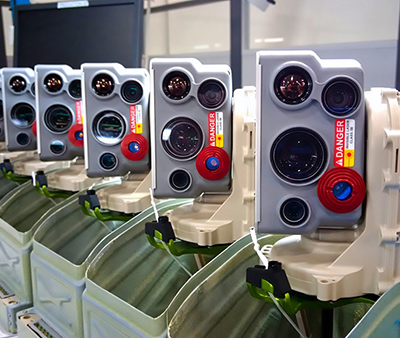

The U.S. Space Force awarded SpaceX a $4.16 billion Other Transaction Authority contract today for the Space-Based Airborne Moving Target Indicator program, an effort to field a constellation of low-Earth orbit satellites capable of continuously detecting and tracking aircraft, cruise missiles, and hypersonic weapons from space.
Space Systems Command announced the award on May 29, describing it as the initial increment of a program intended to deliver fielded capability to the joint force by 2028.
The SB-AMTI program is designed to shift airborne surveillance missions from crewed aircraft to space, complementing and eventually reducing reliance on the Air Force’s E-3 Sentry AWACS fleet and the newer E-7 Wedgetail. The impetus is adversary investment in anti-access/area-denial systems that increasingly threaten the survivability of airborne surveillance platforms in contested environments.
The program has direct implications for autonomous systems operations. Space-based AMTI data is a key enabling input for the AI-enabled strike and intercept systems the Pentagon has been rapidly fielding, including the attritable drone platforms operating under Task Force Scorpion Strike and the counter-UAS interceptors deployed through JIATF-401. Persistent overhead tracking of airborne threats at machine-readable latency is a prerequisite for the kind of autonomous kill chains — from detection through intercept or strike — that have defined U.S. force development since Operation Epic Fury.
“By focusing these capabilities to the space domain, we are providing the Joint Force with sustained battlespace awareness of contested airspace,” said Col. Ryan Frazier, acting Space Force portfolio acquisition executive for Space Based Sensing and Targeting. “We are beginning development and integration efforts immediately to meet the program’s rapid deployment milestones and address emerging national security requirements.”
SpaceX is not the sole vendor. The Space Force confirmed that additional companies were selected for the SB-AMTI vendor pool — their identities and contract values withheld for national security reasons following an announcement by Secretary of the Air Force Troy Meink at the Space Symposium in April. The service said it anticipates issuing multiple additional awards over the coming year to expand vendor diversity and increase capacity for combatant commanders.
The contract follows by two days a separate $2.29 billion OTA award to SpaceX for the Space Data Network backbone, a proliferated LEO mesh communications constellation providing data transport and tactical communications for the joint force. Together the two awards give SpaceX a combined $6.45 billion in Space Force contracts in a single week, spanning both the sensing and communications layers of the emerging space architecture.
Funding for the program’s full scope remains contingent on congressional action. The Space Force’s fiscal year 2027 budget request includes $7.06 billion for SB-AMTI to expand the constellation’s coverage regionally and potentially globally. The Pentagon’s reconciliation package — the One Big Beautiful Bill — separately includes $9.2 billion allocated to target tracking programs, a figure that analysts have linked directly to SB-AMTI’s long-term procurement trajectory. The Space Force’s FY26 baseline budget contains no funds for air moving target indication; the program has been operating on supplemental and OTA authority pending the outcome of the reconciliation process.
A parallel effort, the Space-Based Ground Moving Target Indicator program, is in research and development and has not yet reached the contracting phase.