
Teledyne Optech introduced an expanded lineup of LiDAR, imaging, and marine-mapping technologies at INTERGEO 2025, underscoring the company’s focus on cross-domain data collection for unmanned and automated workflows.
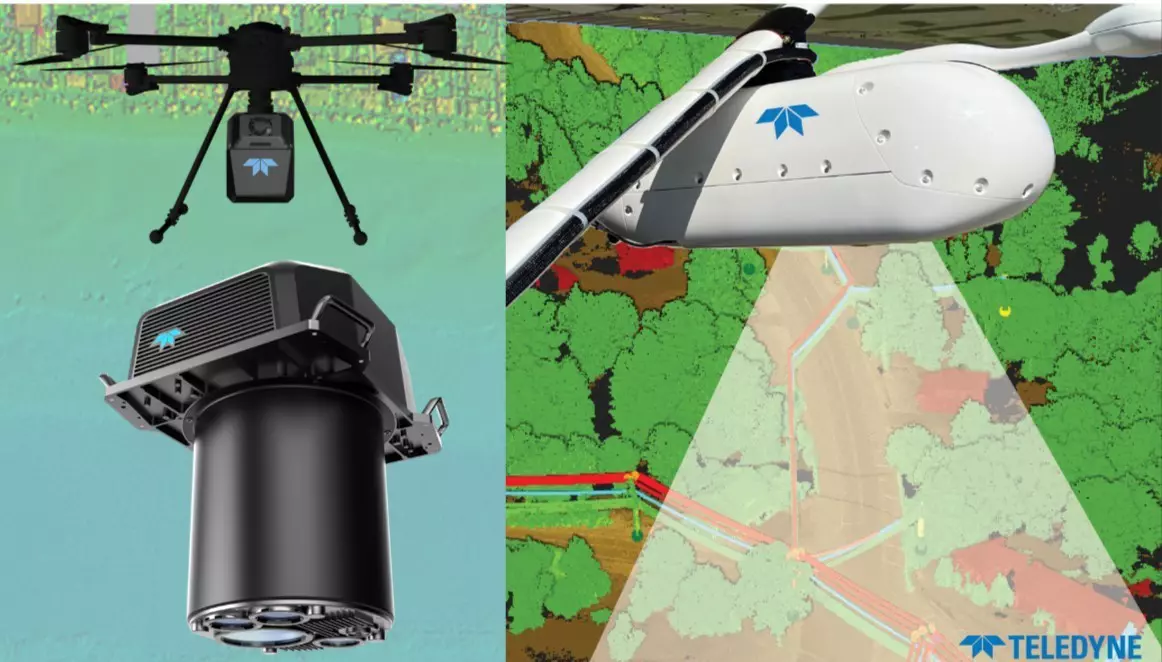
At the center of the exhibit was Fathom, a next-generation topo-bathymetric airborne LiDAR system that merges topographic and bathymetric measurement with co-registered multispectral imaging. Designed for both crewed and unmanned aerial platforms, Fathom captures seamless elevation data across the land-water interface for applications such as coastal resilience modeling, flood mapping, and port infrastructure inspection.
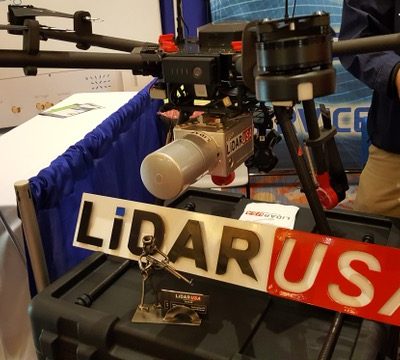
Teledyne Optech also unveiled EchoONE, its smallest and lightest LiDAR sensor to date. Weighing approximately 1.65 kilograms, EchoONE delivers survey-grade, georeferenced point clouds from compact UAVs and small aircraft. The sensor integrates a built-in GNSS/IMU subsystem for direct georeferencing and supports real-time data preview, enabling mission validation without post-flight processing. The small form factor and low-power design make it well suited for drone-based corridor mapping, asset inspection, and rapid-response survey operations.
For large-scale infrastructure monitoring, the company presented Network Surveyor powered by Galaxy Edge, a system that fuses Teledyne Optech’s airborne Galaxy LiDAR technology with onboard edge computing. Network Surveyor allows near–real-time processing of power-line and corridor data, providing automatic feature extraction and anomaly detection during flight. The capability supports emerging semi-autonomous inspection models in the electric-utility sector, where UAV and crewed platforms increasingly operate in coordinated fleets.
Additional hardware on display included a new compact pod-mounted LiDAR for fixed-wing aircraft and helicopters, expanding Teledyne’s offerings for lightweight, high-altitude survey operations. Across all systems, the company emphasized common data standards and compatibility with its CARIS and Optech workflow software, which now feature automated trajectory correction, calibration, and multi-sensor alignment.
In parallel, Teledyne Marine and Teledyne FLIR highlighted complementary technologies, including multibeam sonar, inertial navigation systems, and the Ladybug 6 spherical camera—tools that extend autonomous mapping capabilities below and above the waterline for USV and inspection-class vehicle integration.
By combining airborne, terrestrial, and marine sensors under a unified data architecture, Teledyne Optech continues to position its portfolio for the growing market in autonomous and hybrid mapping. The systems introduced in Frankfurt reflect the company’s effort to deliver survey-grade precision from increasingly smaller, more connected platforms—whether deployed on drones, uncrewed surface vessels, or conventional aircraft.