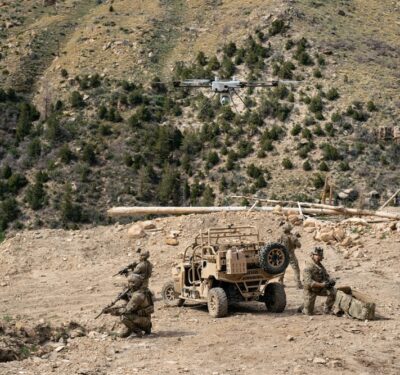

Teledyne FLIR has unveiled an improved Block 2 variant of its Rogue 1 quadcopter enabling the loitering munition to strike harder, more reliably and from over twice the distance.

This upgrade to Rogue 1—which currently arms Marine Corps infantry via the OPF-L program—follows an announcement earlier in May that the U.S. Army is ordering up to 130 Rogues 1 to evaluate this summer for its LASSO (Low Altitude Stalking and Strike Ordnance) program furnishing infantry brigades with standoff precision anti-tank capabilities. The Army will confirmedly receive Rogue 1 Block 2s, though the company currently hasn’t switched all production to the new model.
Rogue 1 is a premium portable quadcopter loitering munition emphasizing autonomy, advanced sensors including the company’s signature Boson 640+ thermal, and safe recoverability (for training or when missions are aborted etc.) using a specially developed mechanical interrupt safety.
Back in 2022 Rogue 1 secretly began testing with the Special Operation Command’s GOPSS program as a ‘micro’-class loitering munition. Then following its public unveiling in Spring 2024 Rogue 1 secured $12 million procurement for the Marine Corps’ Organic Precision Fires-Light program aimed at arming infantry squads and platoons, alongside Bolt-M and Switchblade-300 Block 20 munitions. In December 2025, OPF-L’s Delivery Order 3 ordered an additional 600 Rogue 1s for $42.5 million.
Joe Ailinger Jr., Teledyne FLIR’s director of public relations, confirmed to IUS that Rogue 1 has been used in combat, and that it’s also operated by Canadian Special Forces.
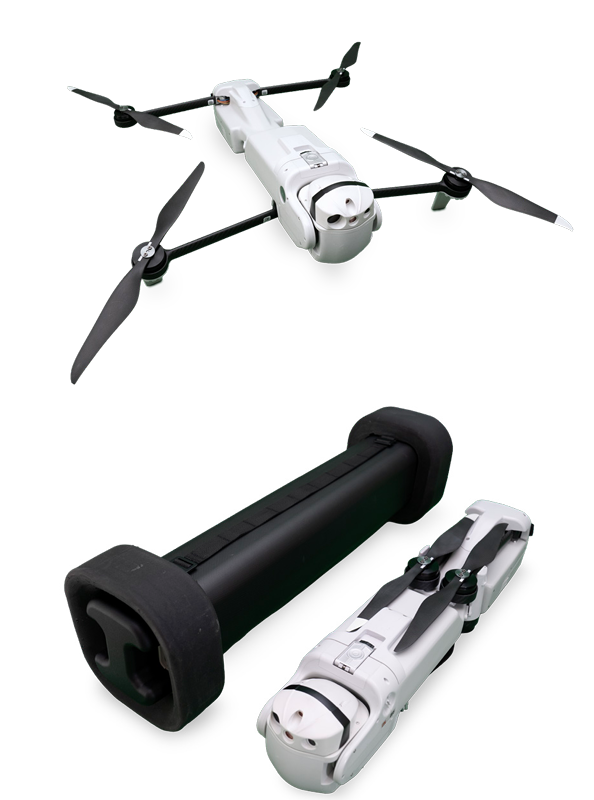
Block 2 retains the original’s form factor and 10-pound weight while upgrading key components. The company says a new advanced battery-cell tech and redesigned propellers has doubled operating range from 6+ to 12+ miles, while bumping up endurance by 20% when executing a “standard mission profile”, which Ailinger explained was typically 40% cruise, 40% hover and 20% dash.
The Rogue 1’s range is specified as “line of sight communication ranges” in datasheets, suggesting longer ranges may be achievable using comms relaying. “In reality we’ve actually flown much further,” Ailinger told IUS.
Block 2 also supports an additional armor-piercing warhead option called the Shaped Charge Jet (SCJ) providing “expanded mission flexibility against more heavily armored targets” (which rather sounds like ‘main battle tanks.’) Ailinger explained SCJ maximizes armor penetration by channeling the shaped charge through a smaller-diameter hole.
The base model already offers a “light anti-armor” explosively formed penetrator, an inert training round, and an anti-personnel/anti-material ‘forward-fragmenting’ munition with a LADAR-based height-of-burst fusing capability.
The company furthermore says improvements to sensors, onboard computing, software and navigation systems in Block 2 have enhanced “…autonomy to further ease user cognitive load”, “electronic warfare communications management”, mapping and visualization, improved flight modes”, and GPS-denied navigation employing both thermal and daytime cameras. Upgraded multi-band antennas and other radio options improve control link range and resiliency to adversary electronic warfare.
Ailinger also highlighted an “…upgraded processor for additional autonomy features currently in development (e.g. Automatic Target Recognition).” In other words, it sounds like the physical groundwork is being laid for future software-based capability upgrades.
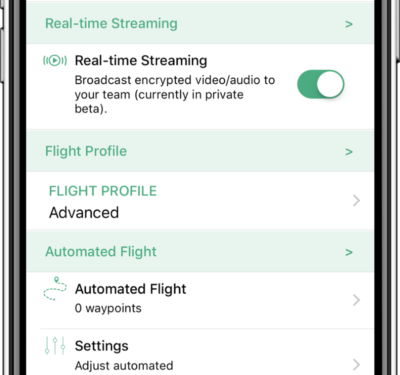
Block 2 also features a new Android-based ground control system, redesigned tactical packaging and ruggedization aimed at averting damage when dropped.
Teledyne FLIR’s UAS director Brian Bills also reemphasized that Rogue 1 remained “…the first certified (concurrence through the Navy WSESRB and Air Force NNMSB) recoverable loitering munition. The Marine Corps and SOCOM place a high value on this capability. Unknown on frequency of use, but we do know they train to it.”
Teledyne FLIR says that it will begin delivering Block 2s the third quarter of 2026. The increased range and punchier SCJ warhead certainly improve its suitability for the Army’s LASSO requirements. After initially acquiring heavier, longer-range Switchblade 600s for LASSO, munitions in 2026 LASSO has ordered evaluation batches for several lighter, shorter-range loitering including Hero-90, Switchblade-400, Damocles and now Rogue 1.
OPF-L Rogue 1 contracts in 2024 and December 2025 averaged $61,706 and $70,833 per UAV respectively. The latest orders for Rogue 1 come at the same time both the Army and Marine Corps are aggressively procuring and experimenting with cheaper First-Person View (FPV) kamikaze quadcopters like Neros Archer aiming for costs of $5,000 or less under the Drone Dominance and Purpose-Built Attritable System (PBAS) programs.
Ailinger shared his perspective regarding the competitive pressure exerted by such cheaper FPV kamikazes on systems like Rogue 1:
“We believe that both can co-exist. We believe the hyper-focus on FPV centers around what everyone sees with the usage in Ukraine. An FPV is certainly another tool in the tool kit but requires an inordinate amount of training to be really proficient. Loitering munitions such as the Rogue 1 are so simple to use an experienced UAV operator can learn in about 15 minutes or less. The system is also extremely accurate in its targeting capability, and the operator is unencumbered by wearing FPV control goggles so they have greater situational awareness in a combat environment.”
For now, the Army’s LASSO order suggests continuing interest in premium loitering munitions with additional capabilities and lower human skill/manhour requirements, even as cheap FPVs mature too in sophistication and production readiness. Time will tell if the services sustain parallel tracks procuring FPVs alongside higher-end Group 1 loitering munitions.
Rogue 1 Block 2’s unveiling comes shortly after Teledyne FLIR also debuted a new hand-tossed nano-UGV called FirstLook-125 as a portable reconnaissance system for dismounted soldiers.