
Mountain Horse Solutions is partnered with two companies battling in the second round of the Army’s Drone Dominance Gauntlet competition seeking lethal but low-cost tactical first-person view (FPV) kamikaze drones.
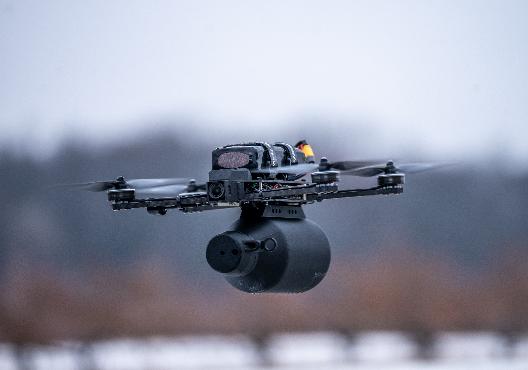
The Colorado-based company’s partnerships offer a study in contrasts. Canada-based Draganfly, an established quadcopter builder since the turn of the century, is offering its highly modular Flex drone. But Mountain Horse is also submitting the SPADE drone of AG3 Labs, a startup founded by Michigan State University students that’s won a name for itself demonstrating swarming capabilities of its training quadcopters.
A subsidiary of Global Ordnance Corporation, Mountain Horse offers a diverse catalogue of UASs developed by partners, and itself was one of five companies to win the DDP program’s Lethality Prize Challenge this April for its ARIES warhead, leading it to be anointed a preferred payload solution for UASs submitted in subsequent Gauntlet challenges.
Mountain Horse confirmed to IUS that both SPADE and Flex now integrate ARIES, while noting they still support alternatives payloads: via Picatinny rail on Flex, or a “mission specific interface” on SPADE. ARIES weighs 3.86 pounds in both its anti-personnel and explosively formed penetrator (EFP) variants—the latter able to penetrate over 1” steel—and supports both electronic and electromechanical safeties.
Rick Budniewski, director of UAS/C-UAS programs at Mountain Horse, said both platforms can complete missions under conditions of control-link and satellite navigation jamming that will be pervasive at Gauntlet 2, highlighting Flex’s Silvus Streamcaster MIMO radio and SPADE’s level 2 autonomy capabilities.
He also said Mountain Horse could produce both designs in a manner “consistent” to production capacity and cost objectives specified for Gauntlet 2. Winners of round two are required to deliver up to 8,500 long-range and 9,500 close-quarter drones at costs not exceeding $5,500 and $4,500 respectively.
“The platforms are engineered around low-cost attritable airframes with commercially available components,” Budniewski stressed. And though neither is presently Blue UAS listed, he added “Both configurations are being delivered to NDAA compliant standards, both are manufactured in the US. Component sourcing to include batteries and motors are being aligned to the DDP supply chain.”
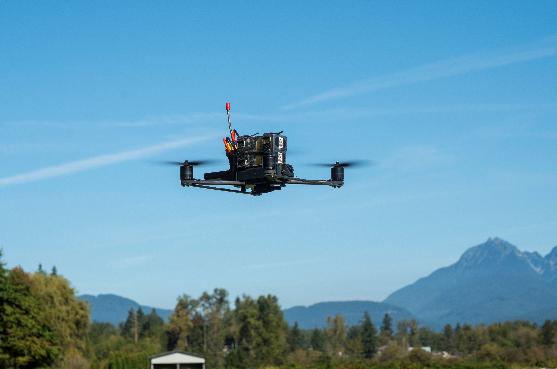
Draganfly Flex
Draganfly’s Draganflyer released in 1999 was one of the world’s first camera-equipped quadcopter drones. Over two decades later, the Saskatchewan-based company dispatched personnel to Ukraine to aid Kyiv in operating the company’s drones. Experience in Ukraine inspired Draganfly’s subsequent design of the Flex FPV quadcopter, particularly in regards to “…modularity (field swappable frames so one platform covers many roles), EW resilience, and affordable mass,” according to Budniewski.
Debuting in 2024, Flex has been delivered to the U.S. Army, U.S. Air Force Special Operations Command, an unnamed “prime defense contractor.” This May, the firm reported deliveries to two additional U.S. military units.
The UAS’s name refers to flexibility in configuration and payload, with all variants sharing a common 1.1-pound core that can be rapidly fitted with arms for 5”, 7”, 10” and 13” rotors.
“FLEX is a modular backbone: it’s common airframe swaps between reconnaissance, training, and payload delivery roles,” Budniewski emphasized.
Flex is being submitted to both Mission A—strikes conducted over 12 mile distances, as well as Mission B—’Close Quarter’ mission over 1.24 miles in built-up or even interior/subterranean environments. Consider that when navigating through buildings, the Flex 5” and 7” configurations measure just one foot and 16.3” in width respectively, which Budaniewski characterizes as “sized for tight ingress.”
| Flex 5” | Flex 7” | Flex 10” | Flex 13” | |
| Max Payload* | 1 lb. | 2.2 lbs. | 4.4 lbs. | 6.6 lbs |
| Hover Endurance (no payload) | 15 minutes | 20 minutes | 30 minutes | 40 minutes |
| Hover Endurance (max payload) | 3 minutes | 8 minutes | 10 minutes | 15 minutes |
| Range (no payload) | 6.2 miles | 12.4 miles | 18.6 miles | 24.8 miles |
| Range (max Payload) | 3.1 miles | 6.2 miles | 9.3 miles | 12.4 miles |
| Suggested Max Speed. | 75 mph | 93 mph | 93 mph | 93 mph. |
| * Some materials released by Draganfly imply a maximum 10-pound payload for Flex. | ||||
Per a Draganfly datasheet, all Flex models share in common a KT&C KPC-C20NUB HD analog day/night camera (1.27 megapixels), MAD70A ESC, an Orqa F405 controller, a Picatinny rail, and a 2.4 GHz IRC Ghost radio control system with a range of 6.6 miles (implying use of relaying or other solutions for max range strikes). Smaller Flexs use 7000 mAh batteries in a 6S configuration, while larger ones feature a 12S format and up to 14,000 mAh batteries.
“FLEX offers a layered autonomy stack – manual, semi-autonomous, position hold, full terminal guidance modes,” Budniewski told IUS. Terminal guidance has proven particularly important due to high odds of signal loss in the final seconds of kamikaze runs due to low altitude and short-range jammers.
Draganfly itself ascribes autonomous and swarming mission modes for Flex, and has integrated at least two third-party swarming systems—most recently, Palladyne AI’s SwarmOS which uses Decentralized Edge Collaborative Autonomy (DECA) to enable individually-driven swarming behaviours without reliance on continuous comms links directed by individual human operators. Earlier in 2024, the Pentagon purchased Flexs integrated with VR Rehab Inc’s Holowarrior augmented reality and swarming technology, alongside Commander 3XL heavy quadcopters intended to release and recover swarms of Flexs.
Whether any of those capabilities will be reflected in Flexs competing at Gauntlet 2 is unclear.
Draganfly by itself completed Flex in Gauntlet 1 but didn’t place amongst the top 11 ranked systems out of 26. IUS inquired as to how the new partnership with Mountain Horse for Gauntlet 2 would impact Flex’s performance.
“We used lessons learned and operator feedback to enhance the FLEX and ensure it meets all of DDP’s requirements,” Budniewski says. “ Mountain Horse/Global Ordnance brings integrated ARIES lethality, systems integrations and contracting accountability, a vetted munition partner ecosystem, and terminal guidance integration. The Gauntlet 2 offering is an end-to-end capability rather than [just] a platform.”
AG3 Labs SPADE
While there’s presently no shortage of promising 2-year-old startups in the small quadcopter industry, AG3 is distinguished for being founded by two pairs of brothers still enrolled in college at Michigan State University: Gavin and Gryson Gardner, and Ryan and Matt Atkinson.
Their 3D-printed training UASs have demonstrated such impressive autonomous swarming capabilities that they rapidly accrued prizes, funding, and military interest. AG3’s FORGE autonomy system reportedly can direct up to 15 EMBER threat-emulation drones controlled from a single tablet interface. The startup has been deployed to trainings by the Army (including its 52nd Air Defense Artillery Brigade), SOCOM, Michigan Army National Guard and NATO allies.
The company’s SPADE FPV, however, is pitched for Gauntlet 2’s Mission B close-quarters strike role. Budniewski noted “SPADE is compact, with onboard autonomy suited to constrained GPS degraded environment. Its swappable IR camera supports low and no light operations.”
SPADE’s datasheet lists a range of 1.24 miles using the stock configuration antenna with 2.4 GHz link, and roughly 20 minutes endurance while carrying its 2.2-pound payload. The 1.65-pound drone is powered by a 5,000 mAh lithium-polymer battery, and can attain a maximum speed of 72 miles per hour (capped at 45 mph when flying autonomously). The datasheet notes SPADE is “…available in two configurations covering the full spectrum from position mode to full acro [ie. manual control].”
SPADE fits into AG3’s UAS ecosystem sharing the FORGE software and HELM ground control station, also including EMBER (reported to cost $1,200 per UAV), the ANVIL heavy-lift ISR/tactical quadcopter and “a few products yet to be announced.” AG3 also offers a mesh networking node hardware called FLUX installable onto third-party UAVs for integration with FORGE, and a five-shot drone launching pod called RACK.
“SPADE runs on the same core software and hardware stack as AG3 Labs’ other platforms – by design,” Budniewski said. “They build one family of drones, not a collection of one-offs. Most operators will start flying SPADE one-to-one, getting comfortable in full FPV before expanding. However, SPADE is also capable of operating simultaneously alongside our other units, with all platforms feeding into a common operating picture. An operator can see the full picture and click into any individual drone to take manual control. Same ecosystem, same intuition – just more capability as the operator grows into it.”
IUS inquired about the leap from the training to launched effects role. “Training is where they started and it’s still their anchor,” Budniewski replied. “The move towards Launched Effects wasn’t much of a pivot – the same airframes and autonomy stack that make their drones effective Red Air threats translate naturally into effect-oriented mission. The capability is already there.”
SPADE’s Level 2 autonomy capabilities he said include “…waypoint missions, return to launch, [and] single interface control of multiple aircraft.” Generally, Level 2 or ‘partial’ autonomy, is defined as the ability to autonomously maintain stable vertical and horizontal position, estimate orientation/position, and sense—but not avoid— obstacles.
Budniewski also highlighted autonomy-enabled applications outside the one-way attack role, including “distributed ISR through single operator swarm control, area coverage, persistent target observation.”
“The last two years has been a wild ride for these guys,” Budniewski says. “They’ve been laser focused on getting systems into end users’ hands as fast as possible – real operators, real feedback, real iteration. That loop is how they were able to build a product that works at scale. Along the way they’ve picked up multiple U.S. Army xTech wins, navigated no shortage of surprises, and kept moving in the right direction. They are more focused than ever on what’s ahead.”
The closest crest on the horizon for AG3, Draganfly, Mountain Horse and 46 other companies are the Gauntlet 2 Qualifying event debuting June 8 and running through June 20 at Camp Grayling in the National All-Domain Warfighting Center (NADWC) in Michigan. Satisfactory performance in this screening round, and subsequent passage of a Production and Delivery Test, are required to participate in the Gauntlet 2 trial later this year which will result in new leaderboard scores and a flurry of production contracts.
The closest crest on the horizon for AG3, Draganfly, Mountain Horse and 46 other companies are the Gauntlet 2 Qualifying event debuting June 8 and running through June 20 at Camp Grayling in the National All-Domain Warfighting Center (NADWC) in Michigan. Satisfactory performance in this screening round, and subsequent passage of a Production and Delivery Test, are required to participate in the Gauntlet 2 trial later this year which will result in new leaderboard scores and a flurry of production contracts.