
The Pentagon’s Drone Dominance Program (DDP) announced this Wednesday its five preferred companies to manufacture modular warheads for small kamikaze drones it seeks to rapidly integrate into U.S. military service to match trends in warfare observed in Ukraine. The winning submissions came from Bravo Ordnance, Kala Defense, Kraken Kinetics, Mountain Horse Solutions and Northrop Grumman.
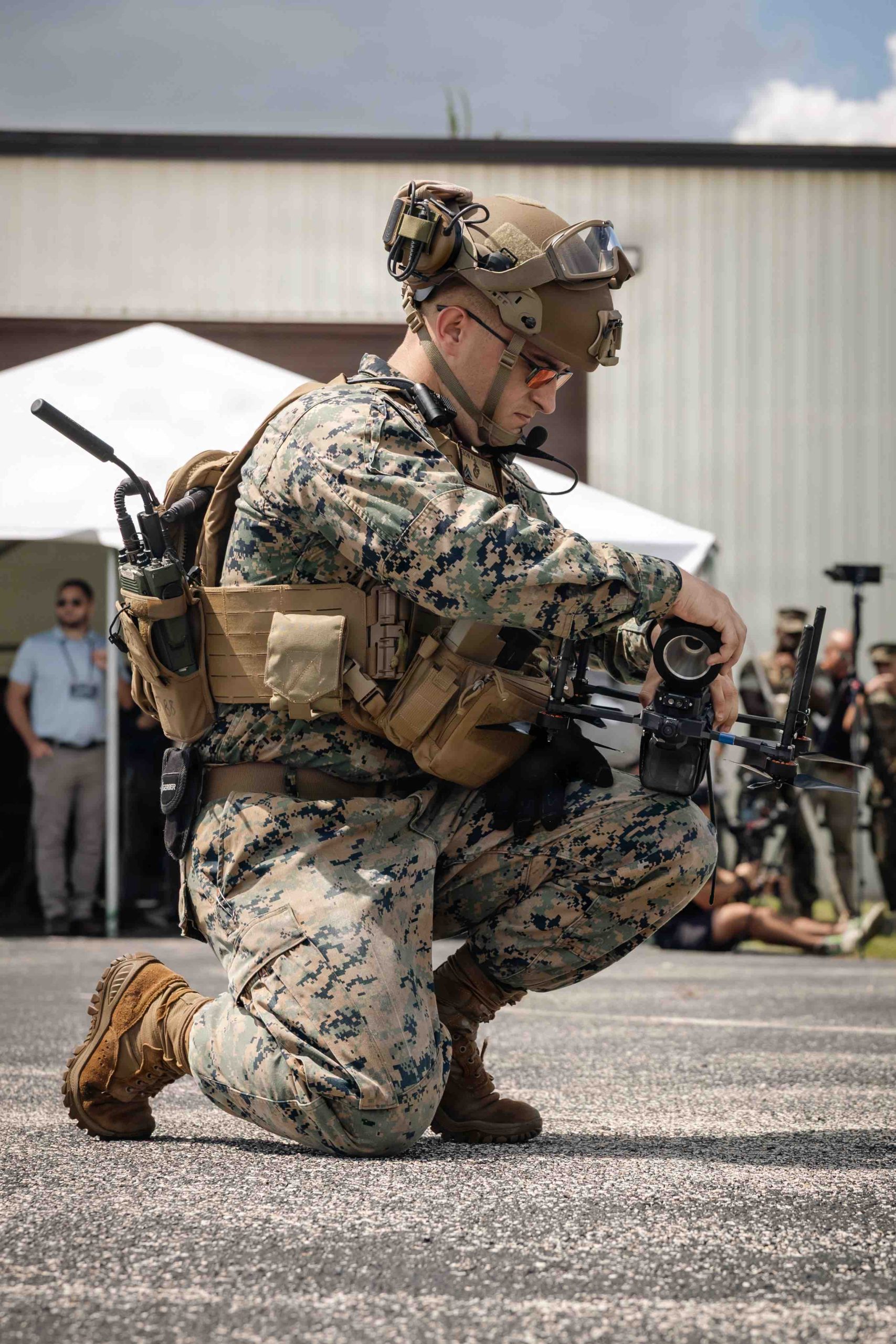
IUS can confirm specific winning submissions include Bravo Ordnance’s HitchHiker munition in its anti-personnel and anti-material variants, as well as Mountain Horse’s AREIS munition coming in anti-personnel and explosively-formed penetrator (EFP) variants. Kraken, meanwhile, likely submitted its Terminus munition.
The five winning submissions are preferred munitions solutions for First-Person View (FPV) strike drones designs submitted to the Defense Department’s Phase II Gauntlet competition most likely held this June or July. The DDP program will even assist UAV vendors with integrating those munitions into their drones and meeting safety qualifications in advance of that competition. At the same time, the program plans to conduct explosive arena and penetration tests of the winning rounds between June and August.
Lethality Prize documents also indicated DDP might choose to extend production contracts directly to some competition winners using OTA, FAR or experimental funding sources.
The Lethality Prize Challenge sought submissions of modular munitions supporting three live warhead types—anti-personnel, anti-material and armor-piercing Explosively Formed Penetrators—as well as corresponding training rounds, including their electronic or electro-mechanical safe arming devices (ESADs or EMSADs).
These munitions needed to reflect modular open-systems approach (MOSA) adaptable to diverse UAS designs, be scalable in production at affordable cost, and were preferred (but not required) to feature the Army’s standardized CLIK and sUIP interface/safety solutions and support for advanced firing modes like Height-of-Burst (HOB) fusing.
Context: why the Pentagon wants to cultivate a pool of separate munition-builders for FPV drones
Russia and Ukraine are producing literally millions of lethal First-Person View (FPV) kamikaze drones annually, and these remotely-piloted quadcopters (alongside gravity-drop ‘heavy bomber’ drones) have accounted for over 70% of combat casualties since 2024.
But while effective quadcopters can be easily assembled from cheap commercial off-the-shelf (COTS) parts, sourcing lethal munitions for these drones poses challenges often solved sub-optimally by retrofitting hand grenades or rocket-propelled anti-tank warheads. Such improvisations suffer high dud and safety failure rates in the field. Therefore an ecosystem of manufacturers like the Wild Hornets non-profit has emerged in Ukraine producing modular warheads designed for pairing with diverse separately manufactured UASs.
Mindful of Ukraine’s stunning production scaling, DDP has always been preoccupied with production scalability and supply chain disruption, and has warned that warheads accounted for a disproportionately high percentage of the price of UASs it evaluated in its Phase 1 Gauntlet. Thus it hopes the Lethality Prize Challenge will nudge the U.S.’s nascent FPV quadcopter industry towards adopting small number of favored ‘champion’ interchangeable solutions mass-producible with attendant economies of scale and training standardization.
Though DDP says it will continue evaluating other warheads offered in tandem with FPV submissions, it seems likely to favorably score drones using its pre-vetted warhead ‘champions.’
Meet the companies that won the Lethality Prize Challenge
Much like the drone designs in the DDP’s Gauntlet trial, the winners of the Lethality Prize Challenge are mostlystartups—with notable exception of Northrop Grumman and its Fuses and Munitions division, the first big defense prime to visibly participate in DDP. Perhaps its winning submission reflects experience transferred from developing the 3.12-pound Lethality Enhanced Ordnance for its six-pound Hatchet mini-glide bomb with HOB and delayed-blast fusing modes.
Arguably the next most prominent winner is Kraken Kinetics, founded in 2023 with facilities in West End and Pinehurst, North Carolina. That company’s Terminus warhead has been deployed operationally in Ukraine and publicly identified as the payload for several Gauntlet-winning UASs: the Griffon Aerospace Scourge, Neros Archer, Auterion SLM-10, Nokturnal AI Nightmare, and ModalAI’s Seeker Vision FPV drone.
Kraken’s website offers payloads including thermobaric, thermite and reactive-material fillers, and ‘standard’ solutions including tungsten-fragmentation, shaped charges and EPF warheads and triple-redundant safe-and-arm devices. Terminus, which resembles a big telephoto lens, also features an additional LIDAR-based HOB triggering mode allowing standoff detonation of armor-piercing EFPs from an optimal distance to defeat cage or spaced armor increasingly popular on armored vehicles for drone defense. The company also offers a Terminus-LV variant with a lower-voltage ESAD to foreign partners.
Meanwhile, Mountain Horse Solutions was founded in 2014 at Colorado Springs and merged with Global Ordnance in December 2022. It offers diverse tactical and CBRNE equipment, ‘drop-in’ autonomous USV conversion kits (DMAKs), and a diverse catalogue of UASs: FPV quadcopters, competition-winning FD-1 drone interceptors by S3 WERX, the Talon DT-300 tandem-rotor cargo SUAS, heavy-lift octocopters and even the British Modini Dart-250 jet-powered strike drone.
Mountain Horse’s Aerial Remote Explosive Initiation System (AREIS) is “…CLIK/sUPI ready and built to MOSA (Modular Open Systems Approach) principles,” according to the company’s UAS/C-UAS program director Richard Budniewski, and is offered both pre-packed and field-packable, supports both ESAD and EMSAD architectures, and is adaptable to low-voltage as well as the default high-voltage configuration.
While AREIS is new, he said it “…draws on combined operational experience from multiple component systems currently in use globally.” The company press-release stresses partnerships with Argus Industrial, Gale Force Marine, and Crucial Defense Technologies. Both AREIS’s anti-personnel and EFP variants weighs 3.86 pounds, with the former including .5 pounds energetic filler and the latter 1.5 pounds. The EFP penetrates more than 1” steel, “a meaningful capability at that size and weight class,” according to Budniewski.
On the production scale side of things, Budniewvski emphasized partnership “…with vendors that have operational experience and the throughput to meet DDP demands—including energetic supply”, and that parent company Global Ordnance “…brings the manufacturing footprint, logistics, and financial capital to scale rate/capacity significantly.”
By contrast, the youngest winner is Bravo Ordnance, founded in 2025 in Bastrop near Austin, Texas with just sixteen employees by former Navy weapons specialist/chemist Jacob Lambuth and Y-Combinator alumni Devan Plantamura. The company says it can develop new munitions from concept to prototype in under two weeks’ time, leveraging computer-based modeling and 3D-printing technology. Its website specifies fragmentation sleeve technology, “advanced kinetic”, C-UAS and thermobaric payloads designed for rapid integration into UASs, USVs and torpedoes.
The company’s likely winning submission, HitchHiker, was conceptualized by Lamuth in December last year, with the first 10 units produced just 19 days later and dynamic strike tests conducted just eight days after that per a company LinkedIn post. HitchHiker comes in anti-material, anti-personnel, EFP and downwards fragmentation variants, is compliant with the Army’s preferred CLIK standards, and mates onto UASs with a 5” Picatinny belly rail —traits Platanmura told IUS have enabled integration onto new platforms with “little to zero physical modification.”
“We designed our HitchHiker offering to be modular across ESAD, energetics, and kinetic effect as well as scalable across different sizes of loitering munitions platforms.” Pointing to different parameters for long range versus urban close-quarters strike drones, he added “We have a much smaller warhead that follows the same modular approach using the CLIK standard +, and mounting format focused on the EFP anti-armor effect; and will be debuting this offering at SOF WEEK.”
Plantamura emphasized Hitchhiker’s simplicity, safety and adaptability in an email to IUS, saying it was “…specifically designed around safe and easy load and packing for seasoned special operators all the way down to fresh trained recruits out of boot camp. As a former service member who never made it past the rank of E-4 I demanded ease of use from the team…”
Plantamura writes that HitchHiker’s kinetic effectiveness had been validated by third-party arena tests, that Bravo already has “multiple teaming agreements,” and that “Other warheads we have designed have been shown to be extremely lethal overseas in Ukraine.”
Bravo, he said, is scaling production capacity to support tens of thousands of munitions monthly and seeks to encompass production of every subcomponent, including transitioning towards self-producing energetics. “We are already producing our own explosives in small quantities at our facility as the RDX supply chain out of Tennessee is extremely fragile and the only other source of RDX.”
He says current munitions industry sourcing challenges stem from “inadvertent concentration of risk created by legacy requirements” which he says “…have accrued specification debt” with the emergence of small, low-cost drone warfare. “Performance-based standards can enable a resilience-focused modernization without sacrificing safety or reliability,” he argued.
Bravo boasts it can develop new munitions from concept to prototype in under two weeks’ time, leveraging computer-based modeling and 3D-printing technology. Its website specifies fragmentation sleeve technology, “advanced kinetic”, C-UAS and thermobaric payloads designed for rapid integration into UASs, USVs and torpedoes. Per a GQ profile, Bravo is shipping warheads sans explosives to Ukraine, as well as producing warheads with RDX explosives sourced from a factory in Tennessee—with ambitions to eventually produce RDX and HMX internally.
Besides HitchHiker, LinkedIn posts reveal Bravo has already developed a C-UAS warhead for a mini-missile developed by Corvus Industries, and an anti-radiation/aircraft warhead “already being used in combat.”
Kela Defense (or Kela Technologies) meanwhile is an Israeli defense startup founded mid-2024 with funding from the CIA’s In-Q-Tel venture capital fund, as well as Sequoia Capital and Lux Capital. Based in Tel Aviv, its leadership team is composed of veterans from Palantir and elite Israeli intelligence and special operations forces units. The company touts a focus on open-architecture C2 platforms with AI-driven data fusion, as well as integrating capabilities into UAS platforms. Kela has offices in New York and San Francisco and has partnered with Neros on developing an NDAA-compliant fiber-optic variant of the latter’s Archer drone. However, its production of drone munitions doesn’t appear to have been made public until now.
Inside Unmanned Systems has reached out to manufacturers for comments and will update if it receives further reply.