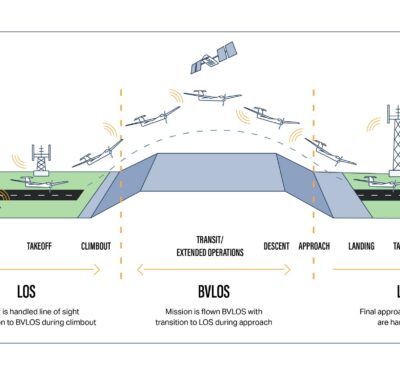

The Association for Uncrewed Vehicle Systems International (AUVSI) has released its initial analysis of the Federal Aviation Administration’s (FAA) long-awaited Notice of Proposed Rulemaking (NPRM) on Beyond Visual Line of Sight (BVLOS) operations.

The proposal—covering new Parts 108 and 146—lays out a performance-based, scalable framework to replace the waiver-driven system that has governed BVLOS approvals for years.
“The BVLOS NPRM is a watershed moment for the UAS industry and for U.S. leadership in advanced aviation,” AUVSI stated. “By replacing a system of one-off approvals with a comprehensive, performance-based framework, this rule has the potential to unleash unprecedented opportunities for innovation, economic growth, and civil interest efforts.”
AUVSI commended the FAA, TSA, DOT, and the White House for their leadership, noting that the proposal “delivers a strong foundation” for safe and scalable BVLOS operations. Among the provisions AUVSI supports:
- Performance-based operational pathways — operational permits and operational certificates tailored to the scale and risk of missions.
- Airworthiness via consensus standards — enabling industry-led, standards-based acceptance rather than prescriptive rule language.
- Defined safety roles — Operations Supervisors and Flight Coordinators to strengthen accountability.
- Part 146 for Automated Data Service Providers — establishing a regulatory baseline for UTM and cooperative operations.
- Broad mission accommodation — from public safety to commercial delivery and recreational BVLOS.
At the same time, AUVSI identified several areas for refinement, including clear transition pathways for current BVLOS waiver holders, proportional compliance options for small and public safety operators, and more clarity on the operational permit vs. certificate distinction.
The association also urged careful calibration of TSA’s role, cautioning against applying “commercial airline-style security requirements to small drones,” and called for “clear, quantitative benchmarks” to guide risk-based compliance.
“Getting this right will require collaboration, precision, and commitment from all stakeholders,” AUVSI said. “The FAA and TSA have put forward a strong foundation, but the details, transition for existing operators, and implementation plan must be refined to ensure the rule works for operators of all sizes and missions.”
AUVSI will submit detailed comments to the FAA and TSA, and continue engaging with regulators, legislators, and industry stakeholders to ensure “the final rule is implemented in a way that enhances safety, supports growth, and preserves U.S. competitiveness.”
Read AUVSI’s full initial analysis here: https://www.auvsi.org/unlocking-routine-bvlos-operations-auvsis-initial-analysis-of-the-faas-nprm/