
BAE Systems unveiled a Loyal Wingman drone fighter called Brontanax at the UK’s Farnborough airshow: a prototype the company’s FalconWorks branch began secretly developing at Warton in 2022 with the efforts of 500 employees and 75 partner companies.
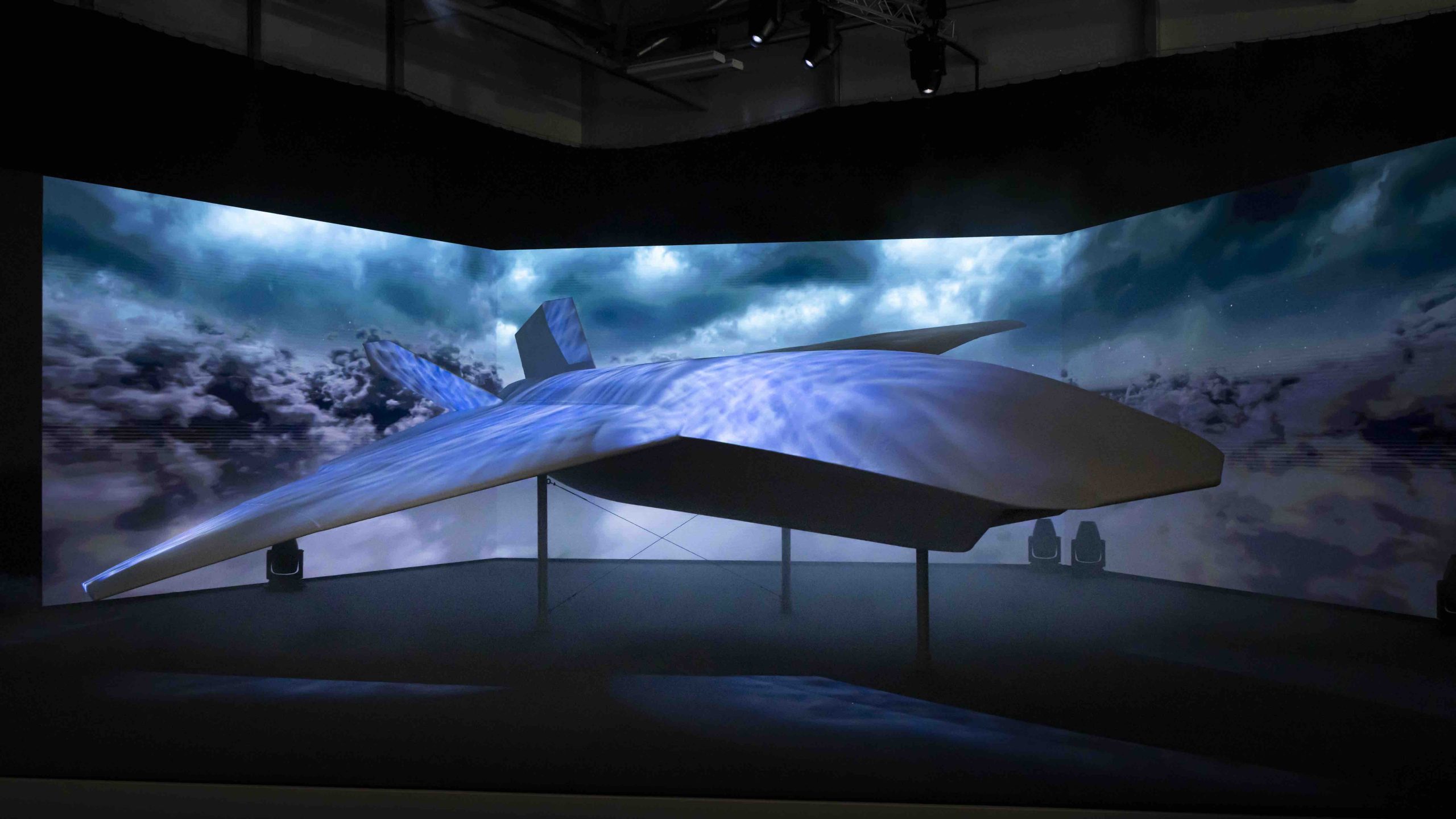
This stealthy-looking ‘drone fighter’ is intended for teaming with the UK’s 4.5-generation Typhoon fighters by offering supporting air-to-air, precision air-to-ground and electronic warfare capabilities. BAE is preparing the Brontanax prototype for ground tests at Warton, and anticipates a first flight by second quarter 2027, followed the same year by participation in NATO’s Steadfast Defender exercise.
The public debut of Brontanax—‘Thunder King’ in Ancient Greek— comes just after the Ministry of Defense kicked off its Storm Fighter program to acquire loyal wingman drones for the Royal Air Force (RAF).
A 3D visualization released by BAE shows four of the drones flying in formation with Typhoon jets, firing missiles from their stealthy internal weapons bays, and even taking off from one of the Royal Navy’s Queen Elizabeth-class carriers.
Brontanax is roughly the size of a BAE Hawk training jet (the latter with a 33-foot wingspan) and weighs roughly 5.5 U.S. tons, sporting a thick fuselage with substantial-looking weapons or fuel capacity. Indeed, BAE says the bay is “compatible with all weapons currently in RAF service”—with notable exception of 5-meter-long Storm Shadow cruise missiles. That still leaves space for powerful 3.65-meter-long Meteor air-to-air missile and 3.8-meter Paveway II glide bombs, as well as smaller weapons such as the Brimstone and forthcoming SPEAR3 air-to-surface missiles, and ASRAAM short-range air-to-air missiles.
The design currently uses an American Williams turbofan with an ‘overbite’ intake under the chin for propulsion, though its hull reportedly can support a Rolls Royce Orpheus twin-spool turbofan if desired. The prototype’s fuselage geometry and serpentine inlet suggest significant effort towards Radar Cross Section reduction. Meanwhile, the trapezoidal wings extending into the tail recall the Tempest/GCAP stealth jet BAE is co-developing with Mitsubishi and Leonardo.
BAE say Brontanax has “modular and open architecture” facilitating easy upgrades and mission re-configuration, and can be controlled both by airborne fighter pilots or from ground bases while complemented by “goal-based autonomy.” Reportedly its BAE-designed control system follows the Defense Ministry’s Pyramid open avionics systems reference architecture.
There remain few firm details regarding Brontanax’s performance specifications, software and hardware. However, a BAE spokesperson suggested Brontanax would cost one-quarter as much as a Typhoon, implying a $25-30 million price tag almost identical to that pegged for the U.S. Air Force’s Increment 1 Collaborative Combat Aircraft (CCAs), the FQ-42 and FQ-44. FalconWorks director Dave Holmes likewise stated Brontanax can perform 70-80% of a Typhoon’s missions at 20-25% the cost, and that its range and endurance will compare favorably to rival CCAs.
Storm Fighter on the horizon, Mosquito in the rearview mirror
Five days before Brontanax’s unveiling, the UK’s Ministry of Defense revealed it was spending £300 million (roughly $400 million) towards testing a ‘Storm Fighter’ to serve as a multi-role loyal wingmen for the RAF—nested inside broader plans to spend $6.6 billion on autonomous systems over the next four years. Storm Fighter will serve as both an “attack dog” and “guardian angel”, according to minister Luke Pollard, with air-to-air, air-to-surface and electronic warfare missions.
Another RAF official was quoted saying the service wanted loyal wingman that were “good enough, cheap enough, that can be produced fast enough” echoing the ‘affordable mass’ buzzword in U.S. defense circles. BAE air sector director Simon Barnes also described Brontanax’s role as to “generate greater combat mass at low cost,” “extend the reach of crewed aircraft”, and “keep pilots out of harm’s way.”
Storm Fighter follows the Royal Navy’s Project Vanquish RFI released last October 2025 seeking an Autonomous Collaborative Platform (ACP) STOL jet for testing from QE carriers. The maritime services broadly plans to transition its Fleet Air Arm to a majority unmanned force by 2040. BAE’s Holmes claimed BAE could easily implement production line modifications including an arrestor hook and ruggedized airframe and landing gears for carrier operations, should the Royal Navy express interest.
However, British defense commentators have expressed skepticism London will follow up tests with the funding needed to actually procure bigger-ticket drones in volume given that the UK can only barely fund its cornerstone sixth-generation GCAP jet.
Underlying such pessimism is recollection of Project Mosquito, kicked off by the RAF’s Rapid Capabilities Office in 2020. This saw the UK’s Spirit Aerosystems partner with Northrop Grumman to develop a loyal wingman to accompany British F-35Bs. This was canceled in 2022, with RAF officials suggesting they preferred to pivot towards a cheaper, faster-to-develop design.
The Great Loyal Wingman Race: BAE Brontanax versus the field
By the mid-2020s every major air force on the planet is considering how and when to integrate loyal wingman/CCA drones into service. And one after another, every large defense-aerospace corporation is trotting out its own loyal wingman offering, hoping to stake a place in that emerging market.
Brontanax will thus test whether the UK’s need for CCAs will be satisfied by a UK-based company. BAE System was already well positioned to join the trend, having developed the stealthy Taranis flying-wing stealth drone demonstrator in the 2010s, and cooperated closely with Lockheed on the F-35 stealth jet program and that corporation’s high-end stealth-optimized Vectis CCA.
BAE’s decision to develop Brontanax independently before a formal government requirement was a wise one given the thread bone state of the British defense spending, the late hour of Storm Fighter’s announcement, and the fact that Brontanax must compete against several already flying CCAs (FQ-42, FQ-44, MQ-28, and XQ-58).
Indeed, Boeing particularly is aggressively marketing its MQ-28 Ghost Bat loyal wingman in Europe having secured Australia as a buyer/co-developer, and Germany’s Rheinmetall as a potential continental manufacturing partner. Other U.S. defense aerospace companies including Lockheed-Martin, General Atomics and Northrop Grumman have their own points of entry into British military procurement. And for good measure the U.S.’s Kratos is partnered with Airbus, which is now offering a trifecta of CCAs.
BAE, however, may be able to anchor Brontanax’s appeal on both a qualitative and political dimensions. Of course, domestically-built platforms have a huge leg up in securing orders—not just for directing economic benefits to constituents, but because the second Trump administration turbulent, anti-NATO foreign policy is disincentivizing continued reliance on American platforms.
Still, political appeal won’t guarantee Brontanax orders if more mature, foreign CCAs are much cheaper and lower risk. In that regard, BAE is competing qualitatively, as the company’s pitch implies Brontanax will come at a cost equivalent to U.S. FQ-42 and FQ-44 CCAs yet boast much greater mission versatility (air-to-air, air-to-surface, and EW, not just air-to-air), payload (all internal and seemingly larger capacity), and possibly stealth.
As a member of the Eurofighter consortium building Typhoon fighters, BAE is also positioned to optimize integration with Typhoon. Given the difficulties 4.5-gen aircraft face from long-range anti-aircraft weapons like Russia’s R-37M air-to-air missile and S-400 surface-to-air system, they arguably may need loyal wingmen more than stealth fighters do.
If BAE can successfully brand Brontanax as the CCA “by the builders of Typhoons, for the operators of Typhoons,” that might encourage export to the nine other Typhoon operators beyond the UK (Austria, Germany, Italy, Kuwait, Oman, Qatar, Saudi Arabia, Spain and soon Turkey.)
On the other hand, because Brontanax remains years behind key, it may have limited margin for error should time-consuming problems delay flight testing or manufacturing development.
BAE also technically faces at least one potential domestic rival, a design concept proposed by MGI Engineering called the T-022 Vortex aiming for very long range (2,500 miles), a half-ton payload and very low price of $4-8 million range for maximal affordability/attritability.
Given BAE’s bona fides in stealth and drone technology, and the growing political appeal of ‘sovereign’ platforms, Brontanax seemingly has a good shot at securing its place as the RAF’s first Loyal Wingman entering service as soon as 2030. Depending, that is, on whether flight testing proceeds smoothly, and if London can follow up tests with the funding needed to kick start mass production.