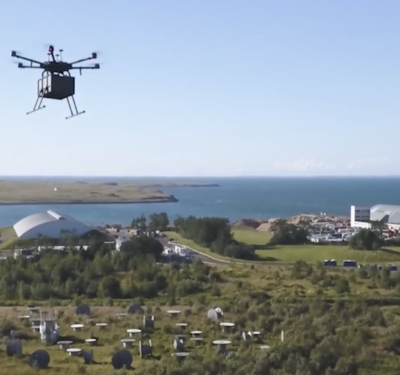

The Pentagon’s Drone Dominance Program (DDP) has issued a dramatically expanded list of participants for its second competitive Drone Dominance Gauntlet trial held this summer—this time competing a total of 48 companies with 78 distinct types of small one-way First Person View (FPV) kamikaze drones.
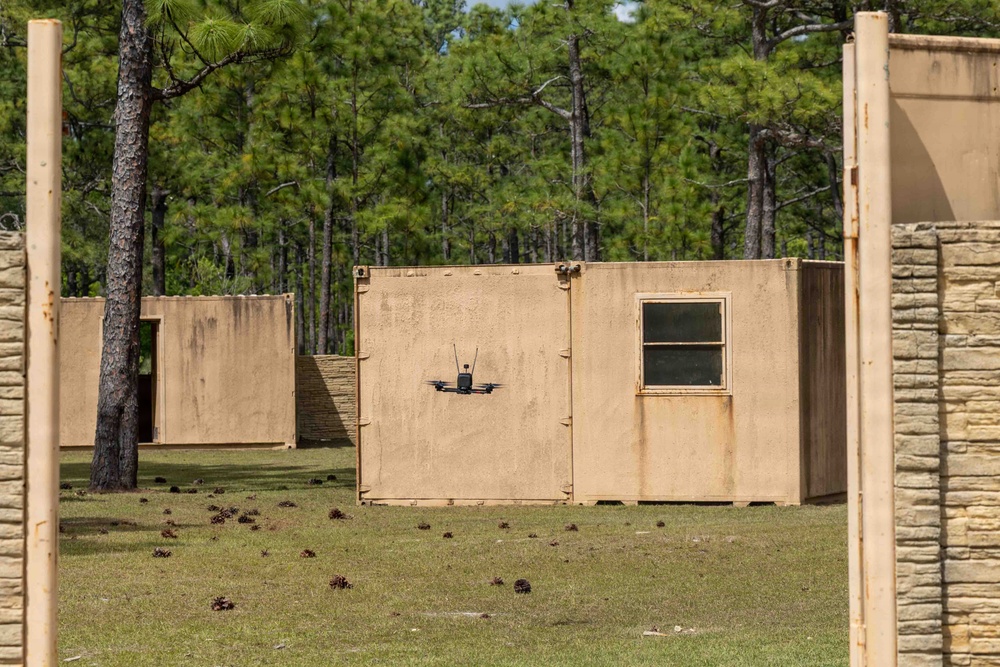
Cheap FPV drones mass-produced in the millions have come to dominate tactical ground warfare in Ukraine since 2022, and the DDP is engaged in the second of four progressively more demanding Gauntlet competitions intended to nurture America’s drone industry to build capacity for mass FPV production without Chinese parts—while identifying the best FPV designs for various missions. Ultimately DDP plans to spend $1.1 billion procuring 300,000 FPV drones from top-performers in Gauntlet trials.
The first Drone Dominance Gauntlet held last February involved 26 companies fielding just one UAS each—and yielded 11 award-winners out of a possible twelve. For Gauntlet 2, however, the DDP is competing long-range (12+ miles) strike drones separately from short-range ‘Close Quarters’ drones for urban, interior and subterranean environments. Ultimately, DDP plans to award contracts for 5 long-range and three close-quarters drones for Gauntlet 2. That’s why Gauntlet 2 has more UAV submissions than participating companies.
Participating companies must supply 120 of their submitted UAVs and eight sets of durable components (control systems, additional comms etc.) for trials conducted by military personnel. Top-performing UASs—based both on mission outcomes and operator ratings—will have their scores posted on the online leaderboard, and will be awarded production contracts for between 9,500 and 4,000 UAVs with two batch delivery dates.
Companies are held to a per-UAV price ceiling of $5,500 or $4,500 for long- and short-range drones respectively, and even stricter restrictions on incorporating Chinese components than in Gauntlet 1. (Read IUS’s earlier article on Gauntlet II for more specifics on requirements and contract awards.)
The 48 qualifying submissions depart dramatically from the slimmed-down selection of 18 qualifiers initially planned for Gauntlet 2. Judging by DDP’s history to date, don’t be surprised if companies are dropped or added by the time the Gauntlet 2 trials take place this summer, and if there are more or fewer winning submissions than expected.
Unlike Gauntlet 1, Gauntlet 2 trials will take place under continuous C-UAS jamming, and military operators will receive four days of familiarization rather than just two hours. This could potentially swing scoring towards more sophisticated UASs and those with superior performance under GPS/control-link degraded conditions.
Gauntlet 2 will also feature more dynamic day/night missions, including against moving targets, and will more heavily reward autonomy features like Automatic Target Recognition, terminal guidance and ‘cognitive de-loading’ for operators generally.
A related Lethality Prize Challenge initiative by DDP may result in a preferential scoring for UASs using warheads by one of five preferred manufacturers: Bravo Ordnance building the Hitchhiker munition, Israeli Kela Defense/Systems, Mountain Horse Solutions and its AREIS Warhead, and Northrop Grumman and its Common UAS Payload.
Late in April DDP also shared a Supply Chain Framework with guidelines for phased imposition of supply chain restrictions exceeding current statutory requirements. The framework particularly affects magnets, batteries, Printed Circuit Boards (PCBs), Semiconductors, the mineral germanium, and a broad array of UAS subcomponents.
What do we know about companies participating in Gauntlet Phase 2?
While larger, older aerospace companies were mostly absent from Gauntlet 1 in favor of young startups, round two sees two drone heavyweights join the arena as award-contract contenders. AeroVironment is well known for its RQ-11 Raven and RQ-20 Puma ISR drones, and more pertinently for its Switchblade family of loitering munitions. Kratos, which participated in Gauntlet 1 without making the leaderboard, returns with greater visibility; the company is known for fixed-wing target drones and its pioneering Valkyrie loyal wingman jet.
Other prominent newcomers include PowerUS—a drone startup backed by investors including Donald Trump Jr. and Eric Trump—Orqa, a newly established U.S. subsidiary of the eponymous Croatian FPV producer, and Envision Technologies which was earlier contracted for the Army’s Purpose Built Attritable System (PBAS) program but did not participate in Gauntlet Phase 1. Envision, Orqa and PowerUS already offer modular, multi-size FPV UASs called Proteus, MRM2 and Matrix.
All but five Gauntlet 1 qualifiers (or 7 depending how you count) are participating in Gauntlet 2. Those not reappearing include Anno.ai, DZYNE Technologies (which recently unveiled the fixed-wing Blitz FPV drone competed in Gauntlet 1), Greensight, Paladin Defense Services, and Titan Dynamics.
There are two corner-cases pertaining to third-place finalist Napatree and eighth-place Nokturnal AI. Neither is technically in Gauntlet 2, but their submissions likely are. Nokturnal was a U.S. manufacturer of the Nightmare drone by Denmark-based Renegade UXS (oddly both under separate Blue UAS listings). Meanwhile, Napatree have distributed the same Bumblee and Hornet drones associated with Perennial Autonomy, both entities connected to Eric Schmidt’s Project Eagle company. Now Renegade and Perennial are listed for Gauntlet 2 but not Nokturnal and Napatree.
Finally, Gauntlet 1 participant General Cherry is now partnered with New Hampshire-based Wilcox Industries under the joint-venture as Wilcox-Cherry Defense LLC; and Mountain Horse Solutions, a Lethality Prize winner, has partnered both with Canada’s Draganfly and newcomer AG3 Labs.
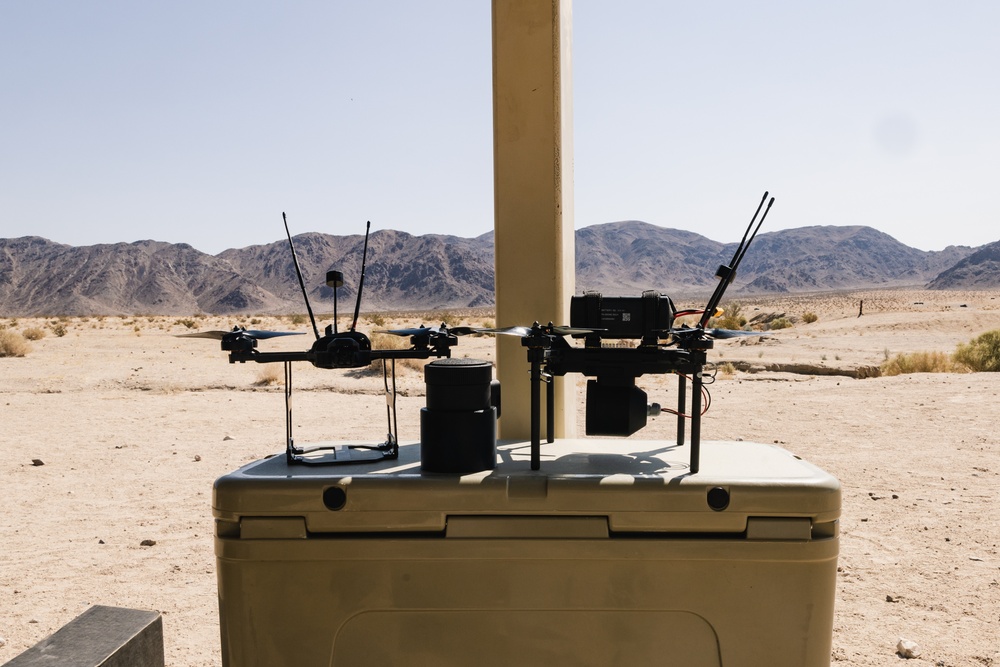
Drone Dominance Gauntlet: Phase 2 Qualifiers
Returning Gauntlet 1 companies (award winners noted with *) [17]
Ascent Aerosystems Inc.*, Auterion*, Draganfly (now in partnership with Mountain Horse Solutions), Ewing Aerospace, Farage Precision*, Griffon Aerospace*, Halo Aeronautics*, ModalAI Inc.*, Neros*, Performance Drone Works, Skycutter*, Swarm Defense, Teal Drones, Ukrainian Defense Drones (UDD) Tech Corp.*, Vector Defense Inc., W.S. Darley, XTEND Reality Inc.
Companies likely competing UASs from Gauntlet 1 under a different company name: [3]
Perennial Autonomy*, Renegade UXS*, Wilcox Cherry Defense (formerly as General Cherry)
Returning without leaderboard placement: [1]
Kratos [participated in Gauntlet 1 but did not make the leaderboard]
Newcomers to Gauntlet [27]:
Adler Aerospace LLC, ADS + LUMENIER, AeroVironment Inc., Agilis Air Inc., Chase Defense Partners/Advanced Aircraft Company, Chey-Tay Inc., Cyclops Defense LLC, DefendEye USA Inc., Envision Technology LCC, Grim Tech, Hyperscale, LTMiltech USA, Mountain Horse Solutions + AG3Labs, Orqa, Planned Systems International, PowerUS, Rajant Corporation, SOF Landing, Stellarion, T3i Inc., Tesseract Ventures, UAS Nexus, Vantor Inc., Viter Systems Inc., Volatus Aerospace USA, WGS Systems LLC, Zaruba
Perspective: Back and Swinging for Gauntlet 2
One company returning to the fray for Gauntlet Phase 2 is Alabama-based Performance Drone Works. Its Attritable Multirotor (AM) did not make the Gauntlet I leaderboard, though DDP did specifically commend its mass-production capacity on its website.
While the company’s C100 ‘Mothership’ heavy quadcopter is being mass produced to serve as an Army company-level multi-mission drone, PDW has readied production capacity for AM and sought to migrate capabilities from C100 including jam-resistant comms, networking and navigation systems and long-endurance hardware.
PDW CIO Ryan Gury, co-founder of the Drone Racing League, and CTO Dylan Hamm, a former Navy SEAL, spoke with IUS prior to the new DDP announcement sharing their experience with Gauntlet 1 and their hopes for qualification in Gauntlet 2. (Their comments, excerpted from a wider-ranging interview, have been lightly edited for concision.)
Would you be able to share anything about the experience with Gauntlet Phase 1?
“So Gauntlet 1 was a very basic straightforward engagement, you know testing if you had integrated an ESAD (explosive safe arm device) and you could go hit targets. That was the baseline. What we’re very excited about with Gauntlet 2 is that layering in of electronic warfare and complex scenarios. We feel that the AM is very well-suited for those types of environments and we’re excited to have the opportunity to participate.”
Was there any feedback from the trials that you wanted to incorporate into the design of AM?
“I think some of the best lessons learned were really from that direct operator feedback. So we had a limited amount of time to train the soldiers and then seeing the successes there and some of the challenges really allowed us to extrapolate: how do we deploy the system not only through the production line, but to train the end users to effectively utilize it? Because the government right now wants millions of drones. They also have to scale their piloting capacity. So a part of our job, as well as making a solid platform itself, is to scale that ability for them to train the soldiers, make this very simple to use and highly repeatable.”
Can you give an example of how you have adapted your approach to usability based on feedback?
“I think tailoring mission workflows is really how you help the customer maintain success. So if they’re going to hit a target and that is all they’re trying to do, you need a workflow that starts from—round one, pairing of the platform, launch, takeoff, counting down distance to target, giving you that fidelity of where that target area is and then helping with final engagement. So we’re very focused on workflows to make sure that from taking this out of the rucksack to that final target engagement, it’s very streamlined.”
So a big question mark is whether the domestic American supply chain can actually support a bunch of different companies all suddenly building thousands of FPVs monthly simultaneously [without Chinese parts]. What is your perspective on the supply chain? And are the Gauntlet exercises having the desired effect of stimulating its maturation?
“A big part of that is the supply chain schedule that they released, which outlines between now and future phases that natural progression of more restrictive applications towards systems and subsystems. Some of the most impacted of those initially being motors—they want motors that are manufactured outside of China next year. And a big emphasis on getting battery assemblies outside of China to reduce that risk to the supply chain. So, I think it’s going to take time.
“Right now, there are a variety of vendors out there that can supply compliant materials, but you really have to engage to make sure you are getting 1) the performance you’re looking for and 2) that availability. So there’s a lot that goes into it, but I think that we are definitely as a nation moving in the right direction.”
What are the parts of the supply chain most in need of greater supply/economies of scale?
“Motor manufacturing and batteries would be the big ones. There’s a lot of companies being stood up to service that demand. The other one is highly embedded systems—any of those surface mount components you see scarcity of in the market, like DDR4 and DDR5 (RAM modules/sticks).”
So how would you characterize AM-FPV compared to other tactical FPV/loitering munitions?
“You see a lot of low capability, low cost one-way strike platforms, and the other end of the spectrum—very high capability, very high-cost platforms that can conduct ISR type missions. So we’re trying to fit somewhere in between where we can support a variety of missions while carrying up to five-pound payload. There’s a lot of utility within that space that our customers can explore and develop applications. A 60-millimeter mortar round is around 4 pounds for high explosives. Then it comes out to endurance—[AM] can carry up to 5 pounds for 18 minutes, which allows to get a lot of work done, cover some good distance and actually employ those. In that mission application you [even] get to recover the platform and then reuse it again for that next operation.”