
Near Earth Autonomy and partners Honeywell, Moog and XP Services have completed a year of integration and flight work on the RUC-60, an optionally crewed UH-60L Black Hawk converted for contested logistics missions, and are now preparing for a full slate of mission flight testing through 2026.
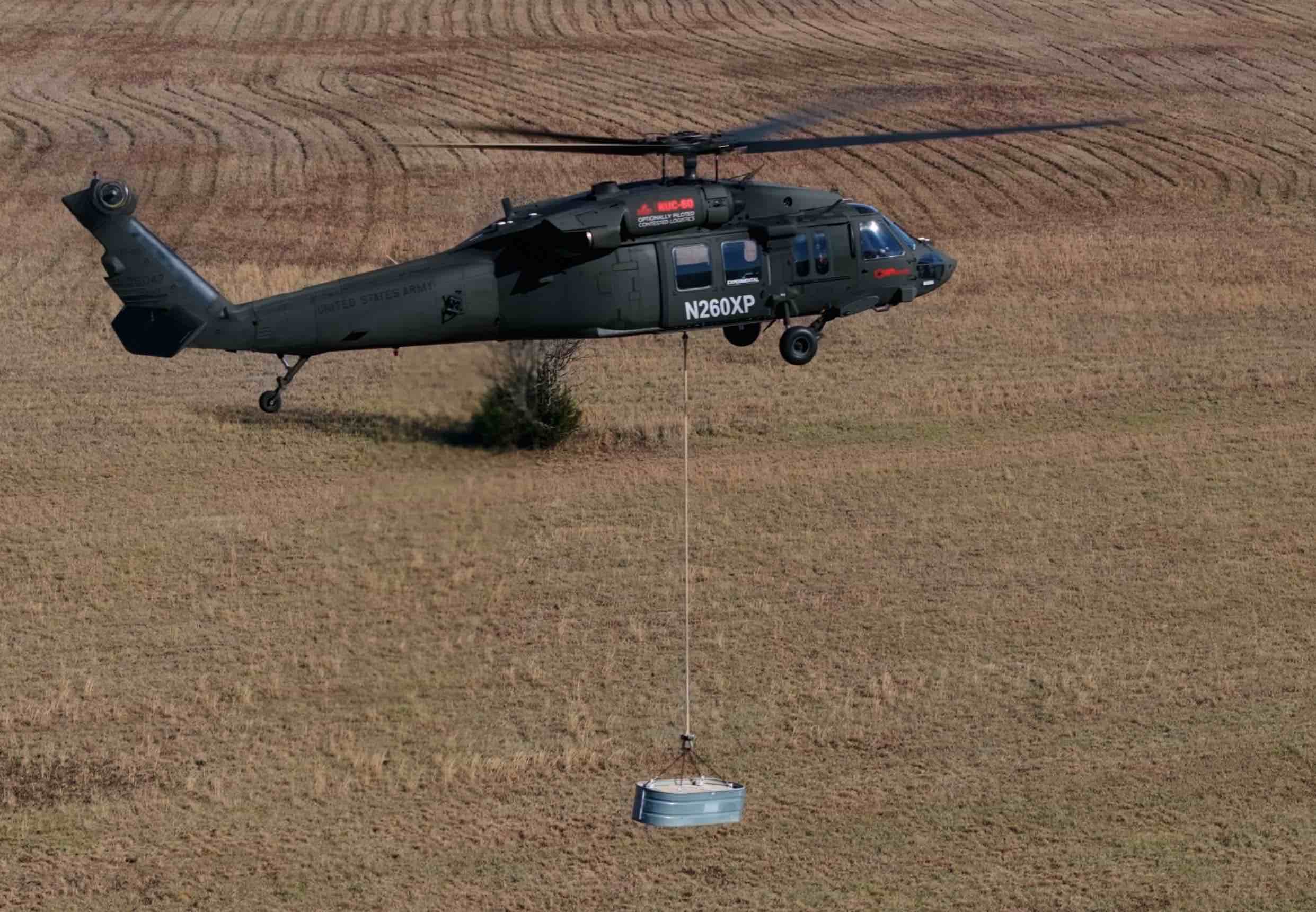
The RUC-60 (Responsive Uncrewed Capability) is designed as a fully integrated logistics aircraft built from surplus Army UH-60L airframes and equipped with Near Earth’s Captain architecture, a safety-critical autonomy system being developed for accreditation under existing aerospace standards. The team’s work over the past year has focused on maturing the autonomy stack, avionics, flight controls and integration roadmap toward productization.
Last summer, the team flew the first of its privately owned Black Hawks on a fully automated sortie from takeoff through landing, demonstrating Captain in a live environment alongside upgraded flight computing, perception sensors and flight control systems. Subsequent integration demonstrations have refined how the system will support end-to-end logistics operations in the field.
Uncrewed logistics for a contested battlefield
Near Earth and its partners position the RUC-60 squarely against a doctrinal shift in how the U.S. military sustains forces in high-threat environments, where large logistics hubs and concentrated assets become attractive targets. In that context, autonomous aircraft that can distribute supplies without putting crews at risk are seen as a key enabler for future operations.
Most current sustainment relies on crewed helicopters and fixed-wing aircraft, which face tempo limits and increased vulnerability along predictable routes. At the same time, many uncrewed alternatives either lack the payload capacity required for heavy logistics or are still years away from operational deployment.
By contrast, the RUC-60 concept repurposes UH-60Ls already in the Army inventory. Near Earth notes the Army has more than 700 UH-60Ls heading toward retirement as newer MV-75 and UH-60M variants enter service. Each legacy Black Hawk, they argue, can move up to 90,000 pounds of cargo per day, with mature maintenance infrastructure and spare-parts pipelines already in place.
“As these aircraft transition out of front-line crewed roles, they provide a ready platform for uncrewed logistics,” Near Earth CEO Sanjiv Singh said in the release. “Once that’s in place, the same autonomy stack can scale to larger platforms and new missions such as casualty evacuation and disaster relief.”
Captain autonomy, Anthem avionics and Genesys flight controls
The RUC-60 is built around Near Earth’s Captain autonomy architecture, designed as a deterministic, safety-critical framework that takes on the full role of the crew—from “cold” on the flight line through mission execution and shutdown. Captain is being developed to meet aerospace accreditation standards and to support a Modular Open Systems Approach (MOSA) so new capabilities, sensors and missions can be integrated over time.
Honeywell is supplying its certified Anthem avionics suite, along with resilient navigation, Satcom and systems-engineering support. The company characterizes the partnership as both a defense logistics enabler and a potential model for adapting existing helicopters to next-generation uncrewed roles, with an emphasis on keeping aircrews out of high-threat environments.
Moog’s contribution centers on its Genesys GRC 4000 four-axis autopilot and associated flight-control hardware. In July testing at XP Services’ Tullahoma, Tennessee, facility, Near Earth and Moog demonstrated automated UH-60 flight using the Genesys system for deterministic control, including automated takeoff, hover and landing without pilot stick input. The prototype has since received FAA TSO civilian certification, positioning it for both defense and dual-use applications in national airspace.
XP Services, a veteran-owned aviation engineering and integration firm, is handling aircraft modification, certification and flight-test support. The company has conducted hundreds of aircraft conversions since 2008 and says it has the capacity to install RUC-60 kits at the rates and quality levels military customers would require.
Pathway to fleet-wide autonomy and Future Vertical Lift
Beyond the RUC-60 itself, Near Earth emphasizes that Captain and the broader architecture are intended as a scalable roadmap for migrating autonomy across rotorcraft fleets. The MOSA approach is meant to ease upgrades, enable new mission packages and extend the same autonomy core to additional platforms such as heavy-lift helicopters.
By pairing surplus UH-60L airframes with a certifiable autonomy and avionics stack, the company and its partners argue they can deliver an uncrewed logistics workhorse that operates around the clock in GPS- or communications-denied environments, without onboard crew, remote pilots or continuous data links. In theory, that combination could sustain forces at the edge while directly informing the development of future doctrine under the Army’s Future Vertical Lift portfolio.