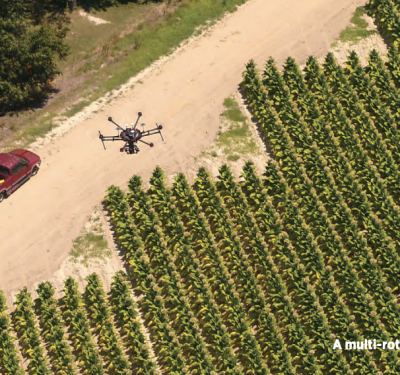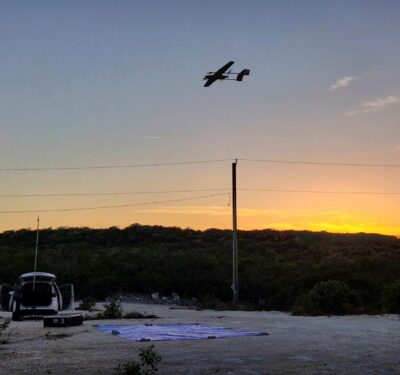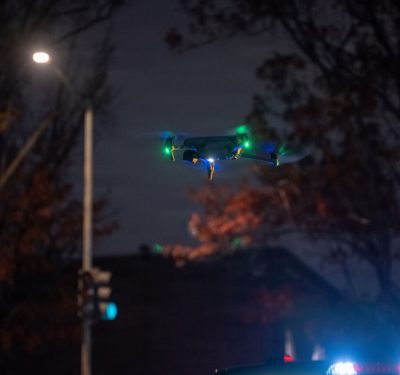

The C-UAS deployment at the 2026 FIFA World Cup was visible, acknowledged—and only part of the picture.
The hex-rotor was easy to spot if you were looking for it—holding station above the crowd flow at the stadium perimeter entry, near the rail access, far enough up to maintain a clean field of view over the queue below. Most of the fans streaming in from Secaucus Junction—many of them in Norwegian red, a few in full Viking helmet—were not looking for it.
They had reason to be there. The Norway-Senegal Group I match at MetLife Stadium on June 22 was Norway’s first World Cup appearance since 1998—a 28-year absence that ended with a perfect qualifying campaign under coach Ståle Solbakken, who was himself a member of that 1998 squad. The tournament’s most-discussed forward, Erling Haaland, had already scored twice against Iraq in the opener and added another brace against Senegal, becoming only the sixth player in World Cup history to score multiple goals in each of his first two appearances. The match was played on a rain-swept pitch—a flood watch had briefly cleared fans from MetLife hours before kickoff—but Norway won 3-2, with Marcus Pedersen opening and Haaland scoring in the 48th and 58th minutes before Ismaïla Sarr pulled two back for Senegal in a tense finish. After the final whistle, Norway’s players joined fans in the “Viking row” celebration that has become the signature image of their tournament run. The fans at Secaucus heading back to New York were still doing it on the platform.

EYES ABOVE THE GATE
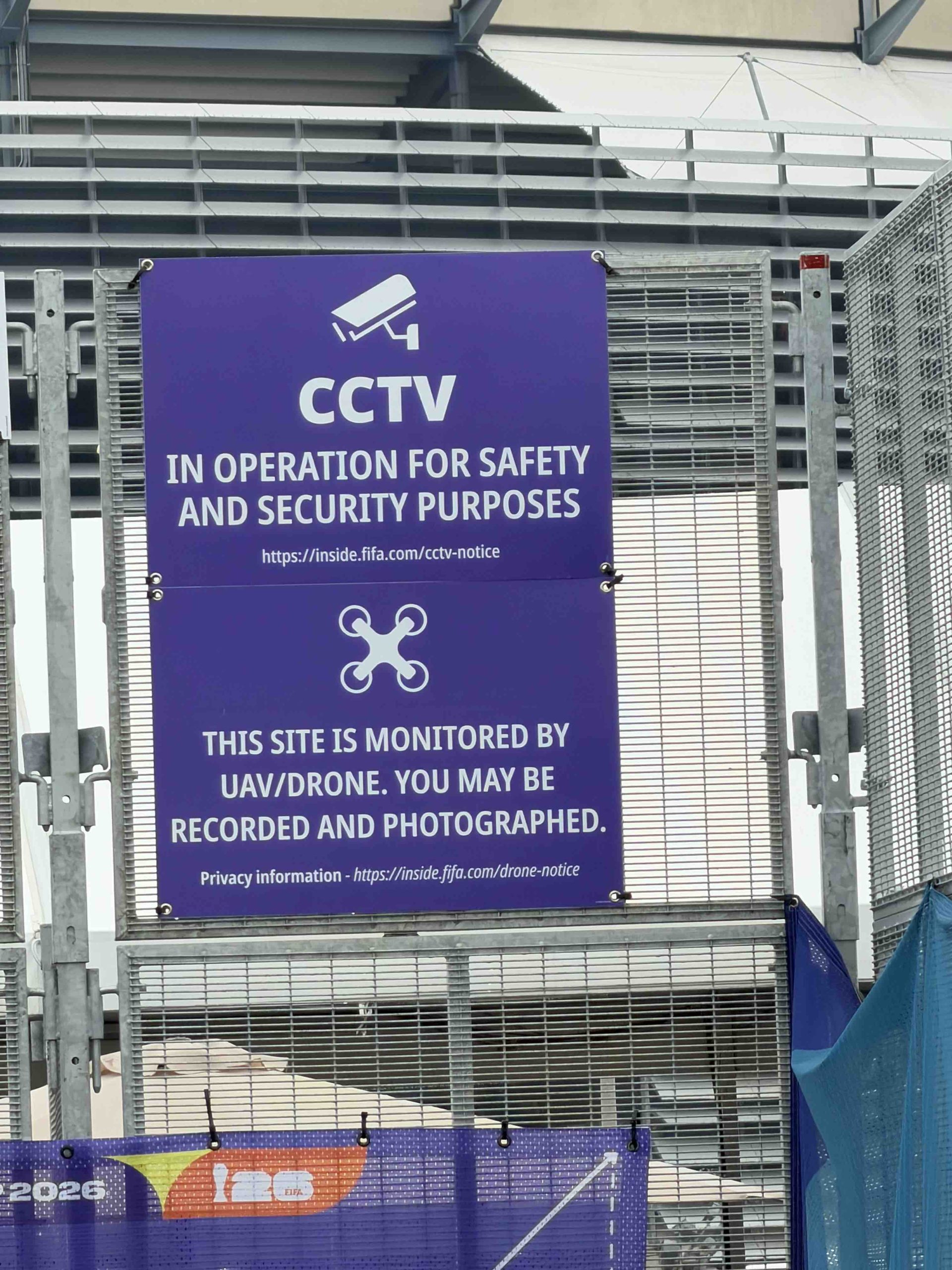
The sign posted at the gate before any of that unfolded was more direct. “This site is monitored by UAV/drone,” it read, beneath the FIFA logo and alongside a separate CCTV notice. “You may be recorded and photographed.” A QR-linked privacy notice was offered below. Most people walked past it without breaking stride.
That combination—an acknowledged, signposted drone deployment operating in parallel with conventional CCTV infrastructure—offered a ground-level picture of what FIFA World Cup security actually looked like in practice. The platform visible over the match appeared to be a multi-rotor hexacopter equipped with a downward-facing payload consistent with a surveillance configuration. Its position and flight pattern suggested crowd overwatch at a natural chokepoint: the perimeter gate closest to the rail transit link, where fans arriving by train compressed into queue lines before dispersal into the broader venue footprint. Transit access is the variable security planners have the least control over—a high-density, linear flow of people with limited screening options—and persistent aerial overwatch at that specific point reflects a clear-eyed assessment of where risk concentrates.
The visible layer was, by definition, only part of the picture. The broader security apparatus at World Cup venues included radio frequency detection, radar, and in some deployments kinetic defeat capability—a layered approach that the preceding feature in this issue covers in detail, including the FEMA C-UAS Grant Program that funded it and the Safer Skies Act that extended mitigation authority to state and local law enforcement for the first time. What was visible at the MetLife perimeter—drone overwatch, acknowledged and signed—was the public face of a considerably more complex infrastructure operating largely out of sight.
That visibility is itself worth noting. FIFA’s decision to post explicit drone surveillance notices rather than operate surveillance platforms without public acknowledgment reflects an approach that treats notification as standard practice at this scale of event. It also captures the dual nature of the drone problem at major gatherings: the same technology used to protect the venue is, in a different configuration and with a different payload, the threat the security architecture is designed against.