
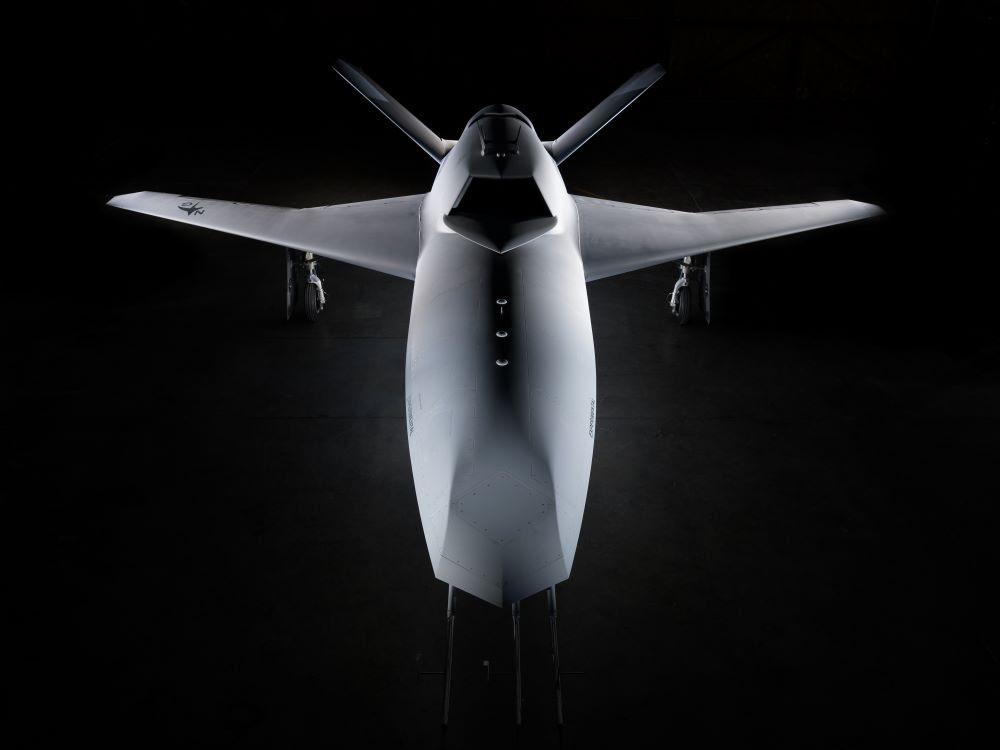
Northrop Grumman unveiled early in December a new Loyal Wingman-style autonomous demonstrator jet called Project Talon built by its Scaled Composites subsidiarity at Mojave Air and Space Port. Reportedly the program took just 15 months to go from concept to complete assembly, with a first flight planned in the next nine months.
The aerospace giant says the design is a “significantly different” evolution of its submission to the U.S. Air Force’s Collaborative Combat Aircraft (CCA) Increment 1 competition seeking armed drones to assist manned jet fighters in air-to-air combat. The Air Force in 2024 downselected General Atomics and Anduril’s proposed designs instead.
Deeming that proposal to have veered too far in the high-capability/high-cost direction, Northrop Grumman aeronautics chief Tom Jones said the company sought to reduce cost and complexity as far as possible at minimal tradeoff to performance. The resulting demonstrator reportedly has 50% fewer parts, was 30% faster to build using exclusively composite materials, and weighs a half ton less. Reportedly a combination of rapid prototyping and digital design tools (though short of making a full digital twin) accelerated development of what was initially called Project Lotus.
The images and video shared by Northrop Grumman show an airframe seemingly designed for agility and stealth. Presumably designated Model 444 going by its N444LX FAA registration number, its distinctive elements include a dorsal turbofan engine with a pentagonal intake, a canted V tail, stealthy lambda wings and faceted surfaces, and a shovel nose sporting the expected testing probes. Some of these features echo aspects of Northrop Grumman’s manned Model 437 jet and General Atomics’ XQ-67 UAV.
The Model 444’s wing-mounted landing gears—reportedly ported wholesale from an already established aircraft to cut costs—should free additional space for a weapons bay in the fuselage. However, Project Talon reportedly doesn’t yet integrate mission systems.
What’s Northrop Grumman’s angle in the crowded Loyal Wingman market?
Project Talon is going public at the end of a year which saw two major additional higher-end Loyal Wingman offerings go public (Lockheed’s Vectis and Sheild AI’s X-BAT), the first flights of both the YFQ-42A and YFQ-44A competing for the Air Force’s CCA contract, and procurement of two lower-cost loyal wingman designs—Kratos’s Valkyrie and Boeing’s MQ-28 Ghostbat—by the U.S. Marine Corps, Australia and Germany.
Northrop Grumman is the last of the Big Three aerospace corporations to publicly propose a Loyal Wingman style aircraft. On one hand, it arguably makes sense to cast a stone in the still rapidly evolving multinational market for CCA/Loyal Wingman aircraft, for which operational concepts and price points remain fluid. But Northrop Grumman will still need to differentiate their CCA concept amidst a crowded field.
The company says the project has already incurred interest from U.S. military services and multiple foreign delegations. Looming on the horizon is Increment 2 of the Air Force’s CCA program, which remains publicly undefined. There are also unexpectedly early inquiries by the U.S. Navy for carrier-based CCAs.
Northrop Grumman officials haven’t characterized Project Talon as aimed at either, though perhaps Model 444 could be offered for the former. Northrop-Grumman can also stake the claim of having built the XQ-47B, the first drone to have catapult-launched and landed onto an aircraft carrier.
Project Talon will fly using Northrop-Grumman’s open-architecture Prism autonomy system, already integrated into its Beacon autonomy testbed based on a Model 437 jet. Prism is designed for ‘plug-and-play’ integration of external vendor AI solutions that could range from highly specific capabilities (operating a specific sensor), or very broad ones like mission autonomy for complex combat missions. Prism partners reportedly include Applied Intuition, Autonodyne, Merlin, Red 6, Shield AI, and SoarTech. Accordingly, it’s suggested a missionized Talon could rapidly incorporate new modular capabilities extrinsic to the aircraft itself.
Northrop Grumman has yet offer specifics on Project Talon’s performance, capabilities or components. However, the company’s messaging hammers home the designs’ economies: “high performance”, yes, but “fast to produce” for “affordable mass ostensibly in wars of attrition” where replenishing losses is also important.
For reference, currently the American Loyal Wingman market exhibits a very broad cost/capability range from $5-$10 million to $40 million or higher per UAV, with CCA Increment 1 candidates seemingly aimed at the mid $20 millions.
Rather than talking up sexy hypothetical combat scenarios, Jones described the Project Talon’s ambition thusly: “the [foremost] outcome we’re shooting for was the process. How do we design and build things that perform at a high level, but that we can build quickly now and can do affordably?”
The goal, he argued was to foster flexibility away from a culture focused exclusively on maximizing performance for exquisite platforms like the company’s B-21 bomber, towards also being able to prioritize cost- and time-efficient solutions when appropriate.
Perhaps then Northrop Grumman is betting that its groundwork in Project Talon will leave it better positioned to adapt and iterate in future, despite the numerous competitors offering rival platforms for the still emerging Loyal Wingman market.