
From Garage Startups to Pentagon Champions: Meet the Eleven Companies Remaking American FPV Warfare
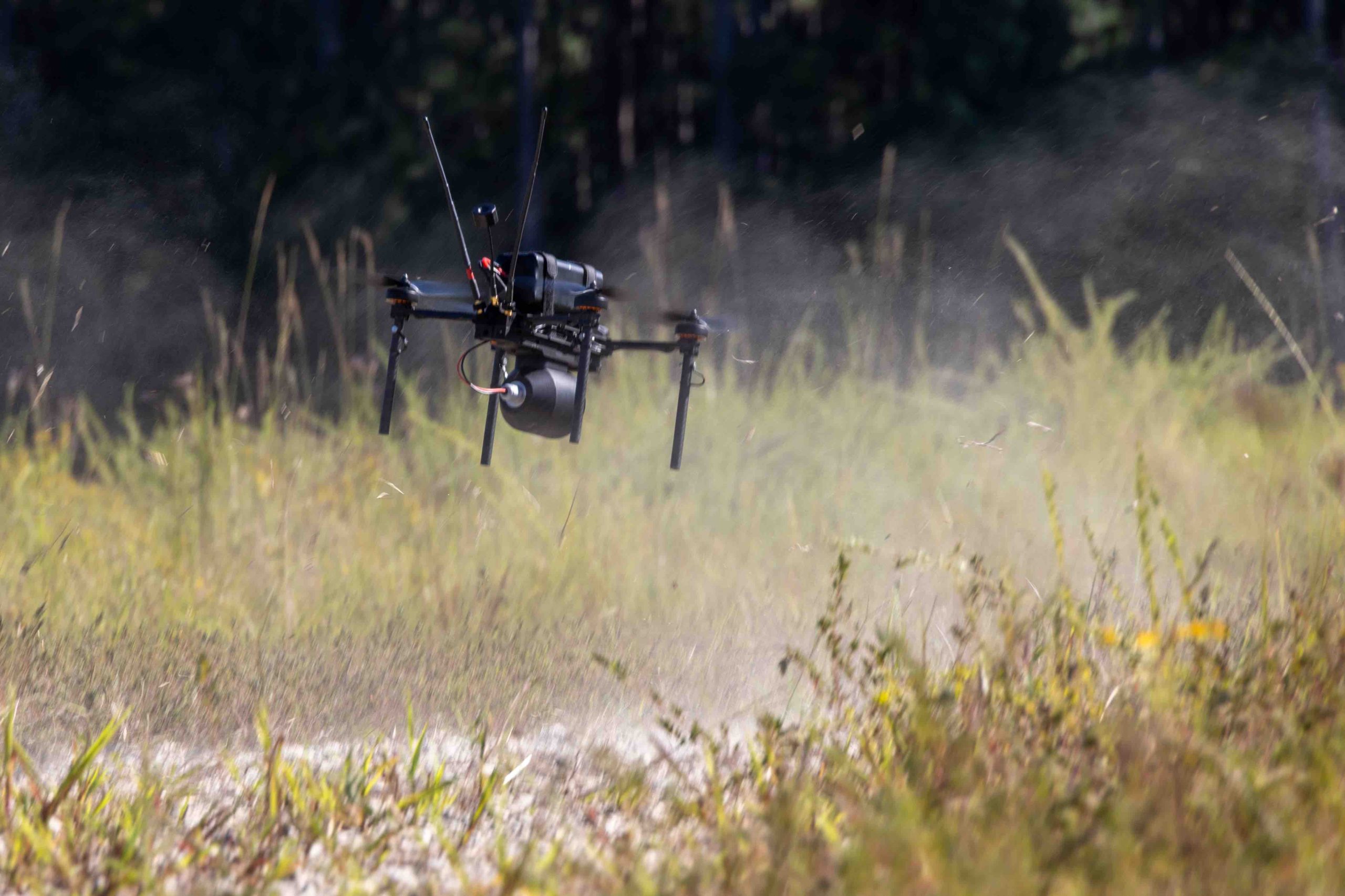
Phase 1 of the Pentagon’s Drone Dominance Gauntlet saw 26 small and medium-sized defense contractors submit quadcopter drones for competitive trials at Fort Moore, Georgia, held from mid-February through early March. The top scorers were promised orders of up to 30,000 FPV drones between them — the first such buys intended to stimulate an indigenous U.S. industry and identify its most promising production partners.
Defense giants like Lockheed and Anduril were nowhere to be seen. For years America’s largest defense companies had struggled to approach the low costs of lethal FPV quadcopters mass-deployed on Ukraine’s battlefields — now the Pentagon wanted to see what the smaller players could do. The stumbling block remained familiar: UASs needed to adhere to NDAA regulations forbidding Chinese components, despite the tempting costs and deep inventory offered by the world’s largest small drone producer.
Early in March, the DDP posted a leaderboard scoring the 11 companies awarded production contracts. The results were startling: an obscure British-Ukrainian partnership held a commanding lead with a near-perfect score. Neros, already leading FPV adoption for the Army and Marine Corps, came in a strong second, followed by the little-known Napatree Technologies. The remainder hovered mostly at the lower end of passing, with six of the 11 scoring between 70 and 73.
The Phase 1 winners are a mixed and often obscure bunch — very young as a rule, with many fewer than three years old and only one founded before 2013. Some are squarely dedicated to FPV mass production; others style themselves primarily as software developers and R&D contractors. Some had never been publicly associated with FPV UASs before Gauntlet. Meanwhile, several well-known UAS builders that participated didn’t make the leaderboard at all.
Gauntlet Phase 1 Scoring
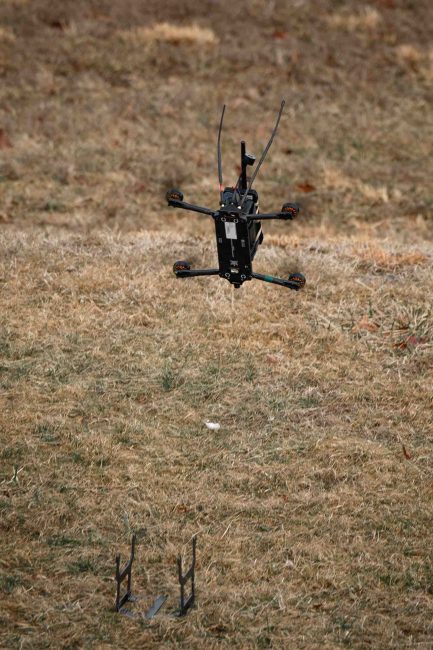
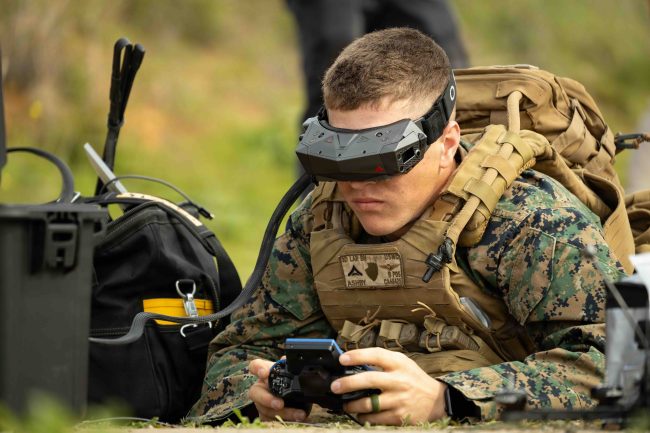
Submitted FPV systems were provided to military personnel with just two hours of training before they were asked to perform strikes against fixed targets in the open at up to 6.6 miles, or in a congested urban environment at up to 1.2 miles. DDP calculated a 0–100 score factoring in those two mission categories, soldier-operator evaluations, and estimated production capacity. A majority of participants also brought warhead-armed UAVs for an optional kinetic evaluation using vendor pilots.
Beside the main leaderboard, DDP separately ranked seven companies for long-distance strike performance and nine for urban strike. Seven companies were rated for strong production capabilities. Some companies that didn’t make the main leaderboard were recognized in sub-categories — Alabama-based Performance Defense Works and Illinois-based W.S. Darley for production capacity; Ukraine’s General Cherry ranked 7th in long-distance strike; Greensight, Vector Defense, Firestorm, Draganfly, and Darley placed 4th through 9th respectively in urban strike.
#1 Skycutter / Skyfall — Score: 99.3
Drones ordered: up to 2,500
Gauntlet’s first-place winner by a wide margin is the Shrike 10 Fiber quadcopter — a joint product of Ukraine’s Skyfall and the UK’s Skycutter, which is listed as the official DDP entrant. The two firms have cooperated since the first year of the war, with Skycutter co-founder Vincent Gardner telling Axios that his company helped Skyfall redesign the Shrike to exclude any Chinese parts or components.
Skyfall, with thousands of employees producing over a million UAVs annually, is best known for three systems prominently engaged on Ukraine’s frontlines: the Vampyr hexacopter heavy bomber, the P1 Sun Shahed-killer interceptor, and most numerously, the Shrike FPV. Skycutter, a smaller firm, is particularly noted for long-endurance VTOL platforms and high-density battery development. Following the Gauntlet win, Gardner told the BBC that his business may need to relocate to U.S. soil given the limited traction with the British Ministry of Defense compared to Pentagon interest.
Despite the weight and cost limitations of trailing a fiber-optic cable, fiber drones are viewed as highly lethal in Ukraine due to their immunity to jamming and the crystal-clear video feed they maintain right until impact. That quality appears to have made a powerful impression on U.S. military evaluators with limited prior experience with fiber-optic UASs.
Shrike comes in 7″ and 10″ configurations ranging from roughly $300 to $1,500, encompassing day, night, fiber, and computer-vision variants, including a waterproof model capable of launching while submerged. The Shrike 10 Fiber trails up to 12.4 miles of cable. A combat-tested CV variant with dual cameras allows the operator to designate targets up to one kilometer away; a second tracking camera enables automatic terminal guidance even if the command link is jammed.
#2 Neros Technology — Score: 87.5
Drones ordered: 2,400
In just two years, a startup founded by drone racing veterans Soren Monroe-Anderson and Olaf Hichwa (both in their 20s) rocketed to the forefront, its Archer FPV securing the Pentagon’s first larger-scale U.S. production contracts for FPV one-way attack drones from the Marine Corps and Army — including the Army’s PBAS 1.1 rapid-procurement program concurrent with Gauntlet. Neros delivered its first PBAS batch ahead of schedule in March. The Marine Corps procurement cost $17 million for approximately 8,000 drones — roughly $2,125 per unit, approaching Ukrainian pricing levels.
Neros delivered its first Archer prototypes to Ukraine in September 2023, beginning an iterative cycle of combat testing followed by engineering updates based on frontline feedback. By late 2025 the company had closed a $75 million Series B led by Sequoia Capital, bringing total raised capital to over $121 million, and won contracts to supply Archers to Ukraine and both U.S. military branches. In December 2025 it announced an NDAA-compliant fiber-optic variant, Archer Fiber, co-developed with Kela Technologies.
Neros’s new Project Millennium facility in Torrance, California aims to produce 100,000 Archers by end of 2026, scaling up from 2,500 per month at its El Segundo headquarters. At maximum capacity, the company claims the facility could produce up to one million UAVs annually. The company sources all electronic components in the U.S. and plans to eventually self-produce motors, antennas, and other mechanical components currently sourced from U.S.-allied countries.
#3 Napatree Technology — Score: 80.3
Drones ordered: TBD
Third-place finisher Napatree Technology has no public website — but operates under a better-known alter ego. Last November, General Curtis King stated in a press briefing that Project Eagle — developer of the Merops drone interceptor — was a “portfolio” of Napatree, and that Napatree was also building Bumblebee and Hornet one-way attack drones.
Project Eagle, backed and driven by former Google CEO Eric Schmidt, first operated under the name White Stork. Its Merops counter-UAS system began U.S. military evaluations in 2025 and was rush-deployed to the Middle East in March 2026 following Iranian strikes on U.S. bases in the region, with approximately 13,000 interceptors reported on order. Schmidt’s involvement has spanned multiple shell companies and entities, including Aurelian Industries, Swift Beat, and Volya Robotics, with engineers recruited from Apple, SpaceX, Google, and federal agencies. The Merops Surveyor interceptor, priced at approximately $15,000 per unit, operates autonomously in GPS- and comms-denied environments using sensor fusion and AI-guided targeting.
If Merops is any guide, Napatree’s FPV offering likely features polished autonomy and optical terminal guidance — which would explain its first-place finish in operator evaluations despite its low public profile.
#4 ModalAI — Score: 77.7
Drones ordered: 2,240
Spun off from Qualcomm in 2018, ModalAI built its reputation on computer vision and GPS-denied navigation, particularly through its VOXL2 AI-autopilot system. Its Gauntlet FPV entry appears to have been the Seeker Vision, a Blue UAS-cleared platform marketed to government customers, described as highly reconfigurable, MOSA-based system. According to company mateirals, it is capable of operating in GPS-denied environments, using visual-inertial odometry, a VOXL2 Mini board, and dual thermal and low-light cameras. Those characteristics—precision in denied environments, strong software architecture, modularity—align well with Phase II’s requirements for C-UAS resilience and autonomous navigation. ModalAI has also partnered with Booz Allen Hamilton on a Sparrow microdrone proposal through the Army’s xTechPrime Program.
#5 Auterion — Score: 77
Drones ordered: 2,160
Another software-oriented company, Auterion was founded to commercialize PX4 autopilot software developed at ETH Zurich, receiving early Blue UAS certification through a DIU partnership. By late 2025 it had raised $130 million at a valuation reportedly targeting $1.2 billion, with Rheinmetall and In-Q-Tel among its strategic investors.
Core products include the Skynode flight controller and mission computer, the Auterion Mission Control system, a Track and Intercept app for autonomous terminal guidance, and the Nemyx swarming system. Its SLM-10 “Dragon” reference design quadcopter — with a 15.5-mile range and support for GPS-denied operations — served as its likely Gauntlet submission, and has been tested in U.S. military trials. Germany has also contracted Auterion and Ukrainian partner Airlogix to supply thousands of Anubis and Seth-X strike drones. Other contracts include a $50 million DoD program to supply Ukraine with 33,000 Skynode kits.
In a live-fire test at Fort Blanding in January 2026, Auterion’s Nemyx swarming system demonstrated a distributed strike in which multiple SLM-10 FPVs, communicating via a jam-resistant mesh network, each engaged separate targets in rapid succession after receiving initial guidance from a lead drone. According to co-founder and CEO Lorenz Meier, Nemyx may be operationally deployed by the U.S. military by end of 2026.
#6 Ukrainian Defense Drones (UDD) — Score: 72.9
Drones ordered: 2,000
UDD sells its products under the brand name F-Drones — not to be confused with a Singapore startup of the same name. A New York Times report from March 2026 describes the company producing most of its own components, critically including circuit boards soldered in a secretive basement workshop, while European suppliers fill in the gaps. By 2024, UDD had localized carbon-fiber frame and antenna production — building 15,000 antennas daily by 2026 — and by 2025 had added flight controllers, ESCs, radios, and video transmitters to its in-house production. The company wants to establish camera production elsewhere in Europe; it currently sources cameras from another Ukrainian manufacturer using European parts.
Besides the F10, F-Drones produces the 7″ F7 quadcopter and its F7 Litavr interceptor variant. In March 2026 an automatic terminal guidance system entered production for integration into baseline Litavrs, following three successful intercept tests; the company has also developed a GCS and software upgrade enabling remote operations, already used to down a Russian Shahed from hundreds of kilometers away.
#7 Griffon Aerospace — Score: 72
Drones ordered: 1,920
Founded in 1995 originally to manufacture biplanes, Griffon eventually carved out a niche in fixed-wing target drones, delivering over 12,000 UASs to the U.S. military by 2026 across its MQM-170 Outlaw and MQM-171 Broadsword lines. Its Group 3 Valiant eVTOL very nearly secured Army FTUAS procurement before that program was canceled by the Trump administration in 2025.
Griffon’s Gauntlet entry, the Scourge, was co-developed with Kinetic Frames, an FPV carbon frame printer in Talking Rock, Georgia with roots in the hobbyist community. Available in 5″, 7″, and 10″ variants with NDAA compliance and Kraken Terminus warhead integration, Scourge represents Griffon’s first venture into quadcopter SUAS. According to DDP program manager Daniel Beck’s LinkedIn post, approximately 2,000 Scourges have already been delivered to the U.S. military as a “rugged, rapid response asset.”
#8 Nokturnal AI — Score: 70.3
Drones ordered: 1,840
Low-profile Nokturnal AI sells the Nightmare FPV quadcopter, developed by Danish startup Renegade UXS — formed by two Danish SOF veterans who sought to design UASs that remained effective under Russian EW conditions. Renegade follows the Ukrainian model of rapid combat iteration: prototypes are tested in Ukraine, with design updates implemented within days of operator feedback.
By February 2026 the company had delivered its 10,000th Nightmare to Ukraine, including a digital variant developed to overcome limitations in jamming resistance, encryption, and interoperability. Nightmare had also achieved top-three rankings in several Army and Marine Corps evaluations prior to Gauntlet. Nokturnal AI was notably removed from the DDP’s participant list in February only to appear on the leaderboard in March, without explanation.
Both Nokturnal AI and Renegade UXS hold separate Blue UAS certifications for Nightmare. In the near term, Nightmare is deploying to SOCOM tests in Nevada, an AFRICOM exercise in Morocco, and a German joint exercise.
#9 Halo Aeronautics — Score: 70.2
Drones ordered: TBD
Halo Aeronautics is a partnership between military-IT company By Light and Hush Aerospace LLC, a UAS design and manufacturing startup founded in 2019 at Virginia Beach. The company offers a deep catalogue of UAS components including mission equipment, EO/IR cameras, fiber-optic C2 kits, controllers, FPV goggles, and munitions dispensers, emphasizing rapid prototyping of Group 1–3 UASs “in hours rather than weeks” and claiming NDAA compliance with AES-256 encrypted comms throughout.
Its most likely Gauntlet submission is the Perses FPV, described by the company as optimized for autonomous flight with best-in-class EW performance and notable acoustic stealthing relative to comparable platforms. The hull supports interchangeable arms for varying rotor sizes and both V-Block and Picatinny payload mounts. Halo is also involved in a U.S.-funded program to produce Perses and Halo VTOL drones for Ukraine in Montenegro in cooperation with Tara Aerospace and partner firms.
#10 Ascent Aerosystems / Robinson Unmanned — Score: 70.1
Drones ordered: 1,600
Founded in 2014 and acquired by Robinson Helicopter Company in April 2024, Massachusetts-based Ascent AeroSystems competed in Gauntlet under its original name — but in March 2026, Robinson announced the formal establishment of Robinson Unmanned, a dedicated UAS business unit that absorbs Ascent and its coaxial SUAS portfolio while extending the product line upward to Group 3 and 4 platforms derived from Robinson’s R44 and R66 helicopter airframes. Paul Fermo, previously Ascent’s president, leads Robinson Unmanned.
The Gauntlet submission was almost certainly Spirit, Ascent’s medium coaxial platform, distinguished by its cylindrical core form factor with counterrotating propellers — offering superior stability in adverse weather, increased endurance, and a compact profile relative to equivalent quadcopters. Spirit carries 6.5–10 pounds across a 12-mile range and has received U.S. military R&D and upgrade contracts. An attack adaptation is plausible given its payload and range, though Spirit’s commercial pricing — typically $9,995 to $14,000 — significantly exceeds Gauntlet’s unit-cost targets. Remaining competitive in later phases will require a substantially lower-cost production variant. Robinson Unmanned’s manufacturing scale and vertically integrated facility in Torrance, California may be the enabler that makes that viable.
#11 Farage Precision — Score: 70
Drones ordered: TBD
Another dark horse: Virginia-based Farage Precision is an ammunition and firearms company that expanded to military clients in 2019. Its commercial website sells ammunition, firearm components, training, optics, cameras, and assorted tactical gear — some 3D-printed. No specific submission has been publicly identified, but the company’s background in tactical equipment ergonomics, cameras, and additive manufacturing likely informs whatever UAS it brought to Fort Moore.
Yellow-Blue UAS — Ukraine Depends Less and Less on Chinese Parts
It’s no secret that China’s super-scaled drone parts industry fuels both Russia and Ukraine’s military drone programs despite nominal export bans. But as Ukrainian production reaches unprecedented heights — seven million UAVs are forecast for 2026 — that scale has allowed a redirection of effort away from sheer volume and toward de-risking against Chinese parts dependence, particularly given Beijing’s pro-Russian lean.
A report by Ukraine’s Snake Island Institute states that the percentage of drone components imported from China fell from 90 percent to 38 percent between early 2024 and mid-2025, with EU vendors accounting for most of the balance.
Ukraine’s growing indigenous components production and improved access to European substitutes won’t replace Chinese parts entirely anytime soon given voracious wartime demands. But it does mean several Ukrainian companies are already building a subset of China-free drones, often with help from European partners — meaning a growing number of battle-tested Ukrainian UASs will be eligible to participate in the U.S. market by meeting NDAA and Blue UAS standards. It also highlights that Ukraine and Europe more broadly are evolving into major suppliers of UAS components, not just integrators of them.