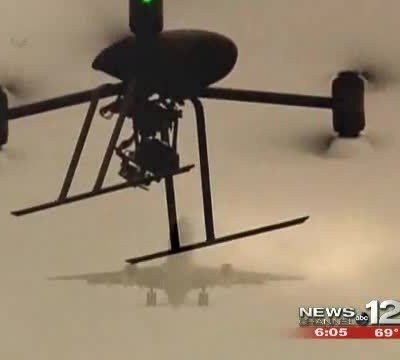

DroneShield and SRI Group offer a model for airport counter-drone protection.
Brussels. Copenhagen. Munich. Oslo. Warsaw. All these cities’ major airports have suffered drone incursions since September 2025. Going back a bit, add in Dublin, Gatwick, Singapore and last year’s “War of the Worlds”-like drone mania over New Jersey. The map looks like a game of Risk—except the ripple effect of a hub stoppage can cost millions. “If Munich is shut down for a day, you’re talking tens of millions of dollars—you’re affecting at least 20 others with flight schedules,” reports John Halinski, CEO of security consultants SRI Group. “It’s the ripple effect.”
Airports, with their kinetic environments, have narrow margins for error. Without a harmonized EU framework and an investment in layered systems and training, they will, as this magazine put it after November’s incursion in Belgium, “continue to absorb safety, security and economic costs from hostile or reckless drones.”
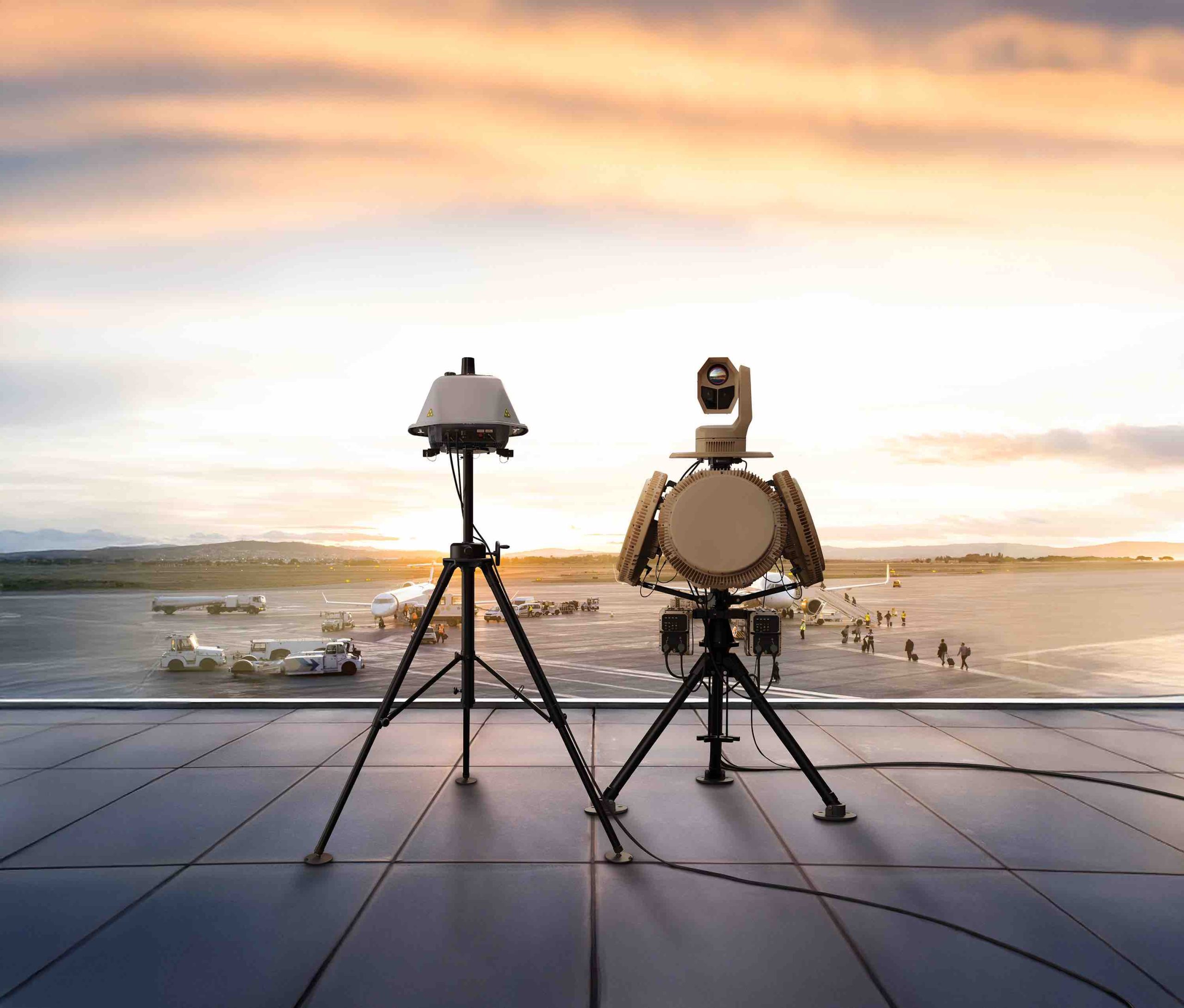
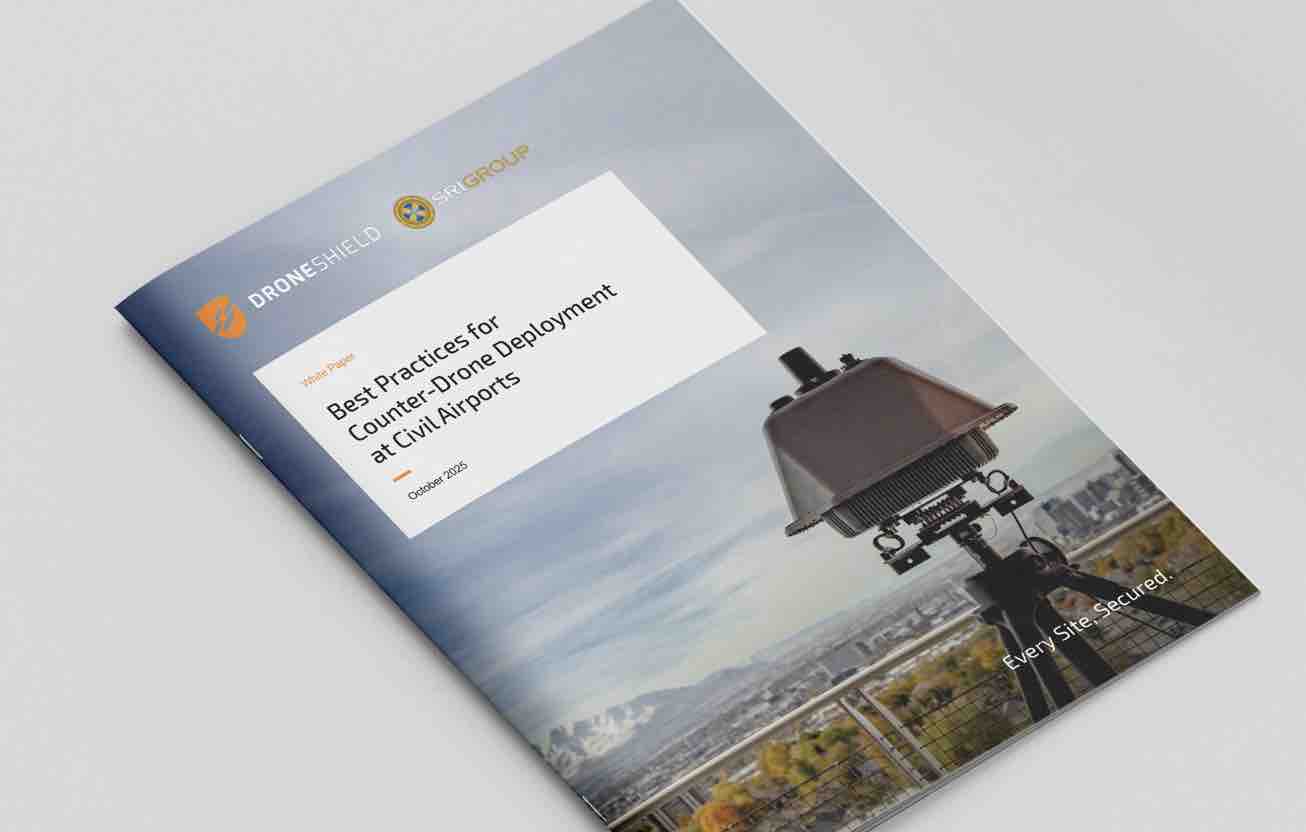
To that end, DroneShield, a fast-growing U.S.-Australia counter-drone company, has authored “Best Practices for Counter-Drone Deployment at Civil Airports” and announced a strategic collaboration with SRI Group. “This White Paper summarizes “an opportunity to combine RF, radar and optical sensors to ensure comprehensive coverage and reduce the risk of false negatives.” A system that consolidates situational awareness and decision-making into a single platform, the report recommends, can be cost-effective, scalable and acceptable to both regulators and the general public.
An online “Counter-UAS Threat Assessment” is a free tool to start airports and other vital infrastructure in analyzing current security postures and strengthen defenses against unauthorized drone activity. Paid consulting with SRI Group kicks in if a customer decides to pursue site surveys and more comprehensive tailored assessment reports.
“The ability to detect and assess drone threats in and around your airport environment should really be part of their physical security and safety program,” said Tom Adams, director of public safety of DroneShield.
Yet, while RF sensors can be highly effective, not every drone will broadcast its location and some may fly via fiber optics or GPS-GNSS waypoints. The White Paper posits a layered approach, “a cohesive, multi-modal detection network [that can] detect, verify and respond to drone incursions with greater accuracy and confidence.” The goal: to ensure “that responses are proportionate, targeted and safe for the surrounding environment.”
Inertia and Implementation
Halinski and Adams come to C-UAS with decades of experience with TSA and the FBI respectively—Adams’ positions included a stint as counter-UAS program manager. Despite the accelerating incidents, Halinski sees slower-than-needed motion. “They’re just not prepared adequately,” he said. “I hate to be a doomsayer, but there will be an incident. The threat is there. The big ones have taken some preliminary action but you’re waiting for that regulatory piece to drop, or a very specific instance where a drone will intentionally or unintentionally bring down an aircraft or hit a terminal.”
Adams added his perspective. “A lot of times the drone threat, whether it’s the careless and clueless or the nefarious, is still relatively new to a lot of agencies and organizations. It’s not something we’ve trained on.” Other inhibitors include cost and that some mitigation technologies may violate federal rules and regulations.
Adams agreed that airports need to step up their game, especially given the proliferation of low-cost drones. “A lot of airports are relying on visual or audible detection, which is very inaccurate,” he said. What’s required is a C-UAS cycle that includes detection, integration with existing systems, awareness, real-time intelligence, recording and storing essential data and, where lawful, actual mitigation.
Getting there led to the corporate hook-up between SRI Group and DroneShield.
Halinski’s security consulting had come to focus on C-UAS, and the need for specific solutions.
“You know the old saying, ‘if you’ve seen one airport, you’ve seen one airport,” he said. That need for customization created a flight path to the industry-focused Threat Assessment. “About six months ago, I saw a need for what we’re trying to do and DroneShield was interested as far as risk and vulnerability assessments. We built a risk template, and we basically ask an airport or facility to do a self-assessment with a multiple of people in their company, and then we go in and do physical surveys, avenues of approach, RF spectrums around that particular airport.”
Adams endorsed the approach. “The education piece, to me, is the most important. Because of my background and experience, I have a consultative sales process so they can make a proper decision. An assessment-type tool is a great place to see where your potential vulnerabilities may be, whether its technology, policies and procedures, training, whatever. You can start to identify where you’re strong and where you might have some opportunities to improve.”
The result is a roster of tailored recommendations with redundancy to overcome system failures. As of mid-November, a study had been done in Barbados and one was impending at the airport in Boise, Idaho. “What’s most important,” Halinski said, “is we get to understand what their crisis incident plan is and we try to assist them in building a counter-UAS strategy and incorporating it into their existing programs.”
Inside the Technology
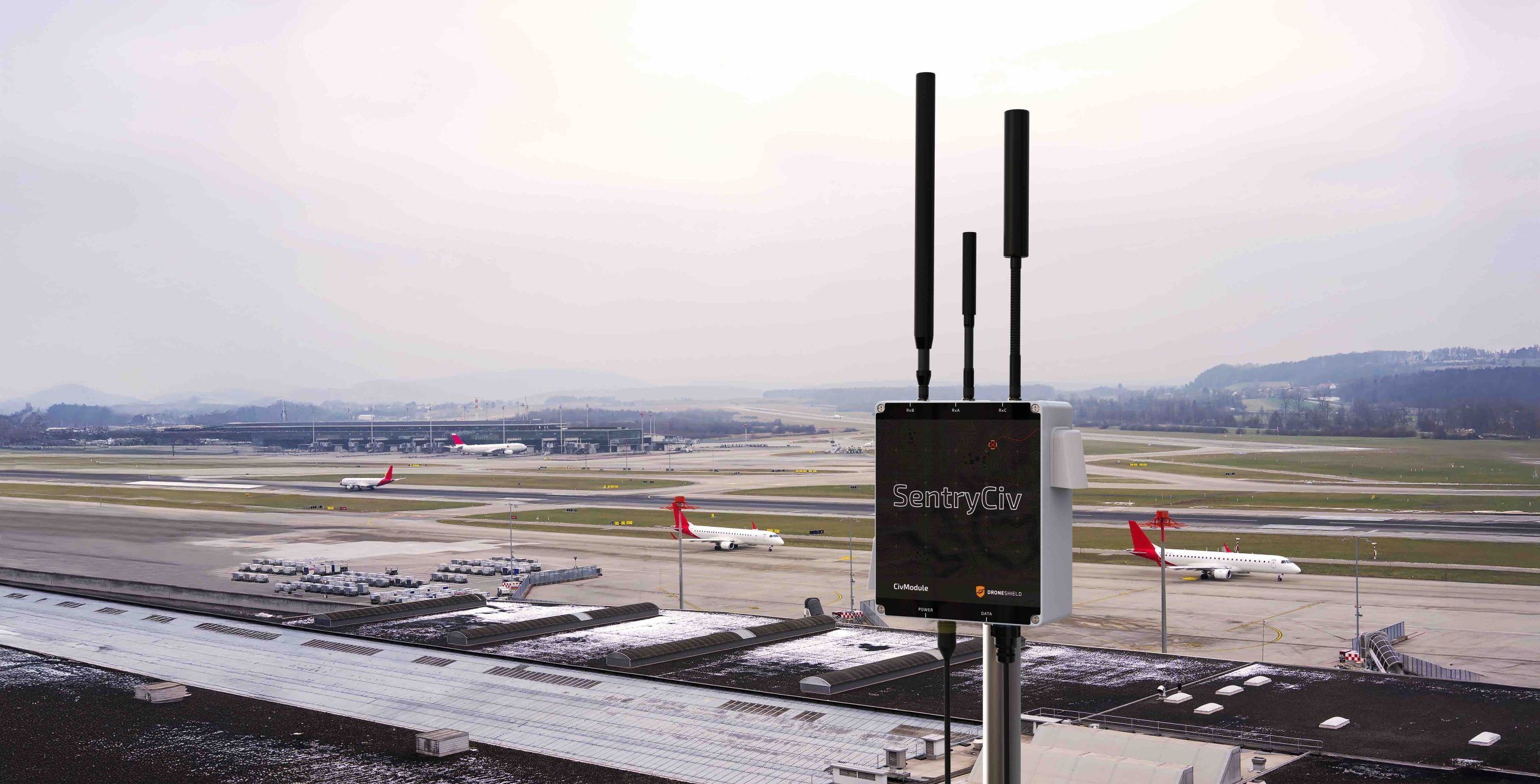
Airport C-UAS has to intercept threats in a matter of seconds. To do so, DroneShield’s C2 suite involves handheld, on-the-move and fixed-site drone detection and defeat capabilities that mesh high-tech capabilities with a streamlined operator experience.
Proprietary hardware, backend software processing and adaptive AI identify the necessary components of the RF signal. Radars, cameras and acoustic sensors (third-party if most effective) deliver enhanced data. “It’s identifying the necessary components and funneling that information into the command and control software,” Adams explained, “which is fusing that sensor information and putting it into a format that’s easier for the operator to assess, identify and respond if needed.”
Adams reiterated the need for tailored multi-modal solutions that can maximize accuracy, speed and resilience. Consequently, what’s being protected may involve one or more systems installed around a facility, with each mode having its own range. “We have capabilities for them to consider as part of developing their user requirements. You want to combine all these sensory inputs into one platform and enable quick and efficient and informed decision-making.”
Government Recognition, Regulatory Reform
On his part, Halinski called for the U.S. to “get off its tail and start putting out regulations.” There are indications that this is starting to happen.
Appearing on “Face the Nation” in mid-November, Army Secretary Dan Driscoll announced a major shift toward both drone acquisition and C-UAS deployment. The Army plans to buy 1 million drones over the next two to three years, he said. As for C-UAS, “this problem is different from nearly anything we’ve faced in a long time,” he told CBS. “It is a flying IED.” Driscoll called for a “digital layer” of multiple protective techniques to “deconflict the skies.”
Driscoll also called for cutting through bureaucratic overlap. “When you’re by an airport…you just have different authorities,” Driscoll said. “And so, a lot of this is a human problem of communication, command and control and having a layered set of solutions.”
Adams voiced a similar perspective. “It’s important that the FAA and all the three-letter agencies have been working together on this because the initial hesitancy is, ‘I don’t know if it will interrupt my air traffic control or anything else,’” he said. “You have to be able to integrate into an already layered, existing system without interfering, and making sure it’s a very clean operation.”
Spurred by an executive order after the New Jersey hysteria, the government is exploring avenues to expand C-UAS capabilities. In September, the House Transportation and Infrastructure Committee approved a bipartisan bill to “reauthorize, reform and reasonably expand the existing counter-unmanned aircraft systems authorities of the Department of Homeland Security and the Department of Justice.” If it becomes a law, it will increase C-UAS system planning and departments at airports, requiring the FAA to establish an Office of Counter-UAS to work with DHS and DOJ on plans for C-UAS at U.S. airports. Initial projects would include a large and a medium hub, and three cargo mega-hubs, to, as house.gov summarized, “assess the feasibility of mitigating errant UAS operations within the airport environment.”
The legislation also would empower a new Counter-UAS Mitigation Law Enforcement Pilot Program so non-federal law enforcement agencies can access tools to mitigate threatening drones within a safe National Airspace System (as well as around events such as the 2028 Olympics). It would list evaluated and approved C-UAS detection and mitigation equipment while addressing long-standing concerns around civil liberties and data retention.
As the DroneShield-SRI Group White Paper concludes, “These events are no longer isolated anomalies but are part of a broader trend that demands coordinated, strategic responses. …As drone technology continues to evolve, so too must the systems and policies design to manage it.”
A C-UAS Checklist
The DroneShield-SRI Group’s best practice White Paper offers key considerations for “a structured and strategic approach to ensure effectiveness, safety and operational continuity.”
- Site Assessment
- Layered Sensor Network
- System Integration
- Training and Simulation
- Ongoing Maintenance and Support
Omnisys C-UAS: It Ain’t Heavy, It’s My Bro
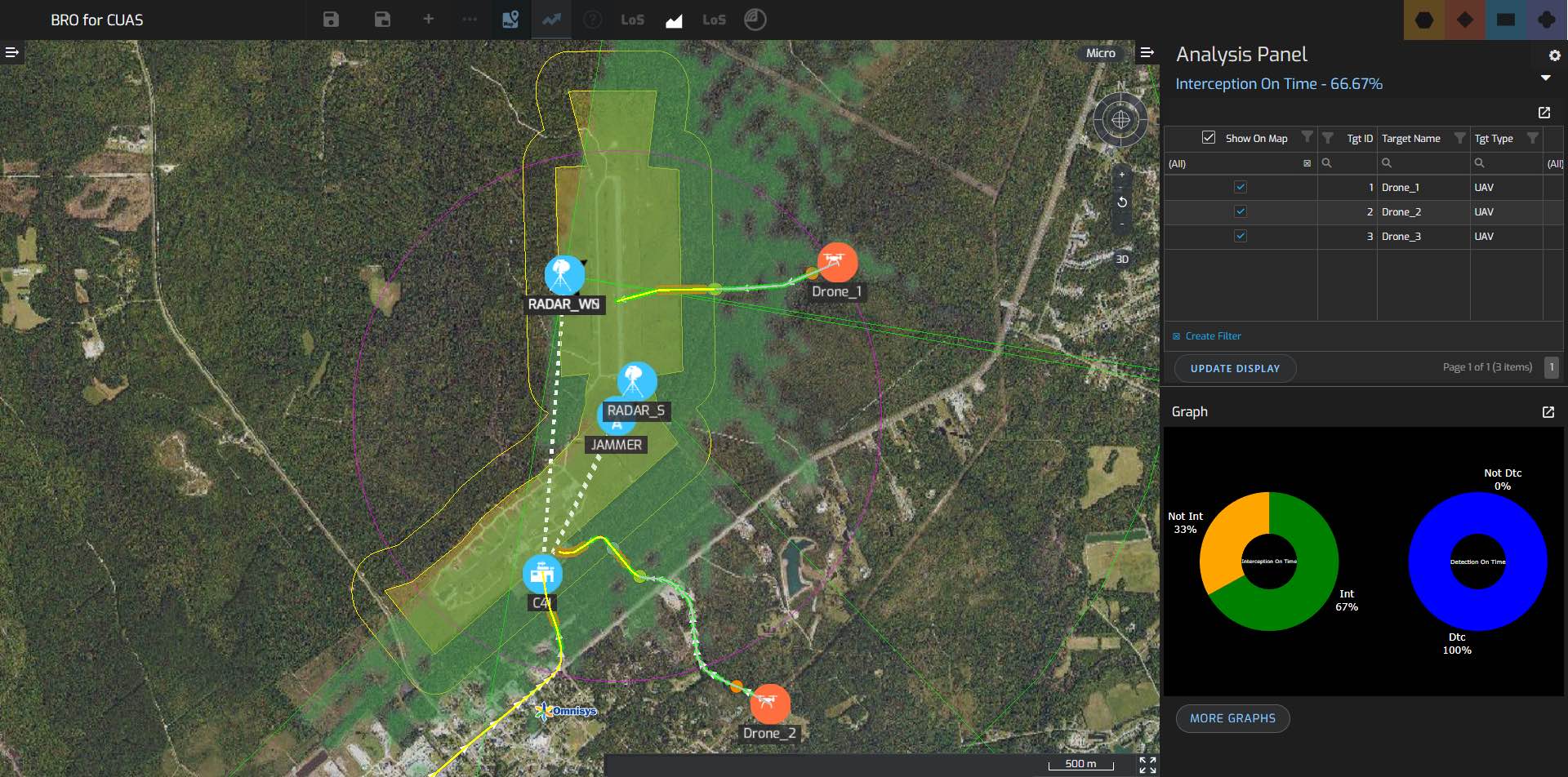
Real-time decision-making is an asset for airport security—and something that Omnisys is featuring with its just-released BRO™ C-UAS system. The BRO (Battle Resource Optimization) offers a field-proven system designed to enable data-driven proportionate responses that can ensure passenger safety while maintaining airport operations. “Its optimization-driven approach empowers authorities to maintain airport functionality and safety even under evolving aerial threats,” Alfred (Fredi) Tzimet, Deputy CEO of the Israel-based company, said in a release.
The dynamic system uses physics modeling, live environmental data and AI-driven recommendations to guide decision-makers in configuring systems for maximum detection while reducing unnecessary shutdowns. It offers smart deployment, identification of detection blind spots, asset prioritization and signaling for safe resumption of operations. Aligned to FAA and EASA guidance, it can be integrated with or operate independently of existing airport C2 systems.
“The BRO system gives security decision-makers the ability to make informed choices about which systems to acquire, where to deploy them and how to operate them—ensuring effective protection which minimizing disruption, which can sometimes result in millions in losses and long-term harm to an airport’s stability,” Tzimet said.