
New York City is scaling up drone-as-first-responder operations across multiple agencies, from the NYPD to Parks and Recreation. With faster FAA approvals and new mission concepts—from shark detection to subway safety—DFR is emerging as a core urban public safety tool.
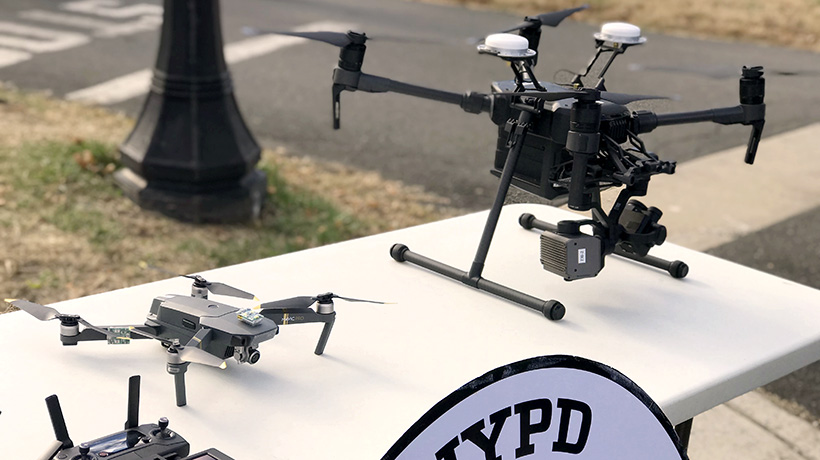
This July, Mayor Eric Adams announced the formation of a new joint Drone Operations Committee coordinating usage of unmanned systems between the New York City police department (NYPD), Fire Department (FDNY) and other agencies ranging from Parks and Recreation to the offices of Emergency Management and Environmental Protection.
Adams, a former policeman and technophile, has enthusiastically promoted adoption of UASs by public agencies and regulatory regimes enabling their more frequent use.
The new committee may help expand the NYPD’s Drone as First Responder (DFR) program, which kicked off in November 2024 with deployment of drone stations in three precincts in Brooklyn, one in the Bronx and another in Central Park, Manhattan—each with two ready-to-launch UAVs.
Though the NYPD’s Technical Assistance Response Unit has been deploying drones since 2018, the DFR program reflects a model spreading across the nation, with over 300 established in the first seven months of 2025 compared to just 50 between 2018 and 2024, per Washington Post reporting.
DFR is a concept for distributed deployment of small unmanned aerial systems (sUAS) to launch stations spanning critical urban areas to enable rapid response to emerging situations. The pre-positioned UAVs are controlled via the police headquarters, not field operators, though their video feeds remain accessible to police on the ground.
The current DFR surge was made possible by reforms reducing time needed to receive an FAA waiver for beyond visual line-of-sight (BVLOS) operations to a matter of days rather than a year plus process—reportedly by removing duplicated steps and improving guidance on waiver submissions. New FAA BVLOS regulations (Part 108 NPRM) released this August may further improve access to longer-range UAS operations.
A non-profit called Drone Responders has also been assisting the start-up of DFR programs by sharing best practices and CONOPs, furnishing mentors and helping with completion of necessary waivers. The market for DFR/public-safety UASs is now forecast to expand 11-12% annually through 2031.
The NYPD itself obtained an FAA Part 107 waiver for BVLOS operations in 2024 with substantial brokering from Skydio. This permitted UAS without detect-and-avoid capability to conduct “shielded” operations 200 feet above ground-level and 50 feet away from buildings to minimize collision risks—contingent on integration of general aviation ADS-B transponders.
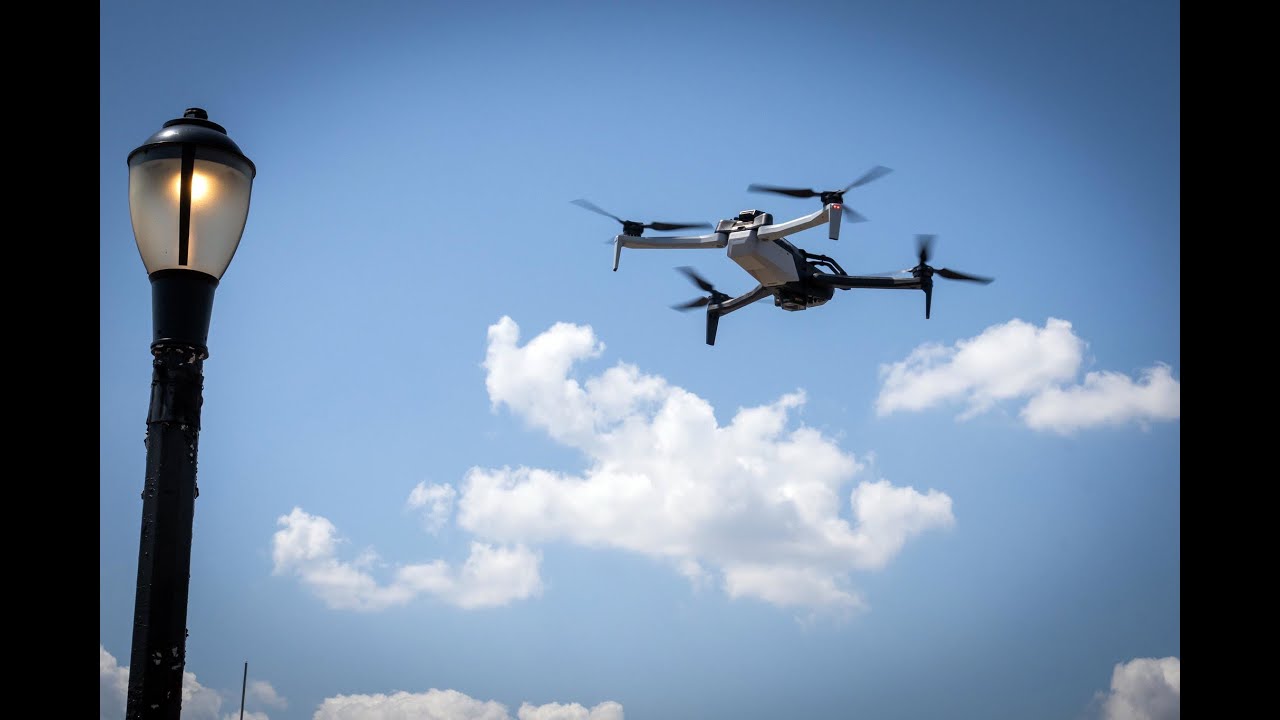
The agency’s DFR drones are intended to respond to specific contingencies:
- Investigating alerts from ShotSpotter, a distributed audio surveillance system that flags potential gunshot sounds
- Searching for missing persons
- Rapid response surveillance to robberies and other crimes-in-progress
UAS bring many benefits in such roles including fast response times to natural disasters or incidents involving hazardous materials that might impede access; greater situational awareness for crowd control and traffic management; easy evidence collection through recorded video; and low costs compared to police helicopters.
NYPD Police Chief John Chell posted a video showing footage from a DFR drone that arrived at the scene within 23 seconds of launch to surveil an attempted smash-and-grab of a 7-11 convenience store in the Bronx’s 46th Precinct. The UAV tracked the fleeing suspects across a highway and through trees, ultimately recording their arrest.
DFR-like concepts inform separate NYPD initiatives regarding subway and beach safety. The NYPD uses drones for other mission, including:
- tracking fleeing suspects
- storm rescue and searching collapsed structures,
- two-way communication with barricaded individuals,
- collision and crime scene documentation/evidence-collection, and mapping 3D floor plans
- building/bridge inspection (done following 2024’s 4.8-magnitude earthquake)
The city also implies it’s considering using UAVs to deploy emergency medical supplies to bystanders, including automated defibrillators, torniquets or naloxone to treat opioid overdoes.
Chula Vista: the Origins of DFR
DFR’s genesis traces back to a concept formulated in 2015 by the police department of Chula Vista, California. This program debuted in 2018 with three launch sites providing partial coverage for the city of 52 square miles. These UAVs could be launched in response to 911 or 311 calls—sometimes even mid-message—and remotely dispatched to the relevant area via the Police HQ. The CVPD’s detailed record-keeping made this pioneering effort a valuable guinea pig.
By July 2025, the CVPD had deployed DFR UAS more than 22,700 times—and in roughly 71% of incidents (16,190) they were the first to arrive on scene, averaging 116 seconds overall (or 95 seconds incidents for first responders.) Other agencies with DFR programs in California and Washington have reported similar first-response rates.
In one incident a burning car reported to have crashed along a stretch of highway was quickly located by the thermal sensor of a responding drone, allowing rescuers to swiftly arrive on the scene to extract the car’s occupant.
A BVLOS waiver obtained in 2020 effectively tripled UAV operational radius from 1 to 3 miles. That combined with the addition of two more launch sites allows coverage of all of Chula Vista. An additional waiver was obtained authorizing deployment of two drones simultaneously from each launch site.
The CVPD primarily employed DJI products: various models of Mavics and Avata FPVs, as well as Phantom 4 and Inspire 2. The department notes acquisition of larger DJI Matrice M210Vs, M300s and M350s provided a leap in sensor capabilities and range/endurance. Outside of Chinese drones, the department acquired Skydio 2s and X2s, Parrot Anafis, and Brinc Lemur-Ss, these last designed for “high-risk…tactical capabilities”.
But drones weren’t just good for rapid interventions—they helped determine when action was not necessary. Many contested police shootings result from snap decisions made in stressful situations while hindered by misperceptions. However, a UAV operator can more calmly surveil the situation from a safe remove—often with the UAV remaining undetected—over a longer period of time.
A recording of one oft-cited incident shows drone surveillance of an individual alarmingly brandishing a pistol in a restaurant parking lot—only for the observers to realize the ‘gun’ was a pistol-shaped lighter after the bearer lit a cigarette. That insight recalibrated the suspect’s subsequent arrest by police.
When short of patrols, the CVPD also deployed UAVs to lower-priority call sites to evaluate if further response was needed. And 20% of the time—or 4,500 incidents by July 2025—UAV reconnaissance determined there was no need, conserving resources.
Mindful of public wariness of drone surveillance, the CVPD instituted transparency and data security policies, including a system allowing the public to track every drone flight, routine deletion of video feed data within context-dependent intervals and a ban on warrantless surveillance of areas with “a reasonable expectation of privacy.” Some agencies pan drone cameras to the horizon to avoid collecting data irrelevant to the mission.
Sharks versus Drones
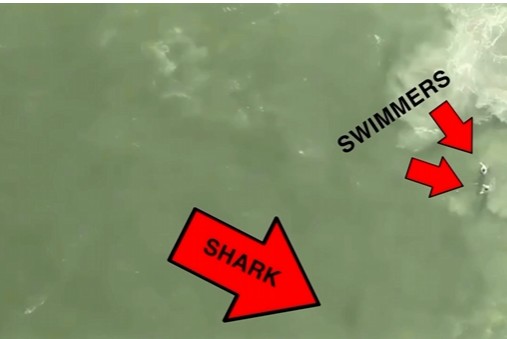
In 2024, a 15% increase in shark sightings near New York City beaches—and a couple shark attack incidents—coincided with a massive shortfall of lifeguards, with only 240 out of 600 on duty. This led to an interagency operation involving the NYPD, FDNY, Office of Emergency Management, and New York Park Police deploying drones to NYC’s eight beaches stretching 14 miles.
The UAS’s high-resolution cameras reportedly allow detection of submerged objects down to 25 feet deep–whether drowning swimmers, lurking sharks or dangerous currents. Drone teams at Rockaway Beach detected sharks 11 times in 2024.
The heftier UAS acquired in 2025 introduced the capability to zip over and drop six-inch-long inflatable tubes on water contact for distressed swimmers to cling to until rescuers arrive. During that interval the same drone could deliver reassuring instructions via loudspeaker.
Tests found drones reached distressed swimmers within 90 seconds on average. Operators reportedly try to drop the tubes almost directly above swimmers from an altitude of 15 feet to maximize odds of capture.
Drones to rescue Subway Surfers
The thrill-seeking practice of “subway surfing” atop NYC subway cars has increased dramatically in recent years—a youth phenomenon grimly testified to by steadily mounting fatalities, with 11 deaths counted in 2023 and 2024, more than twice the total of the preceding five years.
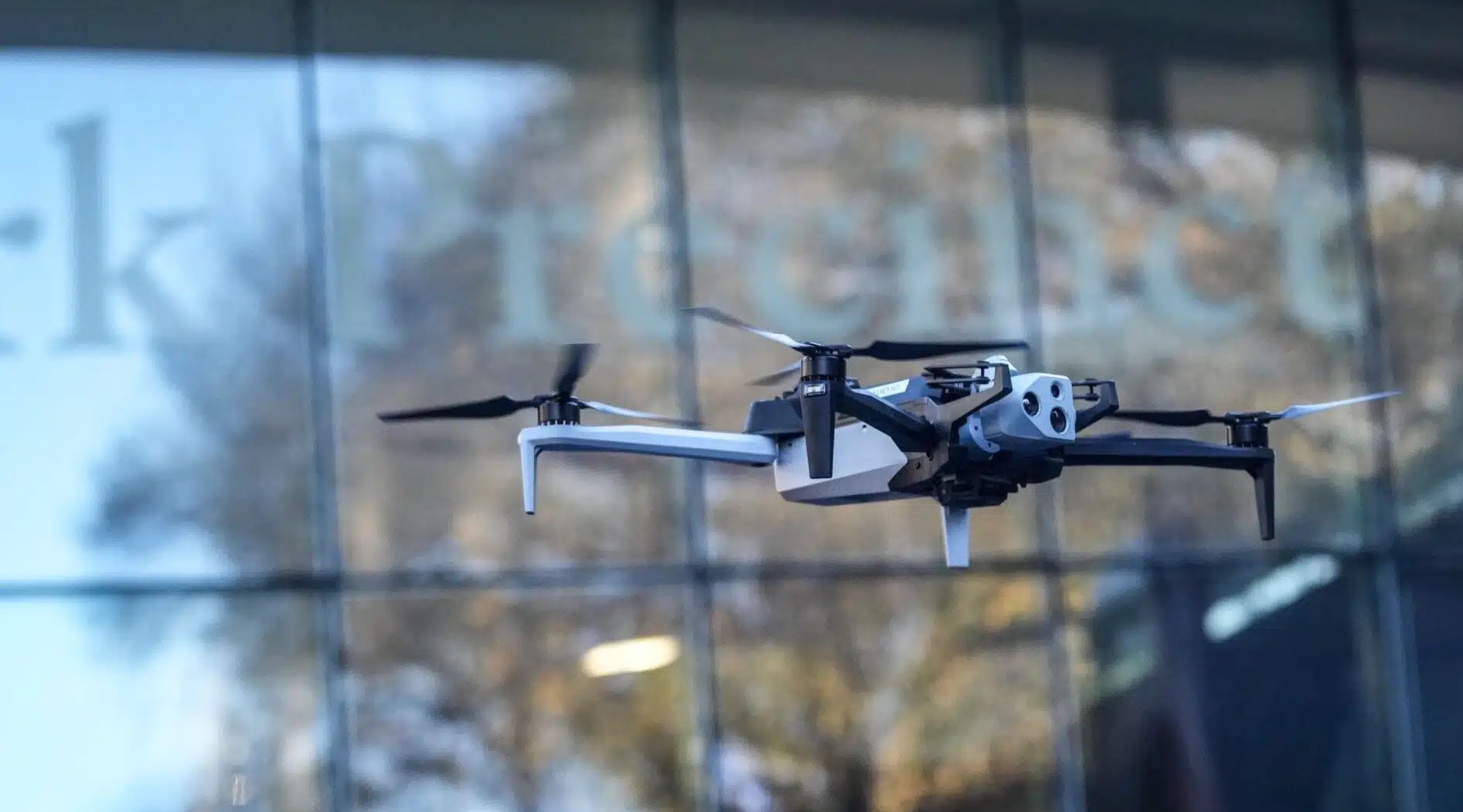
To combat this trend, starting in November 2023 the NYPD acquired Skydio X2 and X10 quadcopters to deploy in response to 911 calls for visual inspection of trains using 4K cameras. When surfers are spotted (often on the elevated 7 train in Queens), the subway is held at the following station so that a field response team can remove the offenders. By July, the NYPD had made 340 anti-subway surfer drone deployments, resulting in the rescue of 200 people.
Solidifying DFR
From its origins in Chula Vista to its rapid expansion in the five boroughs, the drone-as-first-responder model is shifting how cities think about aerial public safety. NYC’s new interagency committee, coupled with streamlined FAA waivers and proven DFR playbooks, positions unmanned systems as a normalized, indispensable part of emergency response. Whether tracking suspects, safeguarding beaches, or deterring dangerous subway stunts, the city’s UAV deployments hint at a future where rapid, automated aerial support is a standard fixture of the urban landscape.
An Iron Drone to protect New York?
Undoubtedly mindful of risks posed by malicious use of UAVs, this summer the NYPD entered talks with American Robotics on possible procurement of its Iron Drone counter-sUAS platform, which already has several Middle Eastern operators.
A single Iron Drone system is deployable both from vehicles or a fixed station. Each carry 2-3 Raider octocopter interceptors armed with net guns, supported by a ground-based radar that detects, classifies and tracks UAVs.
While an operator-in-the-loop can intervene, by default Iron Drone completes engagement autonomously once the operator chooses to engage a UAV. Launched Raiders are automatically cued to target using radar telemetry before switching to fused integral micro radar and optical/thermal sensors for homing, either escorting or downing the target with a ballistic net. For public safety, net payloads can optionally deploy a parachute to ensure downed UAVs float rather than crash below. The Raider meanwhile returns to station for recharge and reload.
New York’s de facto drone czar, Kaz Daughtry, spoke to media of a DFR-like dispersed deployment model across the city, controlled from Police HQ. However, Irone Drone deployment will require convincing federal authorities to authorize UAV shoot downs.