
Since late 2024, elite drone units from Russia’s Rubicon Center for Unmanned Technologies have proven among Russia’s most effective combat forces on the battlefield in Ukraine—and now we know how they’re organized.
The blog Two Marines by former Marine Rob Lee (a noted analyst of Russia’s military) and Ukrainian marine drone operator Dmytro Putiata published a rundown on the Rubicon Center organizations including a detailed Table of Organization & Equipment (TO&E) of its mainstay combat unit: battalion-sized ‘detachments’ which deploy 54 quadcopter and fixed-wing kamikaze drone strike teams each. Given that tactical-range drone teams often expend 10-15 munitions daily, this unit could hypothetically generate over 400 sorties daily at full strength.
These detachments aren’t simply administrative groupings of diffuse assets, but tactical/operational formations with self-sustainment capabilities ‘dropped’ onto key sectors of the battlefront to deliver high volume attacks locally—albeit out to considerable depth thanks to the inclusion of 16 mid-range strike teams.
Rubicon units reportedly played an important role in the roll-back of Ukrainian forces in Kursk (late 2024-2025), and Russian advances around Pokrovsk, Myrnohrad and Kostyantynivka in 2025. That said, they didn’t overturn the bogged-down dynamics of the ‘drone frontline’ in Ukraine, and by 2026 Ukraine has regained an edge in mid-range drone warfare.
This article recaps Two Marines’ key findings specifically pertaining to the Rubicon detachment organizational scheme, then considers their implications as a warfighting concept for NATO militaries.
Though deficiencies in Russia’s military organization and force employment are many and notorious, by 2026 Moscow’s forces have accrued vastly more combat experience conducting large scale tactical-level drone warfare than NATO ground forces. So it’s worth studying one of Russia’s more successful drone formations—both as a potential opposition force, but also to discern whether it has aspects worth emulating.
Rubicon Detachments in focus
Russia systematically deploys Rubicon detachments to priority areas of the frontline where they focus on targets over 6 miles beyond the Forward Line of Enemy Troops (FLET), particularly enemy UAS operators, logistics, and high-value assets including artillery, air defense, EW systems, HQs, and ammo and fuel depots.
According to Lee and Putiata, the Rubicon Center grew from fielding eight standard-pattern detachments in April 2025 authorized 149 personnel each, to twelve in 2026 authorized 474 personnel (including 52 officers, 46 warrant officers and 78 NCOs). However, because Rubicon broadly musters only 5,000 out of 9,000 authorized personnel, many Rubicon detachments likely remain significantly under-strength.
Each Rubicon detachment brings a ‘grab bag’ of strike, reconnaissance and electronic warfare capabilities siloed in distinct companies and platoons, rather than duplicated subunits.
The Quadcopter Kamikaze FPV unit counts 106 personnel and can muster 30 FPV teams (3 or 4 men each) divided between four platoons. Common quadcopter FPV designs used include the VT40 (not much loved by Russian drone operators) and the fiber-optic Prince Vandal of Novgorod (or KNV).
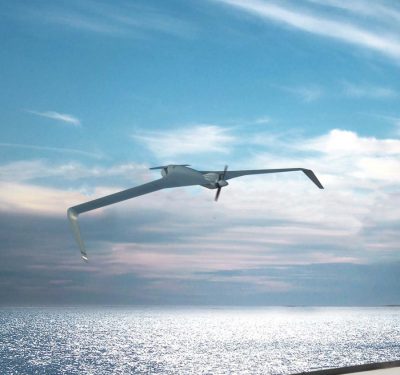
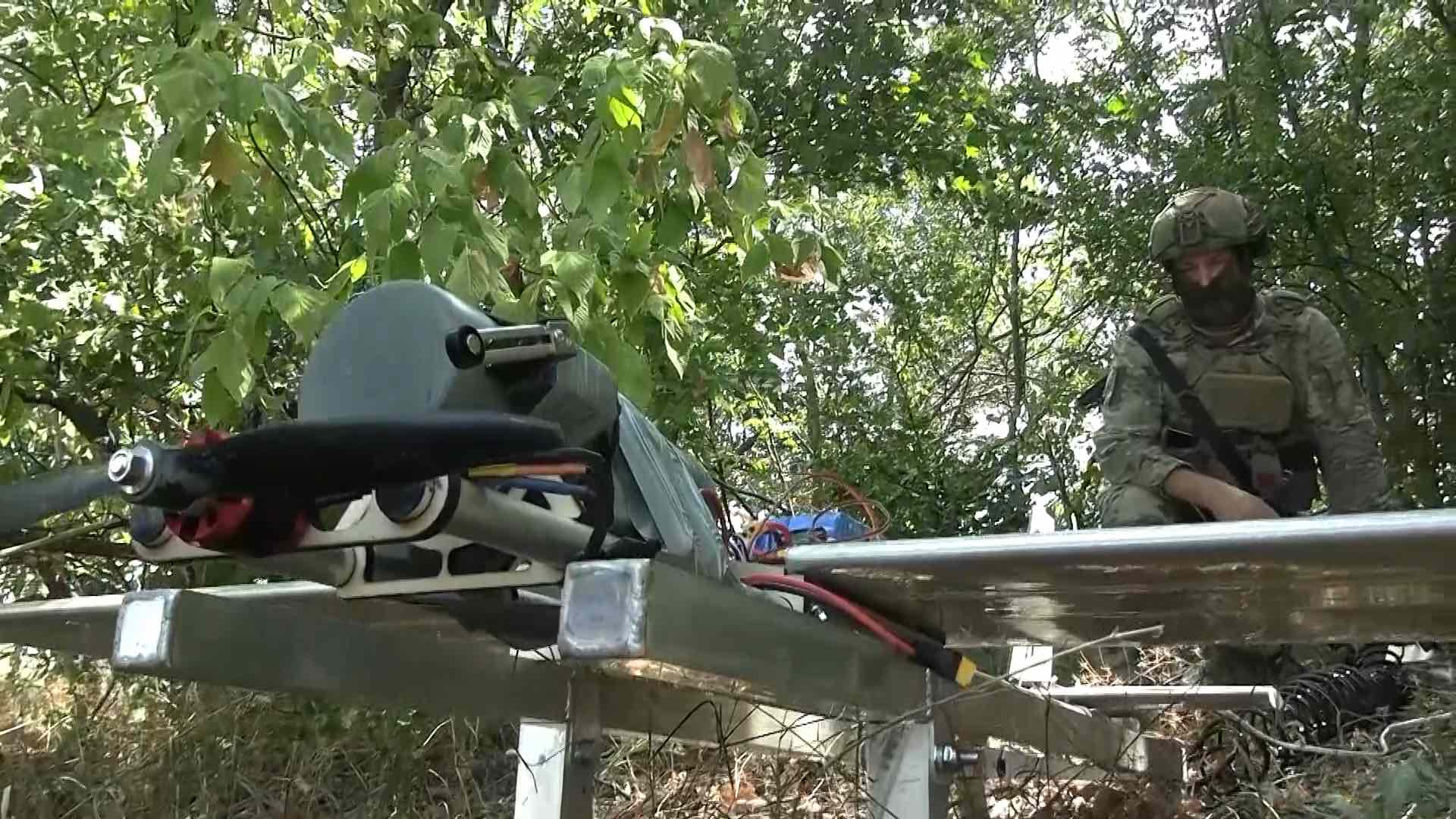
A smaller Fixed-Wing Kamikaze FPV unit counts 72 personnel and musters a total of 16 FPV teams, assigned to two platoons. The typical fixed-wing FPV is the catapult-launched Molniya (“Lightning”) kamikaze drone made largely from plywood and foam, which boasts impressive 25-37 miles range while costing only $300-500 per UAV.
To engage even deeper targets there’s finally a company-sized hybrid Reconnaissance-Strike Unit with 69 personnel, fielding eight teams with eight personnel each combining ISTAR drones with medium-range strike drones (usually Lancets). For the ISTAR component, half of the teams operate Supercam-350NJs, the other half use Zala-421-series UAVs.
Since 2022, Lancets teamed up with Zalas have proven notoriously effective operating in tandem to form fast-moving kill chain able to pounce on valuable targets of opportunity (Patriot and HIMARS missile launchers, a landed jet fighter etc.), with the Zalas additionally recording the outcome of attacks.
Detachments additionally field two non-kinetic units. Firstly, a platoon-sized UAV reconnaissance unit (35 personnel) mustering eight UAV teams: six three-person ‘generic’ ISR drone teams, and two six-person Orlan-10 teams deploying these fixed-wing drones for longer-endurance/range missions.
Secondly, a platoon-sized Counter-UAS unit with 29 personnel fielding two Radar teams, two Electronic Warfare teams, and two Signals Intelligence teams. One presumes the latter aids in geolocating enemy UAS operators.
The detachment TO&E also includes a headquarters platoon (39 personnel), and a substantial logistical ‘tail’ of 124 personnel for self-sustainment in the field. These include a:
- Signal platoon with 15 men in three squads
- Maintenance company with 46 personnel, including separate 17-person platoons dedicated to quadcopter- and fixed-wing drone maintenance: a 3D-printing lab, and an electronic warfare maintenance team
- Medical section (12 personnel)
- Ordnance platoon with 26 personnel
- Support Platoon with 25 personnel with transportation, support and vehicle recovery squads
One takeaway is that though small drones are broadly cheap and expendable, they still require many people to operate them effectively and sustainably at volume.
Furthermore, when considering the formidable offensive output 54 kamikaze drone teams can generate—when FPV teams in Ukraine often report expending 10-15 drones daily—one must also consider high failure rates of FPV attacks due friendly and enemy electronic warfare, misses and faulty fuses. One volunteer in Ukraine reported these decreased individual FPV quadcopter mission success rates to roughly 30%.
That might still crudely imply the battalion may average over 100 successful strikes daily at full strength—though ability of ISR assets to furnish sufficient targets is another limiting factor.
Mobility for the drone warrior
Rubicon detachments field over two dozen motorcycles, 46 All-Terrain Vehicles including golf-cart style Desertcrosses, and dozens of vans and pickup trucks in the vein of the Great Wall King Kong and Toyota Land Cruiser 70. This motor better resembles motorized rebels in North Africa than Western maneuver units with Humvees and MRAPs.
Reliance on unarmored civilian vehicles reflects doctrine evolved in response to the ‘drone frontlines’ where even heavily armored vehicles, once spotted by enemy drones, are rapidly overwhelmed by massed strikes. Low-cost civilian vehicles are used in hopes speed, stealth and dispersion may avoid detection or outrun the FPV kill-chain’s reaction speed.
However, the author posits such adaptations are driven by shortfalls in Russian production of MRAPS, infantry mobility vehicles and C-UAS systems rather than ideal solutions to be emulated: protected vehicles save passenger lives even when the vehicles themselves are disabled.
Russia’s ‘Distance Mining’ drone units
Two Marines lists additional specialized combat units in the Rubicon order of battle, including air defense (PVO) and heavy drone battalions, UGV companies and a USV detachment. Most aren’t novel for NATO militaries, save a specialized Distance/Remote Mining (or DM) battalion, and two DM companies. These specialized in deploying mines using aerial drones—typically on behind-frontline supply roads—a concept little studied by Western armies.
That Russia fields three units dedicated strictly to this mission reflects the importance accorded to drone mining in Russian doctrine—a capability Western armies must prepare to face and consider whether to replicate.
Big picture: dispersing drones versus concentrating drones?
The order of battle shared by Two Marines is a snapshot of Russia’s efforts to evolve more combat effective drone warfare forces, not a finalized, perfected model. It has involved tradeoffs, with frontline units stripped of their best drone operators to staff Rubicon units. Furthermore, Lee and Putiata note that Rubicon Center’s role as Russia’s premier drone warfare force may eventually be displaced by other formations.
Nonetheless, Rubicon detachments are an interesting case study in large drone combat unit with significant self-sustainment capabilities designed to deliver massed kinetic effects at depth. One that’s allegedly proven more effective than drone assets dispersed in regular frontline formations thanks to the concentration of expertise, technology and mission specialization.
That should spur debate on the merits of forming dedicated drone battalions independently of those integrated into regular tactical combat formations. A theoretical ‘Launched Effects Battalion’ (LEB) should be evaluated compared to existing standoff-strike capabilities in divisional-level attack helicopter and howitzer artillery battalions, or Corps-level rocket artillery—each offering strengths and limitations and varying ability to deliver effects out to 150 kilometers depth.
Attack helicopters can scout and hit harder and faster than kamikaze drones but are vulnerable to modern air defenses. Artillery is superior for saturating large areas but depends on expensive munitions for precision attacks. By comparison, an LEB’s forte is sustainable, high-volume precision strikes using affordable munitions, while simultaneously delivering copious ISR functionality.
Bear in mind FPV quadcopters are often cost equivalent (and sometimes much cheaper) than 155mm shells, while Hellfire missiles and guided rockets or shells are orders of magnitude more expensive. Furthermore, maturing autonomy and swarming capabilities is progressively reducing manpower requirements for affordable loitering munitions and increasing range and effectiveness without gravely compromising per-unit costs.
Deploying LEBs undeniably poses complex doctrinal and force design considerations. If divisional assets, should LEBs be designed to subdivide (contrary to Rubicon detachments) into three equivalent company-sized units for farming out to Brigade Combat Teams? Would LEBs in mechanized formations require different capabilities than light-infantry LEBs? Should U.S. LEBs include massed tactical-range capabilities like Rubicon detachments, or focus exclusively on mid-range+ effects?
Yes, there’s little doubt diverse small UAS classes evolved in Ukraine are so cost-effective, lightweight and versatile that they must be integrated at every level of tactical combat formations. But forming larger, dedicated LEB units needn’t be in profound tension with that objective.
Consider that tanks have proven their utility both when concentrated for maneuver and dispersed to support infantry; larger modern armies support both use concepts. And unlike tanks, drones are defined by low potential costs. Thus, force design experimentation concentrating drones in new formations should be seen as complementing right-minded policies dispersing UASs into existing units.